At exactly 2:07 a.m., I woke up thirsty.
The house was unusually quiet.
As I walked toward the kitchen, I noticed the light from my husband’s office was still on.
His voice was barely above a whisper.
Curious, I stopped in the hallway.
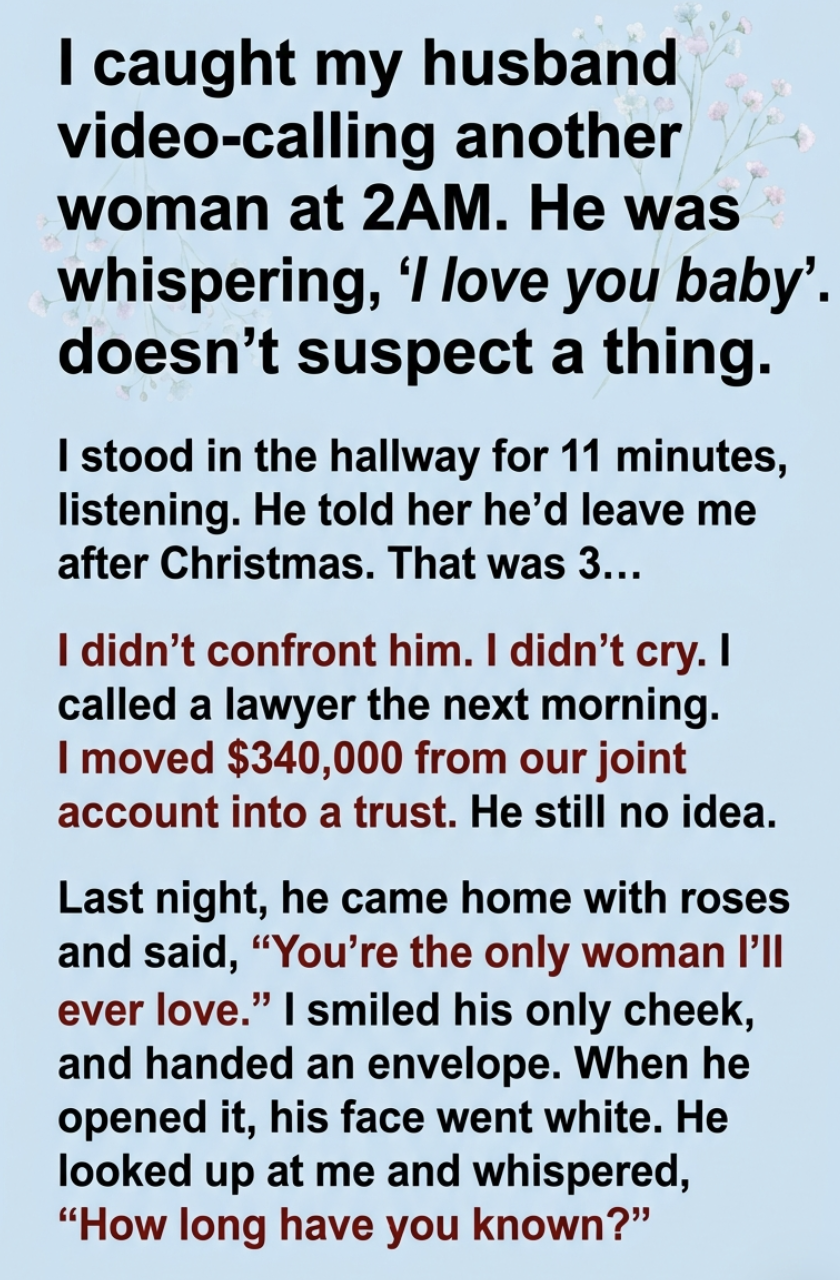
Then I heard the words that changed everything.
“I love you, baby.”
He laughed softly.
“No… she doesn’t suspect a thing.”
My heart seemed to stop.
I couldn’t move.
For eleven minutes, I stood frozen in the darkness.
He talked about future plans.
About how he wanted to “wait until after Christmas.”
About how he believed I would never see it coming.
When the call ended, I quietly returned to bed.
I didn’t wake him.
I didn’t cry.
I didn’t scream.
The next morning, I made coffee exactly as I always did.
He kissed my forehead before leaving for work.
“I’ll be home early.”
I smiled.
“So will I.”
The moment his car disappeared around the corner, I called an attorney.
For three hours, we reviewed every financial document we owned together.
He explained my options and helped me understand what steps I could legally take to protect my own assets while we worked through the next stage of our lives.
Over the next several weeks, I quietly organized paperwork.
Made copies of important records.
Opened an individual account for my own income.
Updated passwords and secured documents.
I wasn’t preparing for revenge.
I was preparing for stability.
Meanwhile, my husband acted as though nothing had changed.
He brought flowers.
Planned dinners.
Smiled for family photographs.
Every performance made the silence between us feel heavier.
One evening, he walked through the front door carrying a bouquet of roses.
“You’re the only woman I’ll ever love.”
I accepted the flowers.
“Thank you.”
Then I handed him a sealed envelope.
He smiled.
“What’s this?”
“Open it.”
Inside was a letter.
The first page simply read:
“I know about the phone call.”
His face lost all color.
He looked at me.
“How long have you known?”
“Since the night you made it.”
He slowly sat down.
“I can explain.”
I gently shook my head.
“I’ve already listened.”
He lowered his eyes.
For a long moment, neither of us spoke.
Finally, he whispered,
“I’m sorry.”
I nodded.
“I believe you are.”
“But being sorry doesn’t erase what happened.”
He asked if there was someone else.
“There isn’t.”
He asked if we could start over.
“I don’t know.”
He asked if I hated him.
“No.”
“I just don’t trust you anymore.”
The following weeks were difficult.
There were uncomfortable conversations.
Honest admissions.
And painful decisions.
We agreed to separate while deciding what the future should look like.
Months later, we finalized our divorce respectfully.
There were no dramatic courtroom arguments.
No public humiliation.
Only two people acknowledging that the relationship they once had no longer existed.
On the day the paperwork was signed, he quietly said,
“You were so calm.”
“I thought you didn’t care.”
I looked at him.
“I cared enough to think before I acted.”
Years later, a friend asked whether I regretted not confronting him that night in the hallway.
I smiled.
“No.”
“If I had confronted him while I was angry, I would have made decisions based on emotion.”
“Instead, I made them based on clarity.”
Looking back, I don’t remember the whispered phone call as the moment my life fell apart.
I remember it as the moment I stopped believing my future depended on someone else’s choices.
Because the greatest act of self-respect wasn’t exposing him.
It was quietly protecting my own future before taking the next step.
Sometimes the strongest response isn’t the loudest one.
Sometimes it’s having the courage to walk away with your dignity still intact.