When my husband, Mark, asked for a divorce after twenty-three years of marriage, it felt like the floor disappeared beneath me.
There had been no screaming matches.
No dramatic betrayal.
No obvious distance.
Just one quiet Tuesday evening.
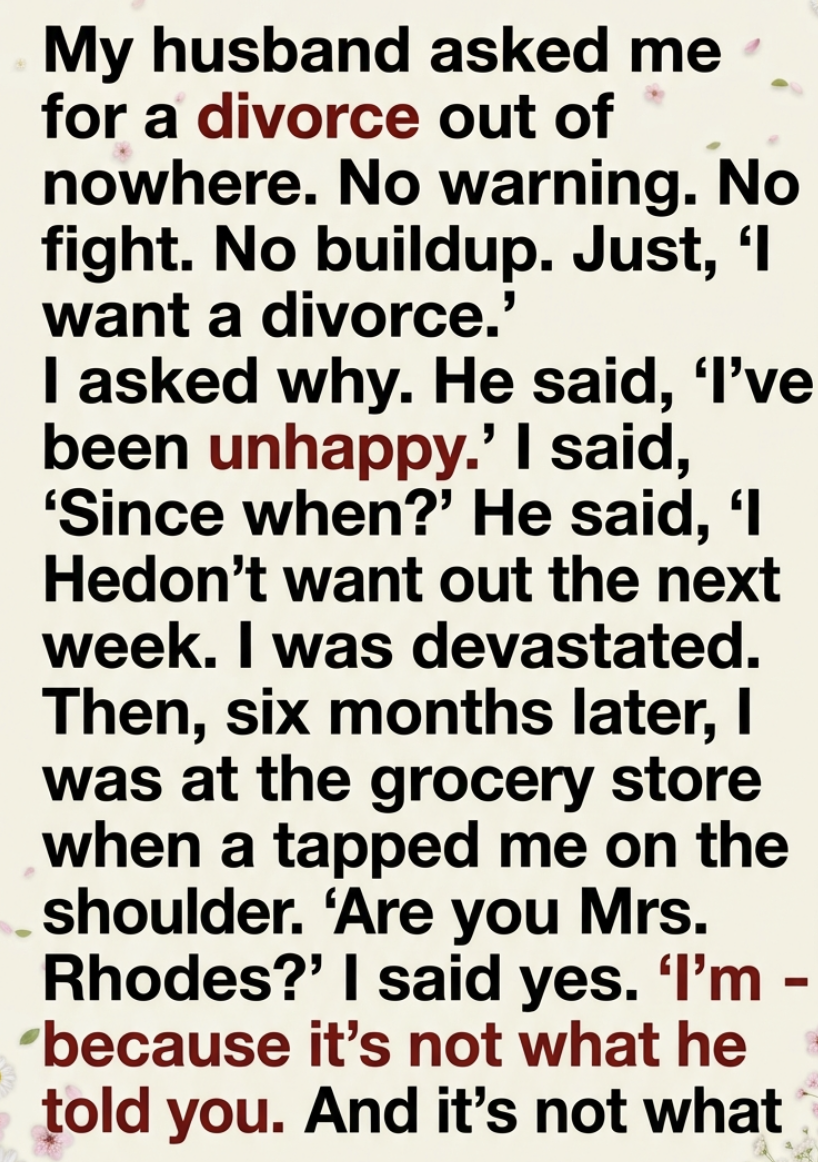
“I want a divorce.”
I stared at him, waiting for the rest.
“There has to be a reason.”
“I’ve been unhappy.”
“Since when?”
He rubbed his forehead.
“I don’t want to talk about it.”
Within a week, he’d packed his clothes, rented an apartment, and was gone.
The divorce was finalized four months later.
He kept the lake cabin.
I kept the house.
Friends tried to comfort me.
Some whispered he’d met someone else.
Others insisted he’d probably have a midlife crisis and come crawling back.
I tried not to care.
I started therapy.
I took gardening classes.
For the first time in decades, I began learning who I was without being someone’s wife.
Then, six months later, everything changed.
I was comparing cereal prices at the grocery store when a woman gently tapped my shoulder.
“Excuse me…”
I turned around.
She looked nervous.
“Are you Mrs. Rhodes?”
“I was.”
She swallowed.
“My name is Claire.”
I recognized her instantly.
I’d seen photos online after the divorce.
She was the woman Mark was living with.
Every muscle in my body tensed.
“If you’re here to apologize, don’t.”
She shook her head.
“I’m here because I finally learned the truth.”
“What truth?”
“I’m the reason your husband left…”
She paused, tears filling her eyes.
“…but not for the reason he told you.”
“And not for the reason he told me.”
I crossed my arms.
“You have five minutes.”
We sat in the coffee shop next door.
Claire looked exhausted.
“When Mark and I met, he told me he’d been separated for over a year.”
I frowned.
“He said your marriage had been over for years.”
“He told me you both stayed together only because of finances.”
I laughed bitterly.
“None of that’s true.”
“I know.”
She looked down.
“I found out three weeks ago.”
“What happened?”
She slid a folder across the table.
“I was cleaning the office.”
Inside were medical records.
Therapy receipts.
Letters.
One document immediately caught my attention.
Neurology Department.
Diagnosis:
Early-onset frontotemporal dementia.
My heart stopped.
“What is this?”
Claire wiped away tears.
“He was diagnosed almost a year before he divorced you.”
I couldn’t speak.
“The doctor recommended counseling… legal planning… and telling immediate family.”
“But he refused.”
“He said he couldn’t bear watching you become his caregiver.”
I stared at the papers.
“He told me…”
Claire’s voice cracked.
“…that he left because he’d fallen out of love.”
“But after I moved in…”
“He kept calling your name in his sleep.”
“He still remembered your birthday.”
“He remembered your anniversary.”
“He forgot where he parked the car…”
“…forgot conversations we’d had an hour earlier…”
“…but never forgot you.”
Tears blurred my vision.
“He lied to both of us.”
Claire nodded.
“He wanted you to hate him.”
“He thought it would make leaving easier.”
“He believed you’d move on if you thought he’d simply stopped loving you.”
I whispered,
“That’s exactly what I did.”
She reached into her purse.
“He wrote something.”
“He never mailed it.”
She handed me an unopened envelope.
On the front, in Mark’s familiar handwriting, were four words.
For Emily. If I’m Gone.
My hands trembled as I unfolded the letter.
“If you’re reading this, then Claire finally ignored my instructions.”
“By the time you know the truth, I’ll probably remember less than I should.”
“I asked for the divorce because I couldn’t ask you to spend the rest of your life watching me disappear one memory at a time.”
“You deserved more than becoming my full-time nurse before we ever got to enjoy retirement.”
“So I chose the only thing I thought would set you free…”
“I made you hate me.”
“If you’re angry after learning this, you have every right to be.”
“But please don’t be angry with Claire.”
“She believed the lies because I needed someone to help me when I could no longer help myself.”
“She didn’t steal me.”
“I walked away before the disease could steal both of our lives.”
I couldn’t finish reading.
For eight months, I’d convinced myself I hadn’t been enough.
That our marriage had meant less to him than I believed.
Instead, he’d carried a diagnosis alone and made the worst decision of his life because he thought it was an act of love.
A week later, Claire called again.
“He’s getting worse.”
“He keeps asking for someone named Emily.”
I went.
When I walked into the care facility, he looked at me with confused eyes.
For a long moment, he said nothing.
Then he smiled.
“There you are.”
“As if I’d only been gone a few minutes.”
He reached for my hand.
“I’ve been looking everywhere for my wife.”
I sat beside him, tears streaming down my face.
“I’m right here.”
He squeezed my hand.
“I knew you’d find me.”
For the next two years, Claire and I took turns caring for him.
Not because either of us owed the other anything.
But because we finally understood we had both been victims of the same heartbreaking lie.
Mark passed away peacefully one spring morning.
At his memorial service, Claire sat beside me.
People assumed we were old friends.
In a way, we had become exactly that.
His greatest mistake wasn’t falling out of love.
It was believing that love meant carrying unbearable burdens alone.
Sometimes, the people we love don’t leave because they stop loving us.
Sometimes, they leave because they mistakenly believe sacrificing their own happiness—and ours—is the kindest thing they can do.