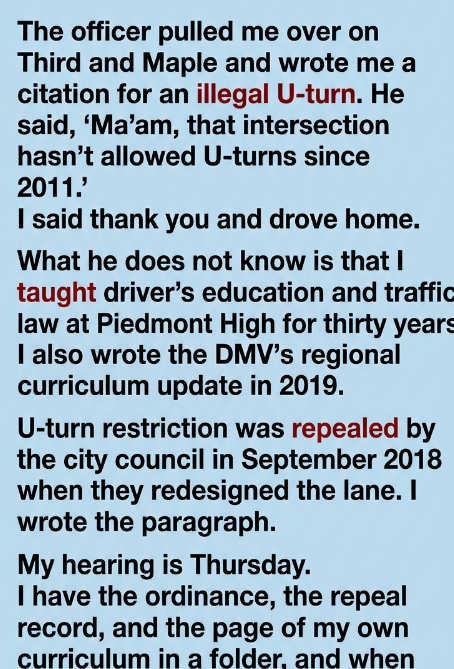
The officer pulled me over on Third and Maple just after lunch.
He approached my window politely.
“Good afternoon, ma’am.”
“Do you know why I stopped you?”
“I believe it’s because I made a U-turn.”
“That’s correct.”
He began writing the citation.
As he handed it to me, he smiled politely.
“That intersection hasn’t allowed U-turns since 2011.”
I thanked him.
Accepted the ticket.
Drove home.
I never argued.
There wasn’t any point arguing on the side of the road.
What he couldn’t possibly have known was that I had spent thirty years teaching driver’s education and traffic law at Piedmont High School.
Even after retiring, I worked with the regional DMV office updating educational materials.
In 2019, I helped rewrite the curriculum used in several counties.
One section covered…
Third and Maple.
The city council had removed the U-turn restriction after redesigning the intersection in September 2018.
Additional turn lanes had been added.
Traffic signals were changed.
The old prohibition had been repealed.
I remembered the project clearly because I’d written the explanation myself.
After making a cup of tea, I opened my filing cabinet.
Old habits die hard.
Inside were copies of city ordinances, transportation bulletins, and curriculum drafts.
Within twenty minutes, I found everything.
The original ordinance.
The council meeting minutes rescinding it.
The engineering report.
The updated DMV training page.
I highlighted the relevant paragraphs.
Then I placed everything into a neat blue folder.
Thursday arrived.
Traffic court was crowded.
People shuffled in and out, many hoping simply to pay reduced fines.
When my case was called, I walked to the podium.
The judge looked over the citation.
“How do you plead?”
“Not responsible, Your Honor.”
The officer stepped forward confidently.
“I observed the defendant make an illegal U-turn at Third and Maple.”
The judge nodded.
“Ma’am?”
I handed the bailiff my folder.
“Your Honor, may I direct the Court’s attention to Exhibit A.”
The judge adjusted his glasses.
He carefully read the city ordinance.
Then the repeal.
Then the engineering report.
Finally, he paused at the DMV curriculum page.
His eyebrows rose.
He looked at me.
“Did you author this training material?”
“Yes, Your Honor.”
“I was part of the committee that updated the regional curriculum after the intersection was redesigned.”
The courtroom became very quiet.
The judge turned toward the officer.
“Officer, are you aware that the restriction you’re citing was repealed several years before this citation was issued?”
The officer looked genuinely surprised.
“No, Your Honor.”
The judge nodded.
“I appreciate your honesty.”
He reviewed the documents one final time.
Then smiled.
“The citation is dismissed.”
He paused before continuing.
“I’d also like the court clerk to forward these materials to the police department’s training division.”
“If this misunderstanding occurred once, it may occur again.”
The officer looked embarrassed.
After court ended, he caught up with me in the hallway.
“Ma’am…”
“I owe you an apology.”
“You were right.”
I smiled.
“No apology necessary.”
“You were doing your job.”
“I should have verified the ordinance before writing the ticket.”
I nodded.
“Every profession requires continuing education.”
He laughed softly.
“I suppose that’s true.”
A month later, I received an unexpected letter from the police department.
The chief thanked me for bringing the outdated information to their attention.
The department had reviewed its training materials and corrected the reference for every patrol officer.
Enclosed was a note handwritten by the same officer.
“Thank you for treating my mistake as an opportunity to teach instead of a chance to embarrass me.”
“I’ll remember that far longer than the ticket.”
I framed the note—not because I was proud of winning a traffic case, but because it reminded me of something I’d spent my entire career telling students.
Being knowledgeable isn’t about proving someone else wrong.
It’s about helping everyone arrive at the right answer.
Sometimes the most important lesson in a courtroom isn’t who wins.
It’s what everyone learns before they leave.