The last thing my husband said before walking out the door was something I would never forget.
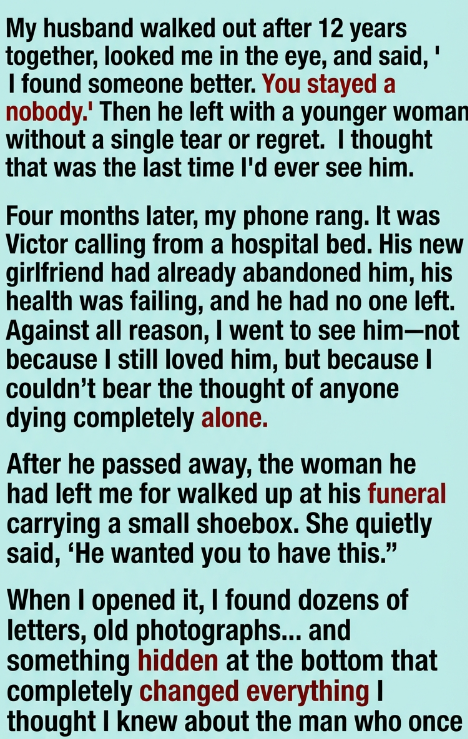
“I found someone better.”
“You stayed a nobody.”
Twelve years.
Gone in one sentence.
Victor didn’t cry.
He didn’t hesitate.
He loaded two suitcases into his car, kissed the twenty-six-year-old woman waiting in the passenger seat, and drove away.
I stood on the porch until the taillights disappeared.
For months, I replayed those words in my head.
A nobody.
They followed me everywhere.
At work.
At the grocery store.
Even in my dreams.
Little by little, I rebuilt my life.
I found a smaller apartment.
Started taking evening classes.
Made friends I’d neglected during my marriage.
I finally believed I would never hear from Victor again.
Then, four months later, my phone rang.
His voice was weak.
“I know I don’t deserve to ask.”
“But… could you come?”
He was in the hospital.
A severe autoimmune disease had attacked his kidneys and lungs.
The doctors weren’t optimistic.
I almost said no.
Almost.
Instead, I drove there.
The younger woman was gone.
She had left weeks earlier.
Victor had no parents.
No brothers or sisters.
No close friends.
Just me.
The woman he’d once called a nobody.
During the weeks that followed, I visited every afternoon.
Not because we were getting back together.
Not because I had forgotten what he’d done.
But because no human being should face death entirely alone.
One evening he whispered,
“I’ve practiced apologizing a thousand times.”
“None of it sounds big enough.”
“It isn’t.”
He nodded.
“I know.”
“I traded loyalty for excitement.”
“I confused attention with love.”
“I was wrong.”
I listened.
But I didn’t rescue him from the consequences of his choices.
Forgiveness isn’t pretending something never happened.
It’s refusing to let bitterness become your future.
On a quiet Tuesday morning, just before sunrise, Victor slipped away.
I held his hand until the nurse gently covered him with a blanket.
At the funeral, I stood near the back.
I didn’t expect anyone to notice me.
Then I saw her.
The younger woman.
Her name was Chloe.
She looked exhausted.
She carried a small, worn shoebox.
Without speaking, she placed it in my hands.
“He wanted you to have this.”
Then she walked away.
I waited until I got home to open it.
Inside were dozens of letters.
Some unopened.
Some folded so many times the paper had become soft.
There were photographs too.
Our honeymoon.
Camping trips.
Christmas mornings.
Pictures I thought had been lost during the divorce.
I smiled through tears.
Then I noticed a false cardboard bottom.
Curious, I lifted it.
Underneath lay a small leather journal.
And a sealed envelope with my name.
I opened the envelope first.
“If you’re reading this…”
“Then I never found the courage to hand this to you myself.”
“You deserve the truth.”
My hands trembled as I turned the page.
Victor confessed that he had lied the day he left.
He hadn’t walked away because I was “a nobody.”
He walked away because his company was collapsing under enormous debt.
He had secretly guaranteed business loans using our assets.
When the business failed, lawsuits followed.
He believed bankruptcy would destroy us both.
Then Chloe entered his life.
She worked for an investment group and convinced him she could help rebuild everything.
Instead, she encouraged him to leave before the financial disaster became public.
Victor admitted that calling me “a nobody” was deliberate.
“I wanted you to hate me.”
“I believed hatred would make it easier for you to let me go before everything fell apart.”
“It was the cruelest thing I’ve ever done.”
I closed my eyes.
Nothing in that letter erased the betrayal.
But it explained something I had never understood.
Why the man who had once celebrated every small success of mine suddenly acted as though I meant nothing.
Then I opened the journal.
Every page documented one thing.
How he planned to repay every dollar I had lost because of him.
There were records of overtime jobs.
Consulting work.
Personal sacrifices.
He had quietly rebuilt enough savings to replace nearly everything he had taken during the divorce.
At the very back was a cashier’s check.
Payable to me.
For $186,000.
Attached was one final note.
“Money can’t repair trust.”
“It can’t return twelve years.”
“It can’t erase the sentence I spoke.”
“But it belongs to you.”
“You were never a nobody.”
“The nobody was the man who forgot your worth.”
Weeks later, I met Chloe for coffee.
“I need to ask you something,” I said.
“If he wrote all of this…”
“Why did you stay?”
She looked down.
“I didn’t know.”
“He never let me read the letters.”
“When he became sick…”
“He asked me to promise I’d deliver the box after he was gone.”
She wiped away a tear.
“I thought he hated you.”
“So did I.”
Years have passed since then.
I invested the money into a scholarship fund for women rebuilding their lives after divorce.
Every recipient receives a handwritten note.
It contains only one sentence.
“Never let someone else’s opinion become your identity.”
Victor’s last gift wasn’t the check.
It wasn’t the photographs.
It wasn’t even the letters.
It was the reminder that the cruelest words spoken in anger—or fear—are not always the truth.
He spent his final months trying to undo one sentence.
He never fully could.
But he gave me something even more valuable.
The certainty that my worth had never depended on the man who failed to see it.
Sometimes the greatest act of redemption isn’t asking for forgiveness.
It’s doing everything you can to leave the world a little more honest than the way you found it.