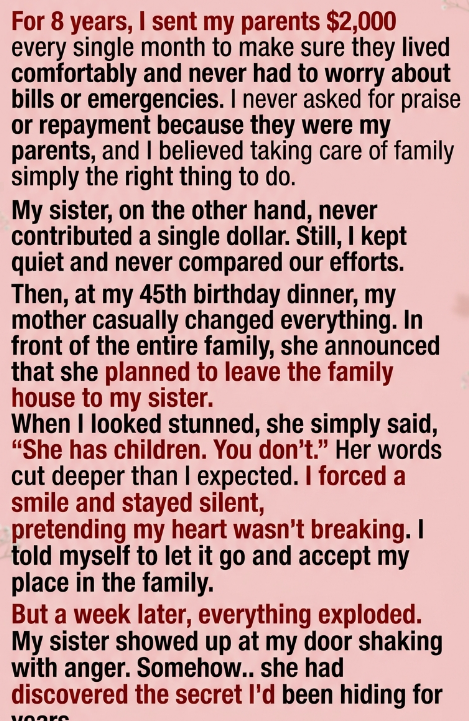
For eight years, on the first day of every month, I sent my parents $2,000.
I never missed a payment.
Not when work was slow.
Not when my own expenses piled up.
Not even when I had to postpone buying my own home.
My parents never asked.
I simply wanted them to live without worrying about money.
My younger sister, Claire, never contributed financially.
She had three children and always said money was tight.
I understood.
I never kept score.
Then came my forty-fifth birthday.
The whole family gathered around my parents’ dining table.
Cake.
Laughter.
Old stories.
Just before dessert, my mother raised her glass.
“I’ve made a decision.”
Everyone looked at her.
“When your father and I are gone…”
“…the house will go to Claire.”
I stared at her.
“I’m sorry… what?”
Mom smiled as though it were obvious.
“She has children.”
“You don’t.”
“She needs it more.”
The room fell silent.
Eight years of quiet sacrifices flashed through my mind.
The monthly transfers.
The emergency repairs.
The medical bills I’d paid without hesitation.
I swallowed hard.
“I understand.”
It was a lie.
I smiled anyway.
That night, I cried in my car before driving home.
A week later, someone pounded on my front door.
Claire stood outside.
Her face was pale.
“What have you done?”
“I don’t know what you mean.”
She held up a thick envelope.
“You hid this from everyone.”
Inside were legal documents.
On top was a letter from my father’s attorney.
I recognized it immediately.
Dad had asked me to keep it confidential years earlier.
Apparently, after his death, the attorney had mistakenly mailed Claire a copy.
She looked at me with tears in her eyes.
“You’ve been paying Mom and Dad every month?”
I nodded.
“For eight years?”
“Yes.”
“Why didn’t you tell anyone?”
“Because it wasn’t anyone else’s business.”
Claire looked down.
“I thought they were living on Dad’s pension.”
I gently shook my head.
“It wasn’t enough.”
She sat down on my porch.
“They told me…”
“…they said you never helped.”
I felt the air leave my lungs.
“What?”
“They said you were too busy with your career.”
“They said they didn’t want to burden you.”
For a long moment, neither of us spoke.
The following weekend, we visited our parents together.
Dad looked confused when he saw us.
Claire quietly placed the envelope on the kitchen table.
“Why?”
Mom stared at the documents.
Then at me.
Then whispered,
“You weren’t supposed to know.”
Dad lowered his eyes.
Finally, he spoke.
“It wasn’t your mother’s idea.”
“It was mine.”
He explained that years earlier, he had convinced Mom never to tell Claire about my financial support.
“She always compared herself to you.”
“I didn’t want her feeling guilty.”
“But then…”
He looked ashamed.
“…the lie grew.”
Over time, Claire had come to believe she was carrying the family emotionally while I contributed nothing.
Mom finally admitted something that broke my heart.
“The house…”
“…was never a reward.”
“We worried Claire wouldn’t be able to provide stable housing for the children.”
“It wasn’t about loving you less.”
“It was about fear.”
I quietly asked,
“Did you ever stop to think how it would feel to hear that after eight years?”
She burst into tears.
“No.”
“I only thought about protecting one child.”
“I forgot I had two.”
Several weeks later, the family met with an estate attorney.
My parents rewrote their wills.
Not because I demanded it.
Because everyone finally had the same information.
The house would eventually be sold.
The proceeds divided equally.
Claire hugged me afterward.
“I spent years believing you didn’t care.”
I smiled sadly.
“I spent years believing it didn’t matter whether anyone knew.”
We were both wrong.
Today, I still help my parents.
Not because I expect an inheritance.
Not because I want recognition.
Because I love them.
But I also learned something important.
Love doesn’t have to be announced.
Yet silence can sometimes create misunderstandings that grow into wounds.
The greatest gift that came from all of this wasn’t the revised will.
It was the conversation our family should have had years earlier.
Sometimes fairness isn’t about who gave more.
It’s about making sure the truth isn’t buried beneath assumptions.
And sometimes, the strongest families aren’t the ones without secrets.
They’re the ones brave enough to finally bring those secrets into the light.