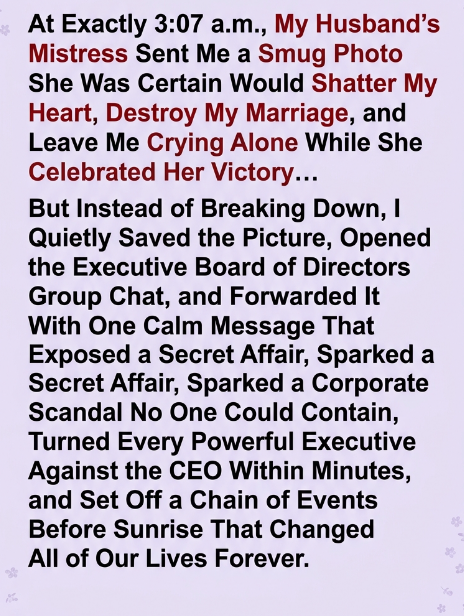
At exactly 3:07 a.m., my phone vibrated.
Half asleep, I reached for it, expecting another spam message or one of those late-night security alerts from work.
Instead, I found a text from an unknown number.
Attached was a photo.
A woman lay in a luxury hotel bed wearing my husband’s white dress shirt.
Behind her, asleep with one arm thrown across the pillow, was my husband.
The caption read:
“Thought you deserved to know who he really chose tonight.”
A second message arrived seconds later.
“You can stop pretending you still have a marriage.”
I stared at the screen.
I didn’t cry.
I didn’t scream.
I simply enlarged the photo.
She had made one critical mistake.
She had been so eager to celebrate that she forgot to notice what else was visible.
My husband wasn’t just any executive.
He was the CEO of a publicly traded healthcare technology company.
And embroidered across the hotel robe hanging behind the bedroom door was the logo of the Executive Leadership Summit the company had been hosting that week.
On the bedside table sat a conference name badge.
His.
Beside it was a folder stamped:
CONFIDENTIAL – BOARD STRATEGY SESSION
The hotel room wasn’t just a hotel room.
It was the executive suite reserved and paid for by the company.
The conference had strict policies.
Executives were prohibited from using corporate funds or company events for personal relationships with employees or vendors.
One violation could trigger an ethics investigation.
Two could become a shareholder nightmare.
I quietly saved the picture.
Then I opened one conversation I had hoped I’d never need.
Executive Board of Directors.
My husband had added me years earlier during a charity gala planning committee and had never bothered removing me after the project ended.
I rarely opened the chat.
There were twelve board members.
The company’s General Counsel.
Its Chief Compliance Officer.
Its Audit Committee Chair.
Without hesitation, I forwarded the photo.
Then I typed exactly one sentence.
“It appears our CEO has been conducting confidential business from the executive suite with someone who is neither his spouse nor listed on the summit’s attendee roster.”
I pressed Send.
Then I turned off my phone.
I made coffee.
At 3:19 a.m., the first knock came.
Not at my door.
At my husband’s hotel suite.
By 3:27, security had entered the executive floor.
At 3:41, every member of the Audit Committee had joined an emergency conference call.
At 4:02, the General Counsel instructed the hotel’s management to preserve all electronic room-access records.
At 4:18, expense reports tied to the summit were frozen pending review.
By 5:00 a.m., the company’s Chief Compliance Officer had confirmed that the woman in the photograph wasn’t a registered guest.
She wasn’t an employee attending the conference.
She was a sales consultant representing a vendor currently bidding on a multi-million-dollar contract with the company.
The affair wasn’t merely personal anymore.
It represented a serious conflict of interest.
As dawn approached, more facts emerged.
Security footage showed my husband personally escorting her through a restricted executive entrance after official conference events had ended.
Their room charges—including expensive meals, premium drinks, and spa services—had all been billed to the company’s executive hospitality account.
The vendor she worked for had advanced to the final stage of contract negotiations only days earlier.
No one could ignore the appearance of favoritism.
By 6:45 a.m., the emergency board meeting had begun.
At 7:12, my husband finally called me.
I didn’t answer.
He left four voicemails.
Then eight text messages.
The last one simply read:
“Please don’t say anything else.”
I never replied.
I didn’t need to.
The evidence was already speaking.
At 8:30 a.m., the board placed him on immediate administrative leave pending an independent investigation.
News spread quickly through corporate headquarters.
Employees who had spent years watching him preach ethics, transparency, and accountability suddenly found themselves reading the company-wide announcement with stunned silence.
Within days, investigators uncovered far more than an affair.
The review found repeated misuse of corporate funds, undisclosed luxury travel charged as business development, and a pattern of approving vendor expenses without proper oversight.
Several senior executives who had quietly ignored warning signs also faced disciplinary action.
The vendor’s contract was suspended.
The company voluntarily disclosed the investigation to regulators and shareholders.
Three weeks later, my husband resigned before the board could vote on his termination.
His carefully crafted reputation collapsed almost overnight.
People often asked whether I planned everything.
I didn’t.
The woman who wanted to humiliate me believed a photograph would destroy my life.
She never imagined it would expose his.
Months later, after the investigations ended, I received one final message from the same unknown number.
It contained only six words.
“I never thought it would happen.”
I looked at the screen for a long moment.
Then I deleted it without replying.
Because by then I had learned something far more valuable than revenge.
When people are determined to expose someone else’s pain, they often forget to hide their own mistakes.
And sometimes, the evidence that ruins a lie isn’t the betrayal itself—
It’s everything sitting quietly in the background of the picture.