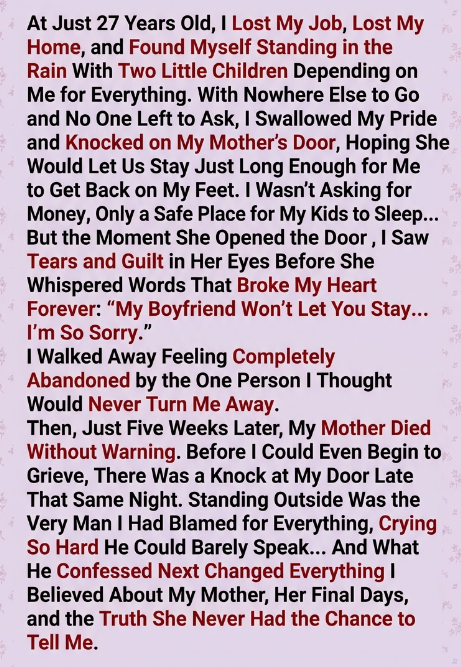
At twenty-seven, I lost everything in less than a month.
First came the layoffs.
The manufacturing company where I’d worked since I was nineteen closed its local plant with almost no warning.
Two weeks later, I fell behind on rent.
Then the eviction notice came.
I packed everything my two children and I owned into the back of my old hatchback.
Emma was six.
Jacob had just turned four.
That evening it started raining.
The kids fell asleep in their car seats while I stared through the windshield, trying to think of somewhere—anywhere—we could go.
There was only one place left.
My mother’s house.
I hadn’t asked her for help since I was a teenager.
We weren’t especially close, but we weren’t estranged either.
I kept telling myself that no mother would turn away her own grandchildren.
When I knocked, she opened the door almost immediately.
The moment she saw us, her eyes filled with tears.
She hugged the children first.
Then she looked at me.
“I’m so sorry,” she whispered.
“What happened?”
I told her everything.
The job.
The eviction.
The car.
The kids.
“I only need a few weeks,” I said.
“I’ll find another job. I just need somewhere safe for them to sleep.”
She looked over her shoulder toward the hallway.
Then back at me.
Her voice broke.
“My boyfriend won’t let you stay.”
For a second, I thought I’d misheard her.
“What?”
“He says if you move in, you’ll never leave.”
“I told him that isn’t true.”
She wiped away tears.
“But he won’t change his mind.”
I stared past her.
Her boyfriend, Dennis, never came to the door.
He never even looked at us.
I glanced down at my children.
Emma was quietly holding her little brother’s hand.
I forced myself to smile.
“It’s okay.”
“It isn’t,” my mother whispered.
She hugged me one last time.
As she pressed her arms around me, she slipped something into my jacket pocket.
I didn’t notice until much later.
We drove away.
That night, we slept in the car behind a twenty-four-hour grocery store.
The next morning I found what she’d placed in my pocket.
Five hundred dollars.
Every dollar she had in cash, as I later learned.
I cried harder than I had at any point during the previous month.
Over the next five weeks, we survived.
A local church helped us with motel vouchers.
I found temporary work unloading delivery trucks during the night and cleaning offices in the morning.
It wasn’t easy.
But little by little, things started improving.
Then my phone rang.
Mom had collapsed from a massive brain aneurysm.
She died before I reached the hospital.
I never got to tell her we’d finally rented a tiny apartment.
I never got to tell her we were going to be okay.
The funeral passed in a blur.
Dennis stood quietly in the back.
I couldn’t even look at him.
In my mind, he was the reason my children had spent nights sleeping in a car.
That evening, after putting the kids to bed, I heard a knock at the apartment door.
Dennis stood outside.
His face was pale.
His eyes were swollen from crying.
“I know you hate me,” he said.
“But I need to tell you something.”
Every instinct told me to shut the door.
Instead, I stepped aside.
He sat at the kitchen table in silence for almost a full minute before speaking.
“It wasn’t me.”
I frowned.
“What?”
“The night you came to the house…”
He swallowed hard.
“I never knew you were there.”
I stared at him.
“Mom said you wouldn’t let us stay.”
He slowly shook his head.
“I was working a night shift.”
“I didn’t get home until after midnight.”
I felt my stomach tighten.
He reached into his coat pocket and carefully unfolded a letter.
“Your mother wrote this three days before she died.”
Across the envelope, in her handwriting, were the words:
For my child, if I don’t get the chance to explain.
My hands trembled as I opened it.
Inside she wrote:
My dear,
If you’re reading this, it means I waited too long.
Dennis never refused to help you.
I lied.
The truth is much harder to admit.
I was terrified.
After your father died, I buried myself in debt trying to save the house.
I borrowed against everything I owned.
The bank had already begun foreclosure proceedings.
I was days away from losing the house.
If you and the children had moved in, you would have been homeless all over again when the bank took it.
I couldn’t bear the thought of making you lose another home because of me.
So I let you believe Dennis was the reason.
I thought it would be easier for you to hate him than to watch me fail you.
I’m so sorry.
The tears blurred the page.
Dennis quietly slid another folder toward me.
Inside were foreclosure notices.
Final demand letters.
Auction paperwork.
Everything she’d described.
“I begged her to tell you the truth,” he said.
“She refused.”
“Why?”
“She said mothers are supposed to protect their children.”
“Even if it meant protecting them from the truth.”
Then he handed me one final envelope.
“This is from me.”
Inside was a cashier’s check.
Enough to cover six months of rent.
“I sold my motorcycle,” he said.
“It’s what your mother wanted.”
I looked up.
“What do you mean?”
He smiled sadly.
“The day before she died, she made me promise that if anything happened to her, I’d help you get back on your feet.”
I couldn’t speak.
For weeks, I had carried anger toward a man who had been trying to honor the last promise he’d made to the woman we both loved.
Over the following months, Dennis became an unexpected part of our lives.
Not as a replacement father.
Not because anyone expected it.
Simply because he cared.
He came to Jacob’s school play.
He taught Emma how to ride a bicycle.
Every year on my mother’s birthday, we visited her favorite park together and brought the sandwiches she used to make when I was little.
One afternoon, I finally asked him the question that had haunted me.
“Why did you keep helping after I blamed you?”
He looked toward my children playing nearby.
“Because your mother loved you.”
“And loving her meant keeping that love alive, even after she was gone.”
Years later, I still wish my mother had trusted me with the truth.
We could have faced those difficult days together.
But I’ve come to understand something.
Sometimes the people who love us make heartbreaking mistakes because they’re trying—however imperfectly—to protect us.
My mother didn’t fail me because she couldn’t give me a home.
She failed to believe that I would rather struggle beside her than live with a lie.
And the man I spent five weeks blaming…
Turned out to be the last person faithfully carrying out her final act of love.