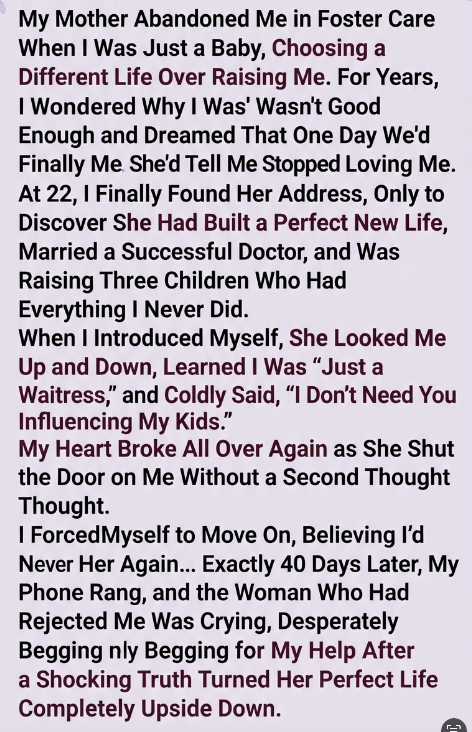
My mother abandoned me before I was old enough to remember her face.
I grew up in foster care.
Some homes were kind.
Some weren’t.
By the time I turned eighteen, I’d learned one lesson better than anything else:
Never expect someone to stay.
Still, there was one question that never stopped following me.
Why wasn’t I enough?
For years, I imagined our first meeting.
Maybe she’d explain.
Maybe she’d cry.
Maybe she’d tell me she’d searched for me every birthday but never knew how to reach me.
I held onto those fantasies longer than I should have.
At twenty-two, after months of searching public records and adoption documents that had finally become available to me, I found her address.
She lived in a beautiful neighborhood.
Two-story brick house.
Perfect lawn.
Luxury SUV in the driveway.
The mailbox carried two names.
Dr. Michael Lawson and Rebecca Lawson.
I sat in my car for almost twenty minutes before gathering enough courage to knock.
She answered the door wearing gardening gloves.
For a few seconds, we simply stared at each other.
She had my eyes.
My smile.
My chin.
“I think…” I whispered.
“I’m your daughter.”
The color drained from her face.
She stepped outside and quietly closed the door behind her.
“How did you find me?”
“I just wanted to meet you.”
She looked terrified.
Then three children ran laughing through the hallway behind the glass door.
A little girl waved.
“Mom!”
Rebecca quickly blocked their view of me.
“What do you do?” she asked abruptly.
I blinked.
“I’m a waitress.”
She looked me up and down.
“A waitress?”
“I’m saving money for nursing school.”
She sighed.
“I’ve worked very hard to build a stable life.”
“I know.”
“My husband is a respected physician.”
“I know.”
“My children don’t know about you.”
I swallowed.
“I wasn’t trying to cause problems.”
Then she said the sentence I’d spent my whole life hoping I’d never hear.
“I don’t need you influencing my kids.”
It felt like someone had reached into my chest and squeezed my heart.
“I only wanted to know why.”
She looked away.
“I’m sorry.”
Then she opened the door, stepped inside, and closed it.
Without another word.
I sat in my car until sunset.
Eventually I drove home.
I cried.
Then I made myself one promise.
I would never contact her again.
Forty days passed.
Life slowly returned to normal.
I worked double shifts.
Studied for nursing school entrance exams.
Tried to forget the woman who had rejected me twice.
Then my phone rang.
Unknown number.
I almost ignored it.
“Hello?”
A voice answered through uncontrollable sobbing.
It was Rebecca.
“Please…”
“I need your help.”
I said nothing.
“My husband…”
She couldn’t finish.
After several deep breaths, she finally explained.
Dr. Lawson had been arrested the previous evening.
Federal investigators had uncovered years of insurance fraud, falsified medical billing, and illegal kickback schemes involving several clinics.
News stations were already parked outside the house.
His medical license had been suspended.
Their bank accounts had been frozen pending investigation.
Reporters surrounded the children every time they left school.
“My whole life is falling apart,” she whispered.
I listened quietly.
Then she said something I never expected.
“I don’t know who else to call.”
I almost laughed.
Forty days earlier, I wasn’t good enough to meet her children.
Now I was the only person answering the phone.
She asked if we could meet.
Against every instinct, I agreed.
She looked nothing like the confident woman I’d met before.
She looked exhausted.
Broken.
Ashamed.
For several minutes, neither of us spoke.
Finally she looked at me.
“I lied to you.”
“I know.”
“No…”
She shook her head.
“I lied about why I gave you up.”
I froze.
“I wasn’t chasing a better life.”
“What do you mean?”
“I was nineteen.”
“Your biological father was violent.”
“He controlled everything.”
“When I found out I was pregnant, I tried to leave.”
She wiped away tears.
“He threatened to kill us both.”
My breath caught.
“I had no family willing to protect us.”
“I believed placing you for adoption was the only way to keep you alive.”
I stared at her.
“Why didn’t you tell me that?”
“Because I was ashamed.”
She looked down.
“When I finally rebuilt my life, I convinced myself that reopening the past would only destroy everything.”
“So you pretended I didn’t exist.”
She nodded through tears.
“Yes.”
“And when you came to my door…”
She covered her face.
“I panicked.”
“I was afraid my children would lose the only stable family they’d ever known.”
I didn’t know what to believe.
Then she handed me a folder.
Inside were court records from more than twenty years earlier.
Restraining order applications.
Police reports.
Hospital photographs documenting injuries.
Letters from a social worker recommending confidential adoption for safety reasons.
Every document confirmed her story.
The woman who had abandoned me…
Had also been a frightened teenager trying to survive.
That didn’t erase the pain.
But it changed its shape.
Then she said quietly,
“I wasn’t crying because Michael was arrested.”
I looked at her.
“I was crying because losing everything made me realize I’d already lost the most important person in my life twice.”
For the first time since we’d met, I believed she was telling the truth.
Over the following months, we rebuilt something neither of us expected.
Not a perfect mother-daughter relationship.
That time was gone.
Instead, we built honesty.
Slowly.
Carefully.
Eventually I met my half-siblings.
They had grown up believing they were only children.
They didn’t reject me.
They hugged me.
The youngest asked,
“Does this mean we have a big sister?”
I smiled.
“Only if you want one.”
She hugged me again.
“I do.”
A year later, I graduated from nursing school.
My biological mother sat quietly in the back row.
She didn’t ask to stand beside me for photos.
She didn’t pretend she had raised me.
She simply waited until everyone else had finished.
Then she handed me a small gift.
Inside was a handwritten letter.
The last line read:
You spent twenty-two years wondering why I let you go.
The truth is, I never stopped hoping you would one day have the chance to become someone stronger than I ever was.
Looking at you now… you did.
People often ask whether I forgave her.
The answer is complicated.
Forgiveness didn’t erase my childhood.
It didn’t erase lonely birthdays or years spent wondering why I wasn’t wanted.
But it gave me something I never thought I’d have.
The truth.
And sometimes, the truth doesn’t heal every wound.
But it finally allows them to stop bleeding.