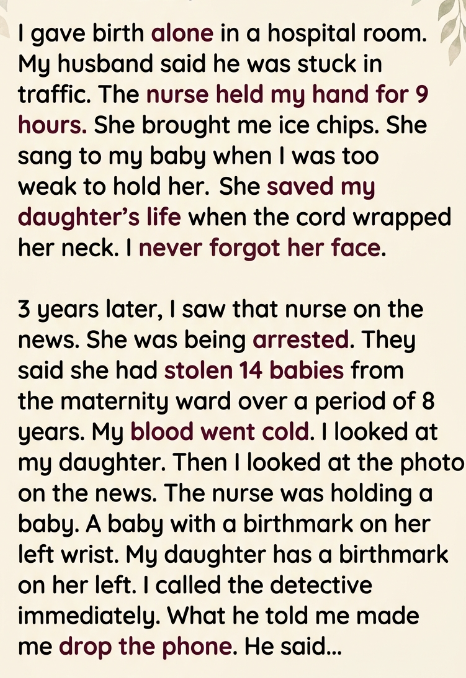
I gave birth alone.
My husband kept calling to say he was stuck in traffic after a highway accident had closed two lanes.
For nine long hours, one nurse stayed beside me.
Her name was Emily.
She held my hand through every contraction.
She brought me ice chips when I couldn’t stop shaking.
She whispered that I was stronger than I believed.
When my daughter’s umbilical cord wrapped around her neck during delivery, the room exploded into motion.
Doctors rushed in.
Emily never left my side.
A few terrifying minutes later, I heard the cry that changed my life forever.
My daughter survived.
I never forgot Emily’s face.
Three years passed.
One evening, while folding laundry, I saw her face on the evening news.
My heart stopped.
She was being led into a courthouse in handcuffs.
The reporter explained that investigators believed several babies had been improperly removed from the maternity ward over many years as part of an ongoing criminal investigation.
Authorities were still working to determine exactly what had happened and which cases, if any, involved unlawful conduct.
Then the screen showed investigators carrying evidence boxes.
One photograph flashed across the screen.
Emily was holding a baby.
The little girl had a tiny birthmark on her left wrist.
My daughter had a birthmark in the exact same place.
My hands began to shake.
I called the number investigators had released for families with concerns.
The detective listened patiently.
After asking for my daughter’s birth date and the hospital’s name, he said,
“I understand why you’re frightened.”
“There is something important I need you to know.”
I could barely breathe.
“What?”
“The photograph shown on television has been widely misunderstood.”
“It isn’t evidence that the child in the picture was taken from her family.”
I closed my eyes.
“What do you mean?”
“The baby in that photograph has already been identified.”
“She was being transported to the neonatal intensive care unit after an emergency delivery.”
“The birthmark is simply a coincidence.”
I let out a breath I didn’t realize I’d been holding.
“But…”
He continued gently.
“Because your daughter was born during the period we’re reviewing, we’d still like to verify the records.”
Over the next several weeks, investigators carefully examined hospital logs, delivery records, electronic identification bands, and security footage that had been preserved from that period.
Eventually, the detective called again.
“This time,” he said,
“I have good news.”
Every record matched.
The identification bands.
The delivery notes.
The pediatric examinations.
The footprints taken after birth.
Everything confirmed that my daughter had been placed in my arms exactly as the records showed.
She was my daughter.
There had never been any question about that.
I cried with relief.
Before ending the call, I asked the detective one last question.
“Then why was that nurse arrested?”
He paused.
“I can’t discuss the entire investigation.”
“But I can tell you this.”
“Not every accusation reported in the first hours of an investigation turns out to be accurate.”
Months later, the case concluded.
The investigation determined that Emily had not kidnapped babies.
Instead, investigators found serious violations of hospital procedures involving falsified documentation and unauthorized transfers of infants between units during staffing shortages.
Those actions had created confusion in medical records and rightly led to criminal charges related to record falsification and patient safety.
However, no evidence supported the original rumor that she had stolen babies from their families.
The television reports that first week had been incomplete.
Emily eventually accepted responsibility for the record-related offenses.
Several hospital administrators were also disciplined after investigators found broader failures in oversight and staffing.
One afternoon, I received a handwritten letter.
It was from Emily.
She wrote:
I’m deeply sorry that seeing my face on the news caused you to question one of the happiest days of your life.
I made serious mistakes, and I accept responsibility for them.
But helping bring your daughter safely into the world remains one of the moments I’ll always remember.
I folded the letter and placed it inside my daughter’s baby book.
Years later, my daughter asked about the old newspaper clipping.
I told her the truth.
“Sometimes frightening headlines don’t tell the whole story.”
“And sometimes the most important thing we can do is wait for the facts before deciding what we believe.”
She smiled.
“So… she’s really my mom?”
I laughed and hugged her tightly.
“Without a doubt.”
That day reminded me of something I’ll never forget.
Fear fills in the blanks faster than truth ever can.
But truth, even when it takes longer to arrive, is still the safest place to build a life.