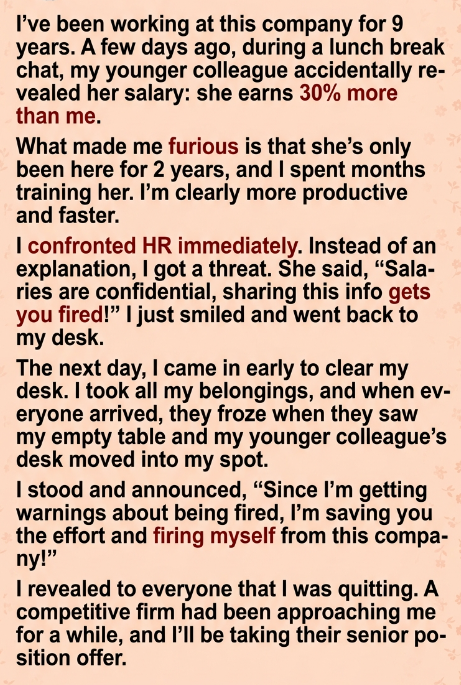
I had worked for the same company for nine years.
I wasn’t the loudest person in the office.
I wasn’t the type to brag about my accomplishments.
I simply showed up every day, worked hard, and believed loyalty would eventually be rewarded.
Whenever new employees were hired, I was the one managers asked to train them.
I never complained.
I enjoyed helping people succeed.
Two years ago, a young analyst named Sophie joined our department.
She was bright, eager to learn, and asked thoughtful questions.
For nearly three months, she sat beside me while I taught her everything I knew.
How to navigate our systems.
How to solve the problems that weren’t written in the manuals.
How to keep difficult clients happy.
She often thanked me.
“I’d be completely lost without you.”
I smiled and told her she’d do just fine.
She did.
A few days ago, during lunch, several of us were talking about rising rent and the cost of groceries.
The conversation eventually turned to raises.
Sophie laughed and said, “At least my last increase helped a little.”
Someone jokingly asked, “How much are they paying you these days?”
Without thinking, she answered.
The room went quiet.
I did the math in my head.
She was earning about thirty percent more than I was.
At first, I assumed I had misunderstood.
After lunch, I quietly asked her if she’d misspoken.
Her face immediately turned pale.
“Oh no…”
“I wasn’t supposed to say that.”
She showed me the number on her payroll app.
It was correct.
I wasn’t angry with her.
She hadn’t negotiated against me.
She hadn’t hidden anything.
She simply answered a question.
The person I was angry with was my employer.
I’d spent nine years building that department.
I’d trained new hires.
Stayed late.
Worked weekends.
Covered vacations.
Received excellent performance reviews.
Yet somehow…
The employee I’d trained was earning significantly more than I was.
That afternoon, I requested a meeting with Human Resources.
I expected a conversation.
Maybe an explanation.
Maybe a promise to review my compensation.
Instead, the HR manager barely let me finish.
“Salaries are confidential.”
I replied calmly, “Employees discussed them voluntarily during lunch.”
She folded her hands.
“Sharing salary information creates conflict.”
“I didn’t share anything.”
“I’m asking why my compensation doesn’t reflect my experience.”
Her expression hardened.
“If this continues, we may have to consider disciplinary action.”
I stared at her.
“You’re threatening to fire me for asking about my own salary?”
“I’m reminding you of company expectations.”
I simply smiled.
“Thank you.”
Then I walked back to my desk.
That evening, I opened an email I’d been ignoring for weeks.
A recruiter from one of our biggest competitors had contacted me several times over the past month.
Until then, I’d always declined.
This time…
I replied.
Within forty-eight hours, I had an interview.
The following morning, they offered me a senior position.
The salary was nearly fifty percent higher than what I was making.
Better benefits.
Flexible hours.
A larger team.
Most importantly…
Respect.
I accepted immediately.
The next day, I arrived at the office an hour earlier than usual.
I packed every personal item into two boxes.
The framed photo of my family.
My favorite coffee mug.
The notebook where I’d written training guides over the years.
When everyone else started arriving, they slowed down as they walked past my desk.
It was completely empty.
A few minutes later, Sophie approached.
“Are you moving departments?”
I smiled.
“No.”
“I’m moving companies.”
By nine o’clock, our weekly team meeting began.
Before my manager could start, I stood up.
“I have an announcement.”
The room fell silent.
“I’ve accepted a senior position with another company.”
“My resignation is effective immediately.”
Several people looked stunned.
My manager frowned.
“You didn’t even discuss this with us.”
“I tried.”
“I asked why I was earning substantially less than employees I’d trained.”
“I wasn’t given an explanation.”
“I was given a warning.”
No one spoke.
I continued.
“I’ve spent nine years helping build this department.”
“I’ve trained many of you sitting here today.”
“I’m proud of that.”
“But loyalty should never become an excuse for undervaluing someone.”
I turned toward Sophie.
“This isn’t your fault.”
“You earned what you negotiated.”
“I hope you continue doing well.”
She looked relieved.
Then I looked back at everyone else.
“If there’s one thing I hope you take away from today…”
“…it’s that knowing your worth isn’t disloyal.”
“It’s necessary.”
By lunchtime, the entire office knew I’d left.
Within two months, three other experienced employees had also resigned after reviewing their own compensation and realizing similar disparities.
My former employer eventually contacted me with a counteroffer.
For the first time in nine years, they suddenly found room in the budget for a significant raise.
I thanked them politely.
Then declined.
Because sometimes the issue isn’t the money.
It’s discovering your value only matters after you’ve decided to leave.
My first day at the new company felt strange.
New faces.
New systems.
New challenges.
But as I sat down in my new office, my manager walked in, shook my hand, and said,
“We hired you because of your experience.”
“We’re excited to learn from you.”
Nine years at one company taught me many lessons.
The most important wasn’t about spreadsheets or deadlines.
It was this:
If an employer only recognizes your worth after you’ve handed in your resignation…
They recognized it all along.
They just hoped you never would.