My name is Maya.
For as long as I can remember, I was the child who could never do anything right.
My younger sister, Emma, was my parents’ pride and joy.
She was prettier.
Smarter.
More talented.
At least, that’s what I heard growing up.
When Emma brought home an A, my parents celebrated.
When I brought home an A, they asked why it wasn’t an A+.
When Emma forgot to do her chores, she was “just busy.”
When I forgot, I was “lazy.”
By the time I left for college, I had accepted that I would never be enough.
So I built a life far away.
I became a trauma surgeon.
The work was demanding, but it gave me something I’d never received at home—respect.
Even then, my parents barely acknowledged my career.
To their friends, they talked endlessly about Emma’s marketing job and beautiful family.
If anyone asked about me, my mother would shrug and say,
“Oh, Maya keeps herself busy.”
When Emma announced her wedding, I debated whether to attend.
But she called and said,
“I’d regret it if my sister wasn’t there.”
I wanted to believe things had changed.
I was wrong.
The reception was beautiful.
Nearly two hundred guests filled the ballroom.
After dinner, the speeches began.
My father spoke first.
Then Emma.
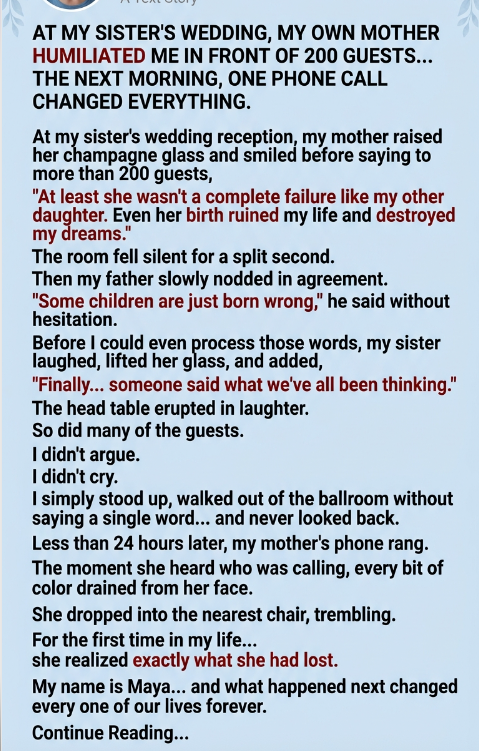
Finally, my mother stood with a champagne glass in her hand.
She smiled warmly at the guests.
“I’ve always been proud of Emma.”
People applauded.
Then she looked directly at me.
“At least she wasn’t a complete failure like my other daughter.”
The room became painfully quiet.
“Even her birth ruined my life and destroyed my dreams.”
I couldn’t move.
My father slowly nodded.
“Some children are just born wrong.”
Emma laughed.
“Finally.”
She lifted her glass.
“Someone said what we’ve all been thinking.”
Laughter spread across the head table.
A few uncomfortable chuckles echoed through the room.
I looked around.
Some guests stared at their plates.
Others looked shocked.
No one said a word.
Neither did I.
I quietly stood up.
Picked up my purse.
Walked through the ballroom.
And left.
No scene.
No tears.
No goodbye.
I drove home that night and blocked every member of my family.
The next morning, I was preparing for another twelve-hour hospital shift when my phone rang.
It was the hospital administrator.
“Maya.”
“Yes?”
“I wanted you to know we’ve just received confirmation.”
“Confirmation of what?”
“You’ve been selected as the new Director of Trauma Services.”
I was speechless.
The promotion came with a significant salary increase, leadership of one of the state’s busiest trauma centers, and national recognition for my years of work.
By noon, the hospital issued a press release.
Local newspapers picked up the story.
Television stations interviewed several colleagues.
One article mentioned that I had recently been honored for performing life-saving surgery on victims of a multi-car highway accident.
That same afternoon, my mother’s phone started ringing.
Friends.
Neighbors.
Extended relatives.
One after another.
Each asking the same question.
“Why did your daughter leave the wedding?”
People who had attended the reception began talking.
Someone had recorded my mother’s speech.
The video spread quickly among family and friends.
Instead of embarrassing me, it exposed them.
People weren’t criticizing me.
They were asking how parents could speak that way about their own child.
Former neighbors called to apologize for never realizing what had been happening.
My aunt, who had remained silent for years, finally called me.
“I should’ve defended you when you were little.”
“I’m sorry.”
Three days later, my parents appeared at my front door.
My mother looked exhausted.
“We need to talk.”
“I don’t.”
She started crying.
“You embarrassed us.”
I stared at her.
“No.”
“You embarrassed yourselves.”
My father stepped forward.
“People won’t stop calling.”
“They’re canceling invitations.”
“Emma’s in-laws are furious.”
I simply replied,
“Those consequences belong to the people who created them.”
My mother suddenly whispered,
“We never thought you’d leave.”
I nodded.
“I know.”
“You expected me to keep accepting it.”
They asked for forgiveness.
I told them forgiveness and reconciliation were not the same thing.
“I can forgive what happened for my own peace.”
“But I don’t have to keep inviting it into my life.”
Months passed.
I heard through relatives that Emma’s marriage struggled almost immediately.
Not because of me.
Because her husband had witnessed how casually she joined in humiliating her own sister.
He later admitted it made him wonder how she might someday treat him or their future children.
Eventually, he insisted they attend counseling together.
As for me, I kept my distance.
I poured my energy into my patients, my colleagues, and the people who had always treated me with kindness.
A year later, I received an award for excellence in trauma surgery.
When I walked onto the stage, I saw something unexpected in the audience.
My parents.
They hadn’t been invited by me.
They had purchased tickets like everyone else.
After the ceremony ended, my mother approached cautiously.
“I watched everyone stand and applaud you.”
She wiped away tears.
“I finally realized…”
“I spent your whole life looking for flaws that never existed.”
I smiled politely.
“I hope you become the kind of person who never does that to anyone again.”
Then I walked away.
That was the last conversation we ever had.
People sometimes ask if I regret leaving the wedding.
I don’t.
Because the most important moment of my life wasn’t when my family humiliated me.
It was the moment I finally understood that someone else’s inability to love you properly is never proof that you are unworthy of love.
Sometimes, walking away isn’t giving up.
Sometimes, it’s the first step toward finally choosing yourself.