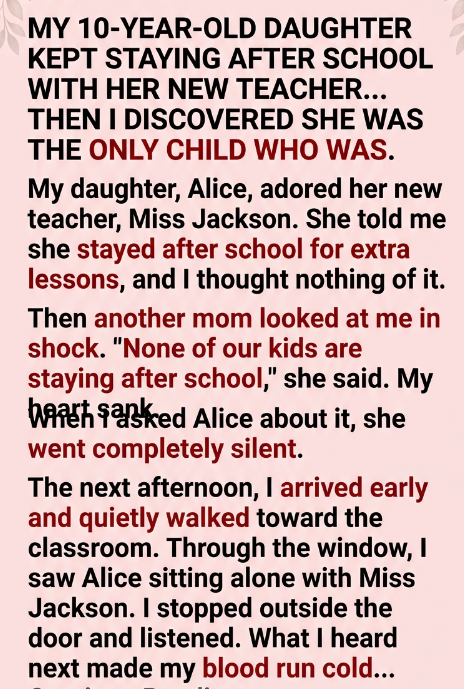
My daughter, Alice, had always loved school.
She was ten years old, curious about everything, and the kind of child who thanked the lunch staff every day before leaving the cafeteria.
When Miss Jackson started teaching her class, Alice couldn’t stop talking about her.
“She’s the nicest teacher ever.”
“She makes math fun.”
“She says I ask great questions.”
So when Alice told me she’d been staying after school for extra lessons twice a week, I didn’t think much about it.
“If it helps you, that’s wonderful,” I told her.
For nearly a month, I picked her up an hour later than usual.
Everything seemed perfectly normal.
Then one afternoon, while waiting outside the school, another mother smiled and asked,
“How’s Alice liking fifth grade?”
“She loves it,” I replied. “She’s even staying after school for extra help with Miss Jackson.”
The woman’s smile disappeared.
“What extra help?”
“The lessons.”
She frowned.
“My son is in the same class.”
“Nobody stays after school.”
A cold feeling settled in my stomach.
That evening, I asked Alice about it.
“So… what do you and Miss Jackson work on after class?”
Alice froze.
She looked down at her plate.
“I don’t know.”
“You don’t know?”
She quietly shrugged.
“We just… talk.”
“What do you talk about?”
She whispered,
“Please don’t be mad.”
“I won’t.”
“Miss Jackson said not to tell anyone because the other kids might get jealous.”
Every alarm bell in my head went off.
The next afternoon, I left work early.
Instead of waiting in the parking lot, I quietly walked down the empty hallway toward Alice’s classroom.
The door was closed.
Through the narrow window, I saw Alice sitting at a desk.
She was the only student there.
Miss Jackson sat beside her.
I stepped closer and paused outside the door.
Then I heard Miss Jackson say,
“Alice, I want you to remember something.”
“You never have to pretend you’re okay just because you don’t want your dad to worry.”
Alice looked down.
“I know.”
“I just don’t want him to be sad again.”
My heart stopped.
Miss Jackson continued gently,
“You’ve told me you’ve been having nightmares since your grandmother passed away.”
“That’s a really hard thing for a child to carry.”
Alice nodded.
“I miss her every day.”
“I know.”
“And it’s okay to miss her.”
I slowly opened the door.
Both of them looked up.
Miss Jackson stood immediately.
“I’m so sorry,” she said.
“I should have contacted you sooner.”
She explained that after my mother’s death six weeks earlier, Alice had started withdrawing in class.
She often cried quietly during reading time and struggled to concentrate.
The school counselor had a waiting list several weeks long.
So Miss Jackson had been staying after school with Alice to read stories, draw pictures, and let her talk about her grandmother.
“There were never academic lessons,” she admitted.
“I just didn’t want her sitting alone with those feelings.”
I looked at Alice.
“Why didn’t you tell me?”
Tears filled her eyes.
“Because you cried every night after Grandma died.”
“I thought if I told you I was still sad…”
“…you’d be sadder.”
I knelt beside her.
“Oh, sweetheart.”
I hugged her tightly.
“I’m supposed to help you carry your sadness.”
“Not the other way around.”
Miss Jackson quietly stepped into the hallway to give us privacy.
A few minutes later, she returned with a folder.
Inside were dozens of drawings Alice had made over the past month.
Pictures of my mother baking cookies.
Working in her garden.
Reading bedtime stories.
One picture showed the three of us holding hands.
On the back, Alice had written,
“I don’t want to forget Grandma’s face.”
I couldn’t hold back my tears.
That evening, Miss Jackson apologized again for not communicating better.
She admitted she should have called me before arranging the after-school meetings, even though her intentions had been to support Alice.
I thanked her for caring about my daughter, but we both agreed that any future support would include me from the beginning.
Over the next several months, Alice began meeting regularly with the school counselor.
We also started our own weekly tradition.
Every Friday after school, we’d stop for hot chocolate and share one favorite memory about Grandma.
Sometimes we laughed.
Sometimes we cried.
But we never kept those feelings to ourselves again.
On the last day of fifth grade, Alice handed Miss Jackson a thank-you card.
Inside she had written,
“Thank you for listening when I couldn’t find the words.”
Miss Jackson later told me she had kept that card in her desk ever since.
Looking back, I learned two important lessons.
Children don’t always hide things because they’re doing something wrong.
Sometimes they hide them because they’re trying to protect the adults they love.
And the best teachers don’t just help children learn math or reading.
Sometimes, they help them find the courage to heal.