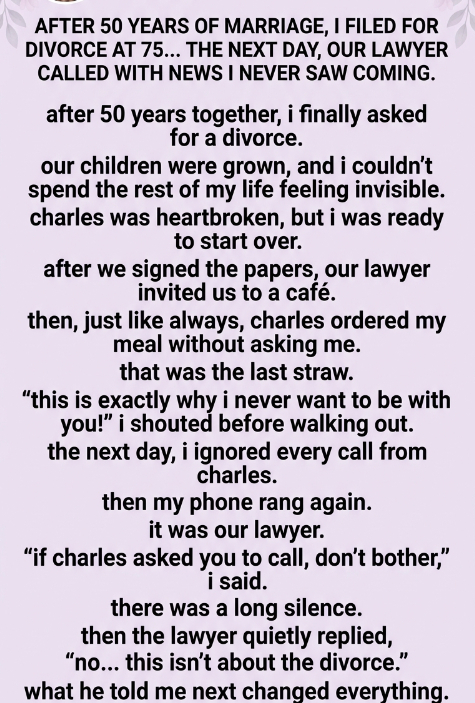
After fifty years of marriage, I asked my husband for a divorce.
Most people thought I was joking.
“You’re seventy-five.”
“What’s the point now?”
The point was simple.
I had spent half a century feeling invisible.
Charles wasn’t abusive.
He wasn’t unfaithful.
He simply believed that loving me meant making every decision for me.
He ordered my meals.
Answered questions directed at me.
Picked our vacations.
Bought my clothes.
If someone asked what I wanted, Charles usually answered before I could open my mouth.
People called him attentive.
I called it lonely.
For years I tried to explain how I felt.
He always smiled and said,
“I’m only trying to make life easier for you.”
One morning, I realized I couldn’t remember the last decision I had made entirely for myself.
That afternoon, I called a lawyer.
The divorce surprised everyone.
Especially Charles.
“I don’t understand,” he kept saying.
“I’ve always taken care of you.”
“You took care of everything,” I replied.
“Except listening to me.”
A month later, we signed the final papers.
Our lawyer suggested we have coffee together before going home.
“It might help end things peacefully,” he said.
We agreed.
A waitress approached our table.
Before she could ask what I wanted, Charles smiled.
“She’ll have the grilled chicken salad with dressing on the side.”
The waitress looked at me.
I hadn’t spoken a word.
Something inside me finally broke.
I pushed back my chair.
“This.”
I looked directly at Charles.
“This is exactly why I never want to be with you.”
“You still don’t see it.”
“You never ask.”
“You assume.”
“You decide.”
The café fell silent.
I walked out.
The next morning, Charles called again and again.
I ignored every call.
Then my lawyer called.
“If Charles asked you to call, don’t bother.”
There was a long pause.
Then he quietly said,
“No.”
“This isn’t about the divorce.”
My stomach tightened.
“What happened?”
“Charles asked me to deliver something to you.”
“I told him he should do it himself.”
“He said he couldn’t.”
“Why?”
“He checked himself into a counseling program this morning.”
I frowned.
“For what?”
The lawyer sighed.
“He said yesterday was the first time in fifty years he realized he’d spent your marriage talking for you instead of listening to you.”
I didn’t know what to say.
“He also asked me to give you this.”
Later that afternoon, I met the lawyer.
He handed me a sealed envelope.
Inside was a single handwritten letter.
“For fifty years I believed I was protecting you.”
“Yesterday I realized I was protecting myself from ever having to hear that I was wrong.”
“When you shouted in that café, I wanted to argue.”
“Instead, for the first time, I heard you.”
“I’m not writing to ask you to come back.”
“I’m writing because you deserved this apology decades ago.”
At the bottom of the page was one sentence that made me cry.
“I don’t know what your favorite meal is.”
“After fifty years… I realized I never actually asked.”
For months, we had no contact.
Charles stayed in counseling.
He joined a support group.
He read books about communication and emotional partnership.
Not because he hoped to save our marriage.
Because he wanted to understand the one he had already lost.
Nearly a year later, I received another letter.
This one contained no apology.
Just one question.
“Would you like to have lunch?”
“You choose the restaurant.”
“You order first.”
Curiosity got the better of me.
I agreed.
When the waitress approached our table, she smiled.
“What can I get you?”
Charles looked at me.
Then folded his hands in his lap.
He didn’t speak.
He simply waited.
For the first time in our entire marriage…
The silence belonged to me.
I ordered exactly what I wanted.
After the waitress walked away, Charles smiled softly.
“I didn’t know you liked salmon.”
I laughed.
“I’ve liked it for forty years.”
He shook his head.
“I never knew.”
“No.”
“You never asked.”
He nodded.
“I know.”
We never remarried.
The divorce remained final.
But something unexpected happened.
Without the old roles weighing us down, we slowly became friends.
Real friends.
We met once a month for lunch.
Sometimes we talked for hours.
Sometimes we sat quietly watching people pass by.
There was no pressure.
No assumptions.
Just two older people finally learning how to have a conversation.
When Charles passed away several years later, our children asked me to speak at his memorial.
I told everyone the truth.
“Your father spent fifty years believing love meant making every decision for someone else.”
“And he spent his final years learning that love begins by asking a simple question.”
“What do you want?”
It was a lesson that came late.
But not too late to change him.
And sometimes, that’s the most hopeful ending of all.