When my father was dying, he asked everyone else to leave the room.
He reached for my hand.
“Promise me something.”
“Anything.”
“Take care of your mother.”
I promised without hesitation.
I never imagined that promise would shape the next twelve years of my life.
After Dad passed away, Mom struggled financially.
Her pension covered only part of her expenses.
Every month, I paid the difference.
Rent.
Groceries.
Utilities.
Prescription medications.
When she needed a hip replacement, I covered the surgery, rehabilitation, and months of in-home care.
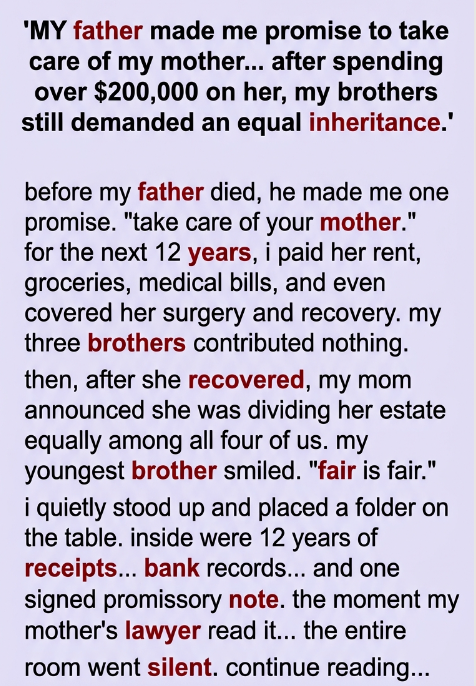
Over twelve years, I spent just over $200,000 helping her.
Not once did I ask my three brothers for reimbursement.
They always had excuses.
“I’m between jobs.”
“The kids are expensive.”
“We’ll help next year.”
Next year never came.
Mom knew where the money came from.
Every time I paid a bill, she thanked me.
More than once she said,
“I’ll make sure you’re repaid someday.”
I always answered the same way.
“I made Dad a promise.”
When Mom passed away at ninety-one, we gathered at her attorney’s office.
Her estate consisted mainly of her paid-off home, some investments, and savings.
The attorney began reading the will.
“My estate shall be divided equally among my four children.”
My youngest brother smiled.
“Fair is fair.”
The other two nodded.
I quietly stood.
“I have something the attorney should see first.”
I placed a thick folder on the conference table.
Inside were twelve years of receipts.
Canceled checks.
Bank transfers.
Medical invoices.
Copies of insurance payments.
Every expense I had paid on Mom’s behalf.
At the very bottom was a notarized document.
The attorney adjusted his glasses and began reading.
It was a promissory note.
Signed by my mother six years earlier.
It stated that any money I advanced for her care was to be treated as a loan to her estate and repaid before the remaining assets were distributed to the beneficiaries.
The room fell completely silent.
My oldest brother finally spoke.
“I’ve never seen that before.”
The attorney looked up.
“It appears to be properly executed and witnessed.”
He spent several minutes reviewing it carefully.
Finally, he closed the folder.
“The estate must first satisfy its outstanding obligations.”
“Including this documented debt.”
No one said another word.
A few weeks later, the accounting was complete.
The estate repaid the documented amount that remained owed under the promissory note.
Only after that were the remaining assets divided equally among the four of us, exactly as my mother had instructed.
The shares were smaller than my brothers had expected.
Mine reflected both the repayment of the documented debt and my equal inheritance.
After the meeting, my youngest brother pulled me aside.
“You planned this?”
I shook my head.
“Mom did.”
“I never asked her to sign that note.”
In fact, I remembered the day she’d insisted on it.
She had looked at me and said,
“You made a promise to your father.”
“I’m making one to myself.”
“I won’t let your kindness become a burden you carry alone.”
Months later, while sorting through Mom’s belongings, I found one final letter addressed to all four of us.
It read:
“Your father asked one son to take care of me.”
“He never asked the others to stand aside.”
“Love is given freely.”
“But fairness requires honesty.”
“Your brother didn’t help me because he expected a reward.”
“He helped because someone needed him.”
“The promissory note wasn’t meant to punish anyone.”
“It was meant to make sure that keeping a promise didn’t become a financial penalty.”
That letter changed the tone of our family forever.
My brothers never apologized for the years they stayed away.
But they never argued about the estate again.
Today, I still keep my father’s old watch in my desk drawer.
Whenever I look at it, I remember the promise I made.
I don’t regret keeping it.
Because I didn’t take care of my mother to earn an inheritance.
I did it because she was my mother.
The inheritance simply ensured that the cost of keeping a promise wasn’t borne by one person alone.