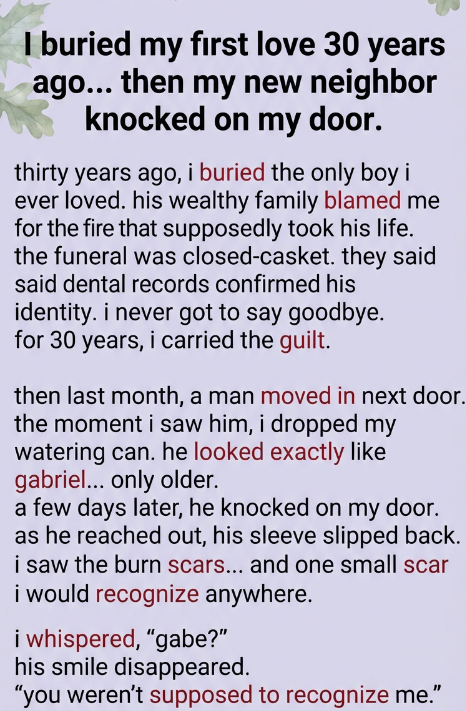
Thirty years ago, I buried the only boy I ever loved.
His name was Gabriel Whitmore.
I was sixteen.
He was seventeen.
His family owned half the businesses in our small lakeside town.
My mother cleaned houses.
My father repaired engines in a garage behind our home.
To Gabriel’s parents, I was the girl who distracted their son from the future they had carefully planned for him.
To Gabriel, I was simply Emma.
The girl he wanted to spend forever with.
The night everything changed, Gabriel told me to meet him at his family’s old lake cabin.
He said he had a surprise.
I never made it there.
My father had collapsed at work, and I spent the evening in the emergency room with my family.
Around midnight, someone called.
The cabin had burned to the ground.
They said Gabriel had died inside.
The funeral was closed-casket because of the fire.
His parents insisted dental records confirmed his identity.
I stood beside a polished oak coffin that I was never allowed to open.
His mother looked at me with tears in her eyes and whispered,
“If he hadn’t been planning a future with you, he’d still be alive.”
Those words haunted me for thirty years.
I never married.
I dated once or twice.
But every relationship ended the same way.
Part of my heart had been buried beside a coffin I never truly believed contained the boy I loved.
Last month, a moving truck pulled into the house next door.
I glanced out the window while watering my flowers.
The man climbing out of the driver’s seat froze me in place.
Gray at the temples.
Older.
Broader.
But unmistakably familiar.
I dropped the watering can.
It couldn’t be.
People don’t return from funerals.
For several days, I watched from a distance, convincing myself grief was playing tricks on me.
Then one Saturday afternoon, my doorbell rang.
The man stood on my porch holding a pie.
“I figured neighbors should introduce themselves.”
As he reached out, his sleeve slipped back.
Burn scars covered much of his forearm.
Near his wrist was a tiny crescent-shaped scar.
When we were teenagers, we’d climbed over an old fence together.
A nail had caught his skin.
I’d teased him for weeks about it.
No one else in the world had that scar.
My voice barely worked.
“…Gabe?”
His smile vanished.
He looked around nervously before quietly saying,
“You weren’t supposed to recognize me.”
My knees nearly gave out.
He caught my arm before I fell.
Inside my living room, neither of us spoke for several minutes.
Finally, I whispered,
“They said you were dead.”
“I know.”
“They buried someone.”
“I know.”
“Why?”
He closed his eyes.
“My father.”
The story that followed sounded impossible.
After the fire, Gabriel survived with severe burns.
While recovering in a private hospital under another name, he learned the truth.
His father had arranged everything.
The Whitmore family business was collapsing under enormous debt.
There was an insurance policy on the lake cabin and another on Gabriel himself through a complicated business trust.
His father believed disappearing Gabriel from public life would solve several problems at once.
The body identified through dental records belonged to an unidentified victim from another fire whose records had been manipulated through a corrupt associate.
Gabriel was told everyone believed he was dead.
Including me.
“I fought him,” Gabriel said.
“I begged to call you.”
“He said if I contacted you, he’d destroy your family’s lives.”
“My father already controlled the bank that held your parents’ mortgage.”
“I believed him.”
“So… you just disappeared?”
His eyes filled with tears.
“I was seventeen.”
“I had burns over half my body.”
“No money.”
“No identity.”
“I thought staying away was protecting you.”
His father died only three years later.
By then, Gabriel had a new legal identity arranged through the same deception that had hidden him.
Ashamed and convinced I had moved on, he stayed away.
Until retirement.
Until fate brought him to the house next door.
“I didn’t choose this neighborhood because of you,” he admitted.
“I had no idea you lived here.”
“I only recognized your name after I bought the house.”
“So why didn’t you tell me?”
“I wanted to leave if you looked happy.”
“But then I saw you wearing the necklace.”
I touched the small silver compass hanging around my neck.
Gabriel had given it to me on my sixteenth birthday.
I’d never taken it off.
“I realized,” he whispered,
“…you never stopped waiting.”
Over the next several months, we worked with investigators, historians, and attorneys.
Most of the crimes were decades beyond prosecution.
Key witnesses had died.
Records had vanished.
But one retired detective found enough evidence to officially amend Gabriel’s file.
The town corrected its records.
His death certificate was voided.
The false identification was acknowledged as a historic injustice.
No criminal trial could give us back thirty years.
But the truth finally existed where everyone could see it.
One afternoon, we visited the cemetery together.
We stood before the gravestone that carried Gabriel’s name.
He rested his hand against the cold granite.
“I spent half my life wondering what this looked like.”
I slipped my hand into his.
“So did I.”
The cemetery agreed to remove the headstone and replace it with a memorial honoring the unidentified victim who had unknowingly been buried there instead.
As we walked away, Gabriel smiled through tears.
“I thought the hardest part would be explaining where I’d been.”
“What was the hardest part?”
He looked at me.
“Finding out whether you’d forgiven me before I even had the chance to ask.”
I squeezed his hand.
“We lost thirty years.”
“We’re not getting them back.”
“No.”
“But we still have today.”
Sometimes life doesn’t give us the ending we imagined at seventeen.
Sometimes it gives us something quieter.
A second beginning.
And after believing for three decades that love had ended in fire, I finally learned that hope can survive far longer than anyone expects—even when the whole world believes it has been buried.