The day I graduated from college was supposed to be one of the happiest days of my life.
My grandparents would have loved it.
They had spent years telling me that education was the one thing no one could ever take away from me.
Before my grandmother passed away, she held my hand and said something I never forgot.
“People don’t change because money appears.”
“Money simply reveals who they already are.”
At the time, I thought she was being overly cautious.
A month after her funeral, I learned she had left me the majority of her estate.
A diversified investment portfolio, cash, and several income-producing properties.
Together, they were worth a little over six million dollars.
The inheritance came with one condition.
She wanted me to finish college before taking control of it.
When graduation week finally arrived, the attorney handling the estate met me privately.
He asked a question that surprised me.
“Has anyone in your family started asking about the inheritance?”
I hesitated.
“My parents have mentioned that we should ‘manage it together.'”
He nodded slowly.
“Then I recommend one thing.”
“Protect it before anyone knows you legally control it.”
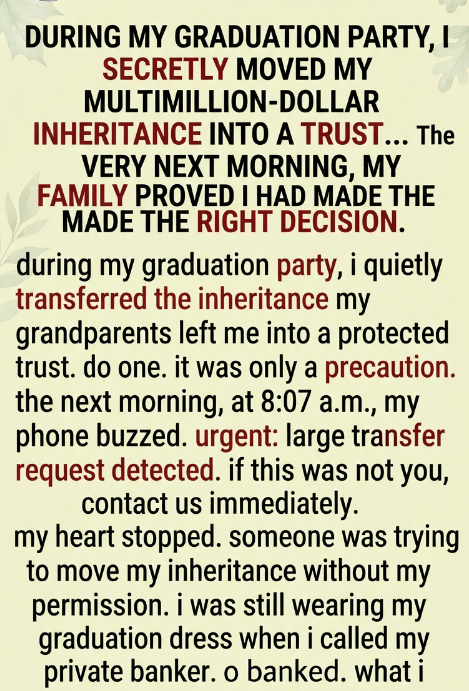
The morning of my graduation, before the ceremony, I met with my private banker and estate attorney.
Together, we transferred every asset into an irrevocable trust managed by an independent fiduciary.
I remained the sole beneficiary.
No withdrawals above a certain amount could occur without multiple levels of verification.
No one else knew.
Not my parents.
Not my older brother.
Not even my closest friends.
That evening, my family threw a large graduation party.
Everyone toasted my future.
My father kept making jokes about how I was “finally rich enough to pay for family vacations.”
My mother laughed.
“We’ll sit down this weekend and organize everything.”
I smiled politely.
Said nothing.
The next morning, at exactly 8:07 a.m., my phone buzzed.
URGENT: Large transfer request detected.
If this was not you, contact your private banker immediately.
My stomach dropped.
I was still wearing the graduation dress I’d fallen asleep in after the celebration.
I called my banker before I even changed clothes.
His voice was unusually serious.
“Miss Carter…”
“I’m very glad you called.”
“What happened?”
“Someone attempted to initiate a transfer of nearly four million dollars from an account connected to your estate.”
“I don’t understand.”
“The trust blocked it automatically.”
“Who requested it?”
There was a long pause.
“I’m afraid I can’t answer that over the phone.”
“Please come to the office.”
An hour later, I sat across from my banker and attorney.
The banker slid a folder toward me.
Inside was a copy of the transfer request.
The authorization hadn’t succeeded because the trust required biometric confirmation.
But attached to the request were scanned copies of my driver’s license.
My Social Security card.
My passport.
Even my signature.
Someone had assembled everything needed to impersonate me.
“Where could they have gotten these?” I whispered.
My attorney looked directly at me.
“Who had access to your room during the graduation party?”
Then I remembered.
My mother had insisted guests use my bedroom to hang coats because it had the largest closet.
The folder where I kept my personal documents had been inside my desk.
Locked.
Or so I thought.
The banker pointed to another page.
“The request originated from a laptop using your family’s home internet connection.”
I felt physically ill.
My attorney asked quietly,
“Do you want us to contact law enforcement?”
I wasn’t ready to believe what the evidence suggested.
I asked to take copies home first.
That afternoon, I sat down with my parents.
“I need to ask you something.”
My father smiled.
“What’s wrong?”
“Did either of you try to access my inheritance this morning?”
The room went silent.
My mother answered first.
“We were only trying to help.”
My heart sank.
“So you did.”
She sighed.
“You’ve never managed this kind of money.”
“We thought it would be safer if your father handled the investments.”
“You forged my authorization.”
“It wasn’t forgery,” my father interrupted.
“We’re your parents.”
“We would’ve told you afterward.”
I stared at him.
“You were going to move four million dollars without asking me.”
My older brother, who had been sitting quietly, suddenly stood up.
“You actually tried?”
They looked at him in surprise.
“You didn’t know?” I asked.
He shook his head.
“I thought they were joking last night.”
He turned toward our parents.
“What were you thinking?”
My mother started crying.
“We’ve sacrificed everything for this family.”
My brother answered before I could.
“And now you’re willing to steal from your own daughter?”
No one spoke.
A week later, after speaking with my attorney, I decided not to pursue criminal charges.
The transfer had failed.
No money had left the trust.
Instead, I permanently tightened every security measure.
I froze my credit, changed every password, replaced my identification documents, and moved into my own apartment.
The hardest decision wasn’t protecting my inheritance.
It was accepting that I needed to protect myself from the people I had trusted most.
Months passed before my parents asked to meet.
They apologized.
Not because they had been caught.
But because, after losing my trust, they finally understood what they’d almost destroyed.
Forgiveness came slowly.
Boundaries came first.
Today, the trust still exists exactly as my grandparents intended.
It funds my education, my business, and several scholarships in their names.
Sometimes people ask whether creating that trust was a sign that I didn’t trust my family.
I tell them the truth.
No.
Creating the trust didn’t destroy my trust in my family.
It revealed that my grandparents understood something long before I did.
The greatest inheritance they left me wasn’t the money.
It was the wisdom to protect it—and myself—before someone else decided they were entitled to both.