In my family, turning eighteen was more than a birthday.
It was a tradition.
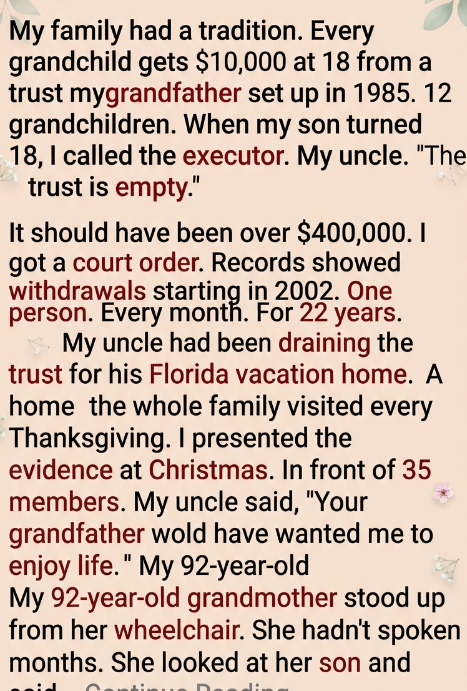
Back in 1985, my grandfather created a trust for every future grandchild.
His instructions were simple.
Each grandchild would receive $10,000 on their eighteenth birthday to help pay for college, start a business, or simply begin adulthood with a little security.
There were twelve grandchildren.
Grandpa used to joke that he’d never be around to see us all turn eighteen, but he hoped we’d remember that the money represented opportunity—not entitlement.
For years, everyone talked about the trust as though it were as dependable as sunrise.
Then my oldest son, Ethan, turned eighteen.
The morning after his birthday breakfast, I called the trustee—my Uncle Richard.
“I’d like to arrange Ethan’s distribution.”
There was a long silence.
Finally, he cleared his throat.
“There isn’t any money.”
I laughed.
“What do you mean?”
“The trust is… empty.”
I thought he was joking.
“It should have well over four hundred thousand dollars.”
“I know.”
“What happened?”
“The investments didn’t perform.”
Something about his voice didn’t sit right.
My grandfather had been conservative.
Certificates of deposit.
Blue-chip dividend stocks.
Municipal bonds.
He wasn’t the sort of man to gamble away a family legacy.
When I asked to review the trust records, Richard refused.
“They’re private.”
That answer made my stomach turn.
I hired an attorney.
Within weeks, we petitioned the court for an accounting.
Richard fought it.
He claimed I had no reason to question his management.
The judge disagreed.
A court order compelled him to produce every financial record.
Three weeks later, my attorney spread hundreds of pages across a conference table.
“You’re going to want to sit down.”
Every month.
Without exception.
Beginning in 2002.
One withdrawal.
Then another.
Then another.
Month after month.
Year after year.
Twenty-two years.
The recipient was always the same.
Richard.
The descriptions varied.
“Administrative reimbursement.”
“Property maintenance.”
“Travel expenses.”
“Investment oversight.”
They sounded legitimate until we added them together.
Nearly every dollar had gone into accounts connected to a waterfront vacation home in Florida.
The same house where our entire family gathered every Thanksgiving.
The same house Richard proudly claimed he’d purchased through “smart investing.”
The irony made me sick.
We’d been making memories in a house financed by money meant for twelve children.
The lawsuit moved quickly after that.
Bank statements matched the withdrawals.
Property tax records lined up with trust payments.
There was little room for explanation.
Still, Richard insisted he had done nothing wrong.
“He knew Grandpa would’ve wanted me to have it.”
My attorney suggested waiting until court.
Instead, I wanted the family to know the truth before rumors took over.
Christmas seemed cruel.
But it was the only time everyone would be together.
Thirty-five relatives packed into my cousin’s living room.
Children opened presents while the adults talked football and recipes.
When dessert was served, I stood.
“I need everyone’s attention.”
The room fell quiet.
I handed out copies of the financial records.
At first there was confusion.
Then disbelief.
Then silence.
Finally, Richard stood.
“This is completely out of context.”
He looked around the room.
“Your grandfather would’ve wanted me to enjoy life.”
No one spoke.
Then something happened that none of us expected.
My grandmother slowly pushed herself up from her wheelchair.
She was ninety-two.
After suffering a stroke months earlier, she’d barely spoken more than a handful of words.
The room froze.
She looked directly at Richard.
Her voice was soft but perfectly clear.
“Your father wanted every child to have a chance.”
She paused.
“You stole their chances.”
Richard’s face went pale.
Grandma wasn’t finished.
She pointed toward the hallway.
“Bring me the cedar box.”
Everyone looked confused except my mother.
She disappeared into Grandma’s bedroom and returned carrying a small cedar chest.
Grandma nodded.
“Open it.”
Inside were Grandpa’s journals.
Dozens of them.
Along with handwritten letters and the original trust documents.
One envelope was marked:
“If anyone ever questions why I created this trust.”
My aunt carefully unfolded the letter and began reading aloud.
“The trust belongs to my grandchildren.”
“Not to their parents.”
“Not to the trustee.”
“The trustee is only a caretaker.”
“If any trustee ever uses one dollar for himself, he has broken faith with me and with every child whose future depends on these funds.”
No one could breathe.
Then came the final sentence.
“If that day ever comes, remove him immediately and recover every dollar possible.”
Richard sat down without another word.
The civil case ended six months later.
Rather than endure a public trial, Richard agreed to a settlement.
He sold the Florida vacation home.
Several investment accounts were liquidated.
The recovered money couldn’t replace every lost year of growth, but it restored enough for every grandchild—including the youngest, who hadn’t yet turned eighteen—to receive what Grandpa had intended.
No one became rich.
That was never the point.
The point was fairness.
Richard never attended another Thanksgiving gathering.
Not because anyone formally excluded him.
Because he couldn’t bring himself to face the family after the truth came out.
The following Thanksgiving, we gathered at a rented lodge instead of the Florida house.
It wasn’t nearly as luxurious.
The furniture didn’t match.
The kitchen was too small.
Half the cousins slept on air mattresses.
But somehow it felt warmer than that big waterfront house ever had.
After dinner, Grandma asked me to bring her Grandpa’s journal.
She smiled as she ran her fingers across the worn leather cover.
“He always believed money tested character,” she whispered.
“I think he was right.”
Looking around the room at my children, my nieces, and my nephews laughing together, I realized the greatest gift my grandfather had left us wasn’t the trust itself.
It was the reminder that a family’s true inheritance isn’t measured by what someone leaves behind.
It’s measured by whether the next generation protects it—or quietly steals it while everyone else is looking the other way.