When my husband asked me to sign the papers, I didn’t hesitate.
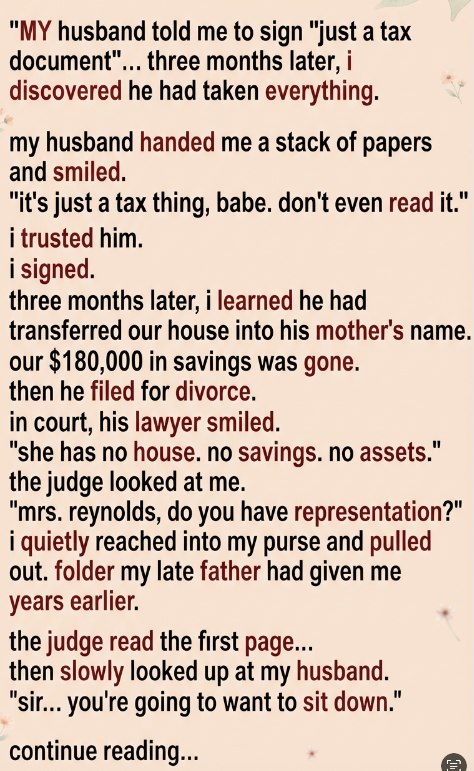
“It’s just a tax thing, babe,” he said with a tired smile.
“You know how much I hate paperwork.”
I laughed.
“So you want me to suffer instead?”
He leaned over and kissed my forehead.
“Exactly.”
The documents were already tabbed with little yellow sticky notes showing where to sign.
There were no blank spaces.
Nothing looked suspicious.
I trusted the man I’d been married to for eighteen years.
So I signed.
Every page.
Without reading a word.
Three months later, my world collapsed.
I came home from work and found a courier standing on my porch.
He handed me an envelope.
Inside were divorce papers.
I thought there had to be some mistake.
Until I kept reading.
The family home had already been transferred.
Not to my husband.
To his mother.
Our joint savings account—nearly one hundred eighty thousand dollars—had been emptied weeks earlier.
Several investment accounts had been closed.
Even my name had disappeared from property records.
I drove straight to the bank.
The manager looked genuinely uncomfortable.
“I’m sorry.”
“These transfers appear to have been authorized.”
“Authorized?”
He slid copies of signed documents across the desk.
My signature appeared on every page.
The papers I’d signed.
The “tax documents.”
My knees nearly gave out.
That night I called my husband over and over.
He finally answered.
“You lied to me.”
“No.”
“You just didn’t read what you signed.”
Then he hung up.
I barely slept for weeks.
Friends urged me to hire the most expensive attorney I could find.
The problem was…
I couldn’t afford one anymore.
Everything had been taken.
Or so I thought.
The morning of the hearing, I sat alone outside the courtroom.
My purse rested beside me.
Inside it was an old blue folder my father had insisted I keep years earlier.
“Promise me you’ll never throw this away,” he’d said.
I hadn’t opened it in almost a decade.
At the time, I assumed it contained insurance papers or old family records.
I brought it with me only because I couldn’t bear to leave behind the last thing my father had organized before he passed away.
When my case was called, my husband walked in wearing an expensive suit.
His lawyer looked confident.
Very confident.
The proceedings began.
His attorney calmly explained that the marital assets had already been legally transferred.
My signature appeared on every required document.
“The parties have no jointly owned property remaining,” he concluded.
“No shared savings.”
“No marital residence.”
He smiled politely.
“My client requests that the divorce proceed accordingly.”
The judge turned toward me.
“Mrs. Reynolds…”
“Do you have legal representation today?”
“No, Your Honor.”
“Do you wish to respond?”
My hands trembled as I reached into my purse.
“I don’t know if this matters.”
“But my father asked me to keep these papers.”
The judge accepted the folder.
The courtroom grew quiet.
He opened the first page.
His expression changed almost immediately.
He read the second page.
Then the third.
Finally, he looked up.
Not at me.
At my husband.
“Sir…”
He removed his glasses.
“You’re going to want to sit down.”
Even my husband’s attorney looked confused.
“What seems to be the issue, Your Honor?”
The judge held up a notarized document.
“This property.”
He tapped the file.
“It was never solely marital property.”
I frowned.
“What?”
The judge looked at me kindly.
“Mrs. Reynolds, according to these records, your late father placed the original down payment for the house into a properly documented family trust.”
I stared at him.
“My father… what?”
The judge nodded.
“The trust agreement specifically states that any funds contributed from the trust remain separate property unless expressly released by the trustee.”
My husband shifted uneasily.
His lawyer quickly reached for the documents.
After several tense minutes, the attorney’s confidence disappeared.
“Your Honor…”
“I wasn’t aware of this trust.”
The judge nodded.
“I believe that.”
He turned another page.
“The trust also required written approval from the trustee before any transfer involving trust assets.”
He looked directly at my husband.
“Was that approval ever obtained?”
Silence.
The answer was obvious.
No.
My father had named a successor trustee after his death.
Not me.
Not my husband.
His longtime accountant, Margaret Ellis.
She was sitting quietly in the back of the courtroom.
At the judge’s request, she stepped forward.
She explained that my father had established the trust after watching friends lose inherited assets during difficult divorces.
He wanted to make sure the money he left me would always remain protected unless I knowingly chose otherwise.
Margaret testified that she had never authorized the transfer of the house.
Nor had she approved the movement of any trust-connected funds.
The courtroom atmosphere shifted instantly.
The judge paused the divorce hearing and scheduled additional proceedings to examine the disputed transfers.
He also ordered that the remaining identifiable assets be frozen until ownership could be determined through the proper legal process.
Over the following months, financial records were carefully reviewed.
Experts compared signatures, account histories, and the sequence of transactions.
It became clear that I had signed documents without understanding their effect and that key trust requirements had not been followed.
The court ultimately ruled that the attempted transfer of the trust-protected interest in the home was ineffective because the required trustee authorization had never been obtained.
The house was returned to the trust’s ownership structure, preserving my interest under its terms.
The savings that had been moved without proper authority were traced through bank records.
Where possible, the funds were recovered or credited during the final property division.
My husband’s mother testified that she had believed the transfer was legitimate.
The court found no evidence that she had understood the legal problems with the documents she received.
She voluntarily transferred the property back once the trust issue was explained.
The divorce itself eventually became almost an afterthought.
When the final hearing concluded, the judge looked at me before leaving the bench.
“I hope one lesson comes from this.”
“No matter who asks…”
“…always read what you sign.”
He was right.
Trust is one of the greatest gifts we can give another person.
But trust should never require blindness.
Today, I still keep my father’s blue folder in a fireproof box.
Not because I expect another courtroom battle.
But because every time I see it, I remember two important truths.
The first is that the people who truly love you often protect you in ways you won’t understand until years later.
The second is that honesty can strengthen a marriage, while deception can destroy one with nothing more than a stack of papers and a signature.
My husband believed one careless moment had taken everything from me.
Instead, it revealed the one thing he could never steal:
The quiet wisdom of a father who had planned, years in advance, for the day his daughter might need someone to protect her when he no longer could.