In my family, one tradition never changed.
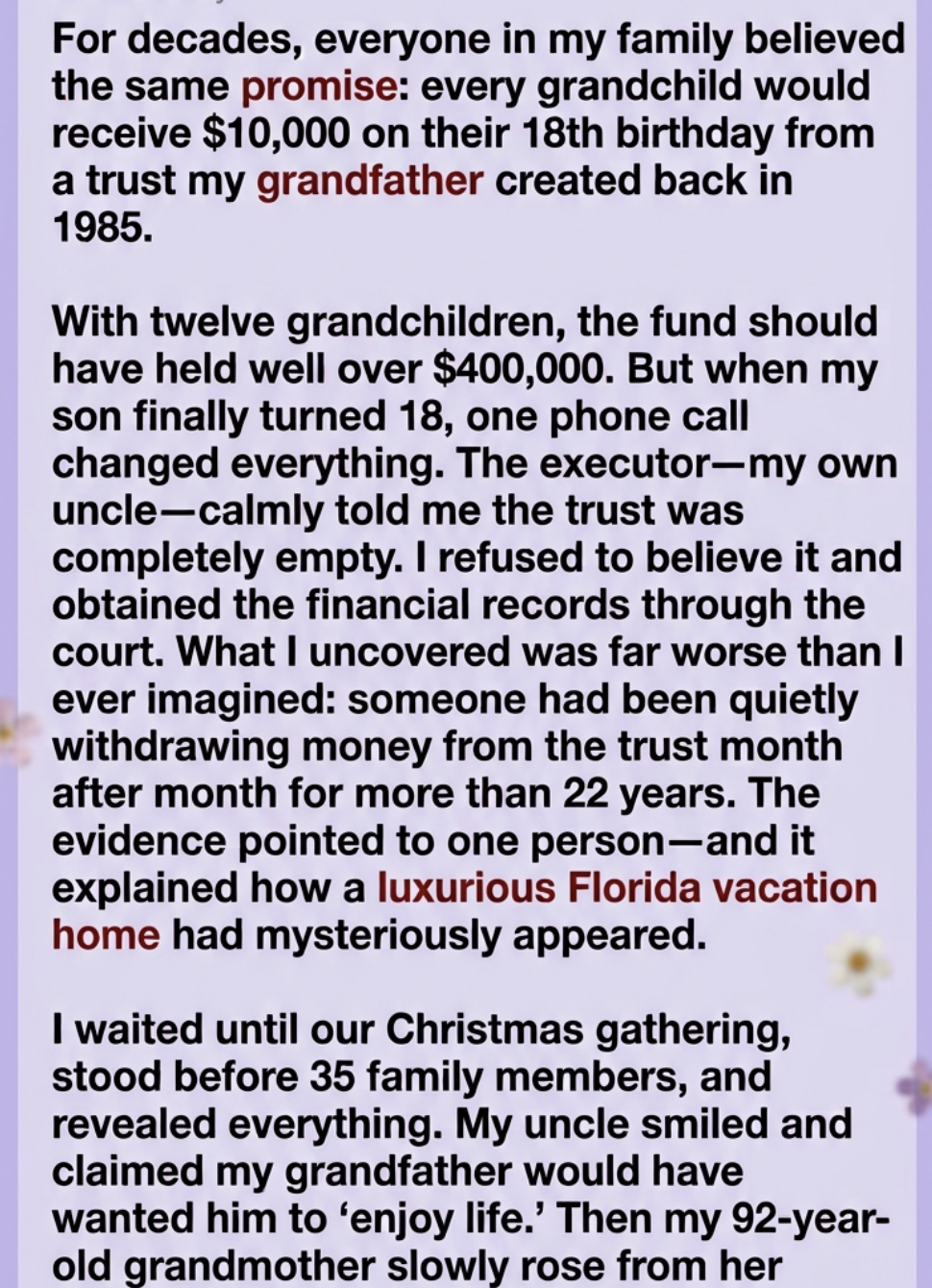
My grandfather created a trust in 1985 with one simple promise.
Every grandchild would receive $10,000 on their eighteenth birthday to help start adult life.
There were twelve grandchildren.
Grandpa was careful with money, invested wisely, and often reminded us that education and opportunity were the greatest gifts he could leave behind.
As each cousin turned eighteen, they received their check.
No one questioned it.
When my son celebrated his eighteenth birthday, I called the executor of the trust—my Uncle Richard.
He sounded strangely calm.
“I’m sorry,” he said. “The trust is empty.”
I laughed because I thought he was joking.
He wasn’t.
According to him, poor investments and market losses had wiped everything out.
Something didn’t feel right.
My grandfather had been conservative with money. He hated risky investments.
I filed a petition with the probate court requesting the trust records.
A month later, I sat in my attorney’s office staring at thousands of pages of bank statements.
There were no disastrous investments.
Instead, there were hundreds of withdrawals.
Every single month.
Beginning in 2002.
The withdrawals continued for more than 22 years.
Nearly every transfer went to accounts controlled by Uncle Richard.
The total exceeded $430,000.
Then another document caught my attention.
Only a year after the withdrawals began, Uncle Richard purchased a waterfront vacation home in Florida.
The timing wasn’t a coincidence.
Neither was the luxury boat, the expensive renovations, or the vacations he proudly shared on social media.
My attorney advised me not to confront him privately.
Instead, we filed a civil action and notified the rest of the family.
Christmas arrived before the first court hearing.
Thirty-five relatives gathered at my grandmother’s house.
After dinner, I stood up.
“I need everyone to see something.”
I handed out copies of the financial records.
At first, people looked confused.
Then the room grew quiet.
One cousin whispered,
“These are trust withdrawals.”
Another looked at Uncle Richard.
He barely reacted.
Instead, he leaned back in his chair and smiled.
“Dad would have wanted me to enjoy life,” he said. “I devoted years to managing his affairs. I deserved something for my time.”
No one spoke.
Then my ninety-two-year-old grandmother slowly pushed herself up from her wheelchair.
She had been silent all evening.
Her voice was soft but steady.
“Your father wrote that trust because he knew greed destroys families.”
She looked directly at Richard.
“I watched you steal from your own nieces and nephews for twenty-two years.”
Richard tried to interrupt.
She raised her hand.
“No.”
Then she reached into a folder beside her chair.
“I’ve been waiting.”
She handed an envelope to the attorney standing beside me.
Inside was a handwritten letter from my grandfather, along with a notebook he had kept during the last years of his life.
In it, Grandpa explained that he had begun suspecting irregularities shortly before his health declined.
Unable to prove it himself, he had documented every concern and instructed his attorney to release the notebook if the trust was ever questioned.
The notebook listed dates, missing balances, and repeated warnings that only one person had full access to the accounts.
Richard.
Grandma looked at her son with tears in her eyes.
“You didn’t betray the money.”
“You betrayed your father’s trust.”
Three months later, the court ruled.
Richard was removed as executor.
He was ordered to repay the trust with interest, sell the Florida vacation home, and surrender several other assets purchased with the stolen funds.
Because he had breached his fiduciary duty, the judge also required him to pay the family’s legal fees.
The vacation home was sold.
The recovered money, along with the proceeds from his other assets, was placed back into a newly managed trust overseen by an independent financial institution.
Not every dollar was recovered, but it was enough for every eligible grandchild—including my son—to receive the $10,000 my grandfather had promised.
The following Christmas felt different.
There were fewer people around the table.
Richard wasn’t invited.
Grandma smiled as she watched her great-grandchildren opening gifts.
She squeezed my hand and quietly said,
“Money can always be earned again.”
“But once trust is stolen, it takes a lifetime to rebuild.”
Those were the last Christmas words she ever shared with our family.
I’ve never forgotten them.