When my father was dying, he asked everyone to leave his hospital room except me.
He reached for my hand with what little strength he had left.
“Promise me you’ll always take care of your mother.”
I promised.
For the next twelve years, I never broke that promise.
After Dad passed away, Mom’s pension barely covered her monthly expenses. I quietly paid the difference. Every month I covered part of her rent, bought groceries, paid utility bills, and handled unexpected expenses without ever asking my brothers for help.
Whenever I mentioned that Mom needed assistance, there was always an excuse.
“I’ve got kids to support.”
“Money’s tight.”
“You earn more than we do.”
Eventually, I stopped asking.
Then Mom suffered a serious stroke.
She spent weeks in the hospital followed by months in rehabilitation. Insurance paid part of the cost, but I still had to cover almost $45,000 out of pocket.
When everything was finally over, I added up what I had spent over the years.
Just under $200,000.
I never showed anyone the numbers.
I believed I was simply honoring my father’s last wish.
A year later, Mom invited all four of us to meet with her estate attorney.
She smiled warmly.
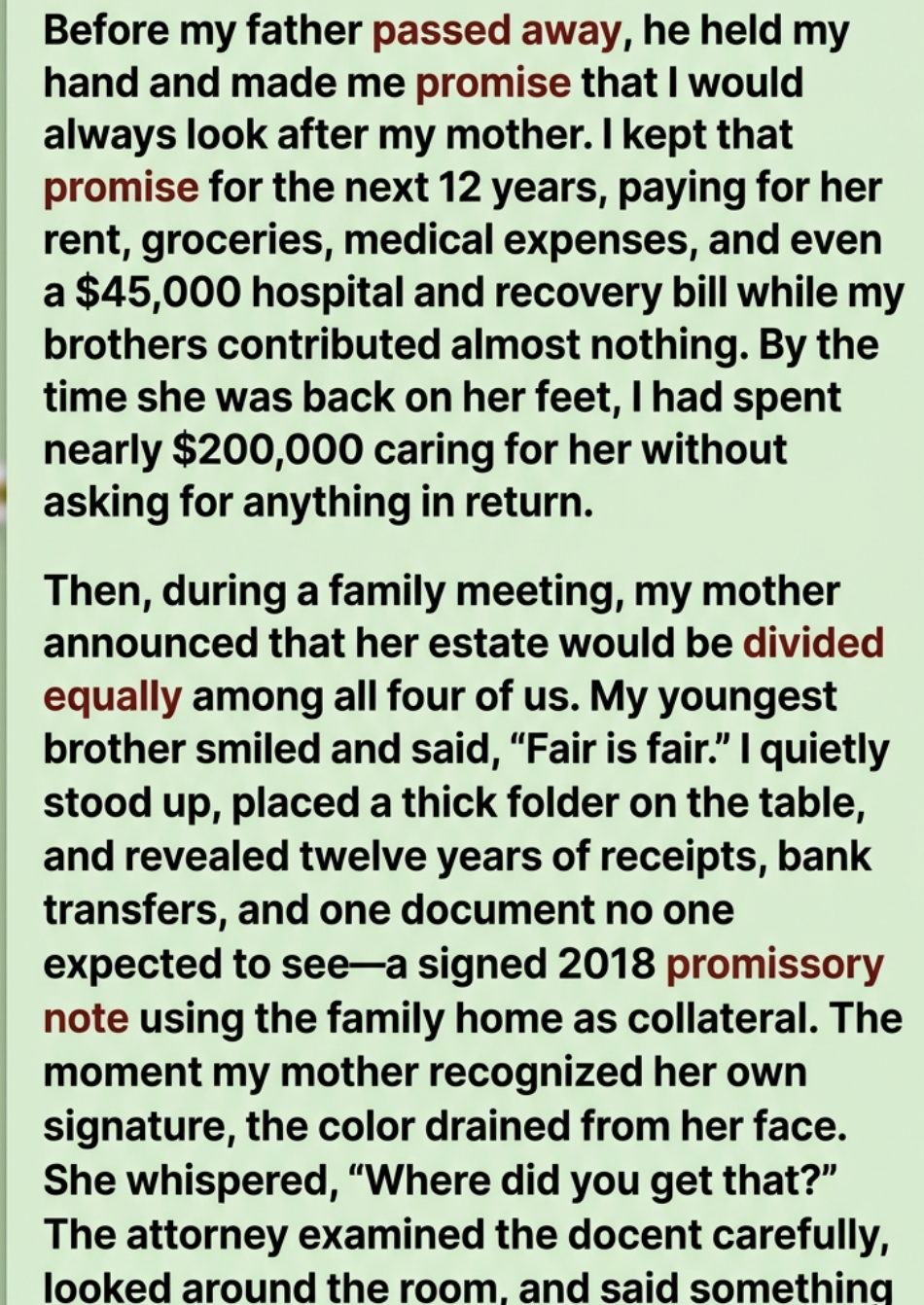
“I want everything divided equally between my children.”
My youngest brother immediately nodded.
“Fair is fair.”
I looked at my mother for a long moment.
Then I stood, opened my briefcase, and placed a thick folder on the conference table.
Inside were twelve years of receipts, canceled checks, wire transfers, medical invoices, pharmacy bills, and bank statements documenting every dollar I had spent for Mom’s care.
The room fell silent.
Then I removed one final document.
A signed 2018 promissory note.
Years earlier, after I had paid for another major medical expense, Mom insisted she didn’t want me carrying the burden alone.
At her own request, we met with her attorney.
She signed a promissory note acknowledging the money as a loan to be repaid from her estate if she couldn’t repay it during her lifetime.
The note also listed the family home as collateral.
Mom looked at the signature.
Her face turned white.
“Where did you get that?”
“You gave me the original after we signed it,” I answered softly.
The attorney carefully examined the document.
He compared the signatures with the originals in Mom’s estate file.
Then he nodded.
“This note is valid.”
My brothers immediately protested.
“That can’t be legal.”
“Mom forgot about it.”
“She never meant that.”
The attorney calmly replied,
“Intent doesn’t override a properly executed legal agreement. Before an estate can be divided among heirs, all valid debts must first be paid.”
The room became completely quiet.
Mom suddenly began crying.
“I never wanted you to think I was taking advantage of you.”
I reached across the table and held her hand.
“I never thought that.”
She admitted that after recovering from the stroke, she had completely forgotten about signing the note.
She had always intended to repay me someday.
She simply believed there would always be more time.
After reviewing every receipt, the attorney confirmed that the documented expenses totaled $197,846.
He suggested the estate repay that amount first, with no interest because I voluntarily waived it.
Only then would the remaining assets be divided equally among the four children.
My brothers were unhappy, but there was little they could argue.
The debt was real.
The paperwork was complete.
The witnesses were still alive.
Everything had been done properly.
A week later, my youngest brother came to my house.
“I’ve been angry,” he admitted.
“But after seeing those receipts… I realized I never knew how much you were doing.”
For the first time in years, we had an honest conversation.
A few months later, Mom called another family meeting.
She thanked all four of us for coming.
Then she surprised everyone.
She announced that, regardless of the promissory note, she wanted to update her will.
She left the repayment clause exactly as it was, but after the debt was satisfied, she instructed that the rest of her estate still be divided equally among all four of us.
“I don’t want my children fighting over money,” she said.
“I want them to remember that one of you carried a burden the others never noticed.”
Mom passed away peacefully two years later.
The estate followed her wishes exactly.
The promissory note was honored.
The remaining inheritance was shared equally.
When everything was finished, I placed the folder of receipts back into my desk.
Not because I ever expected to use it again.
But because it reminded me that keeping my father’s final promise was never about money.
It was about making sure my mother was never alone—even when everyone else assumed someone else would take care of her.