It happened on an ordinary Saturday afternoon.
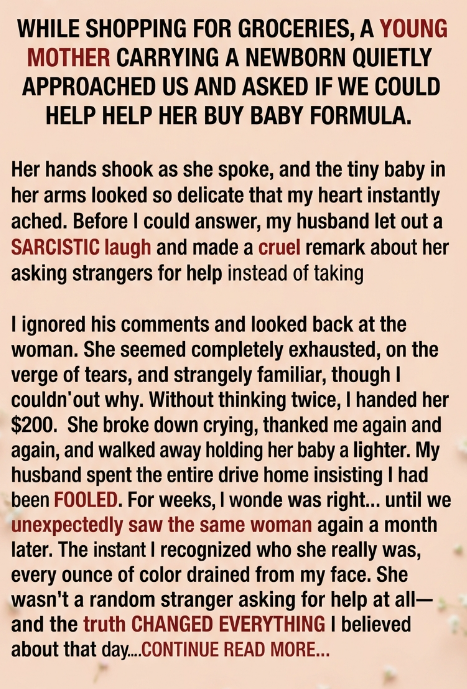
My husband and I were checking out at the grocery store when a young woman holding a newborn quietly approached us.
She couldn’t have been older than twenty-three.
Her clothes were clean but worn, and her hands trembled as she spoke.
“I’m so sorry to bother you,” she whispered. “My baby is out of formula. Could you help me?”
Before I could answer, my husband rolled his eyes.
“Maybe people should plan better before expecting strangers to pay for their children.”
The young woman’s face turned red.
She apologized again and began turning away.
Something stopped me.
I looked at the tiny baby sleeping against her shoulder.
Then I looked back at her face.
She seemed strangely familiar, though I couldn’t place where I’d seen her before.
I reached into my wallet and handed her $200.
She immediately burst into tears.
“You have no idea what this means,” she said.
She thanked me over and over before hurrying toward the baby aisle.
The entire drive home, my husband complained.
“You got scammed.”
“She probably does that every weekend.”
“You’ll never see that money again.”
For a while, I wondered if he was right.
A month later, I stopped by the local hospital to visit a coworker recovering from surgery.
As I walked through the pediatric wing, someone called my name.
I turned around.
It was the same young woman.
She wasn’t wearing worn-out clothes anymore.
She was dressed in blue medical scrubs.
Before I could say anything, she smiled.
“I’ve been hoping I’d see you again.”
I stared at her in confusion.
She introduced herself.
“My name is Sarah. I’m a pediatric nurse.”
She explained that after giving birth prematurely, she had developed a serious infection that forced her to take unpaid medical leave.
Her savings disappeared paying rent and medical bills.
That afternoon at the grocery store had been the first—and only—time she had ever asked a stranger for help.
“I almost turned around before speaking to you,” she admitted.
“Your husband’s words nearly convinced me I didn’t deserve help.”
Then she smiled.
“But your kindness reminded me that good people still exist.”
She told me the money had bought formula, diapers, groceries, and enough gas to make it through until she received her first paycheck after returning to work.
Then she handed me a small envelope.
Inside was exactly $200.
“I promised myself that if I ever found you again, I’d pay it back.”
I pushed the envelope back toward her.
“No.”
She looked surprised.
I smiled.
“Use it for another family who needs it.”
A few months later, I received a handwritten card in the mail.
Inside was a photograph of her healthy baby boy.
She had also included a note.
“Last week, a frightened young mother came into our hospital with no diapers and no money. I quietly paid for everything she needed.”
“You were right. Kindness grows when it’s shared.”
When I showed the card to my husband, he sat quietly for a long time.
Finally, he said,
“I judged someone I knew nothing about.”
The following weekend, he surprised me.
As we left the grocery store, he noticed an elderly man struggling to pay for his medication.
Without saying a word, my husband stepped forward and covered the bill.
On the drive home, he smiled.
“I guess someone taught me something.”
Years have passed since that day.
I still keep Sarah’s card tucked inside my favorite cookbook.
Whenever I begin wondering whether one small act of kindness can really matter, I read her note again.
Because sometimes, the greatest gift isn’t the money you give.
It’s reminding someone they haven’t been forgotten.