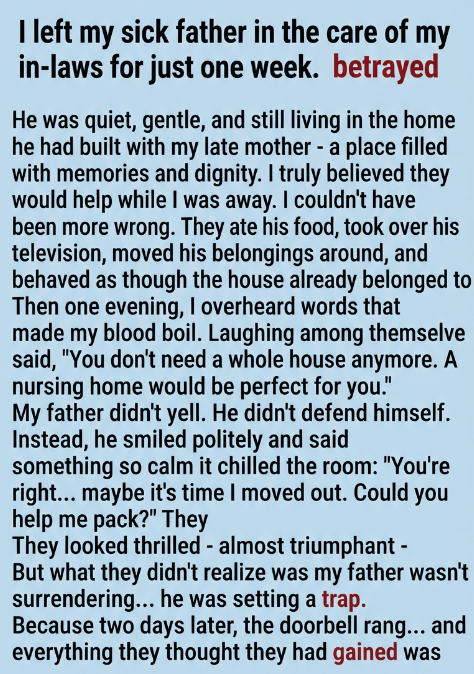
When my father became ill after a minor stroke, he insisted on staying in the house he had built with my late mother forty years earlier.
It wasn’t just a house.
It was the last place where he still felt close to her.
When I had to travel for a week-long business conference, my husband suggested that his parents stay with my father.
“They’ll keep him company,” he said.
“They’ll make sure he eats and takes his medication.”
I believed him.
I stocked the refrigerator, organized his medications, and left detailed instructions before I flew out.
For the first couple of days, everything seemed fine.
Then my father stopped answering my evening video calls.
Instead, my mother-in-law always answered.
“He’s resting,” she would say.
“Don’t worry.”
Something felt wrong.
I cut my trip short and drove home a day early.
As I pulled into the driveway, I immediately noticed unfamiliar cars parked outside.
When I walked in, the living room looked completely different.
My father’s favorite recliner had been pushed into a corner.
Family photos of my parents were stacked on the floor.
The television was blasting a game my father never watched.
The refrigerator was almost empty.
Dad sat quietly at the kitchen table eating plain toast.
That evening, I stayed upstairs organizing my luggage.
As I came down the hallway, I heard laughter from the dining room.
My in-laws were talking.
My father sat silently beside them.
My father-in-law laughed.
“You don’t need a whole house anymore.”
My mother-in-law nodded.
“A nice nursing home would be perfect.”
Another relative chimed in.
“This place would be much easier for the family to manage if you weren’t here.”
I froze.
Then my father smiled.
He didn’t argue.
He didn’t raise his voice.
Instead, he calmly said,
“You’re right.”
“Maybe it is time I moved out.”
“If you don’t mind… could you help me pack tomorrow?”
They looked at each other with barely concealed excitement.
They thought they had won.
That night, I confronted my father.
“Dad, why would you say that?”
He smiled.
“Because sometimes people reveal exactly who they are when they think they’ve gotten what they want.”
The next morning, he packed only one small suitcase.
He asked me to drive him to a nearby hotel.
I was confused, but I trusted him.
Two days later, the doorbell rang at the house.
A real estate attorney walked in, followed by a court-appointed trustee.
My in-laws looked stunned.
The attorney introduced himself.
Then he explained why he was there.
Years earlier, after my mother’s death, my father had transferred the home into a living trust.
I was the successor trustee.
The trust clearly stated that no one other than my father could occupy the property without his written permission.
Since my father had temporarily moved out, every unauthorized guest had to leave immediately.
My father had already revoked the permission he had given my in-laws to stay there.
The attorney handed them written notices.
They had until sunset to remove their belongings.
My mother-in-law protested.
“We were taking care of him!”
The attorney calmly replied,
“Several neighbors provided statements that Mr. Harris was regularly left alone while you entertained guests and used the property as your own.”
He also produced security camera footage from the front porch—cameras my father had installed years earlier after a package theft.
The recordings showed my in-laws bringing friends into the house, moving furniture, joking about “when the place would finally be theirs,” and discussing nursing homes while my father sat quietly nearby.
Their smiles disappeared.
By that evening, they were gone.
A week later, my father moved back home.
He restored every family photograph to its place.
His recliner returned to the window where he liked to read.
As for my husband, he was devastated by his parents’ behavior.
He apologized to my father over and over.
My father accepted the apology but quietly said,
“Trust is easy to lose and slow to earn back.”
Over time, my husband proved through his actions that he meant his words.
He helped care for my father every weekend and never again left the responsibility to anyone else.
One afternoon, while we were sitting on the porch, I asked Dad if he had planned everything the moment he agreed to move.
He smiled.
“No.”
“I simply knew that greedy people usually rush toward what they think they’ve won.”
“All I had to do was step aside long enough for them to show everyone who they really were.”
My father passed away peacefully three years later in the home he built with my mother.
He never spent a single day in a nursing home.
And the house remained exactly where he always wanted it—
in the hands of someone who loved the memories inside it more than the walls themselves.