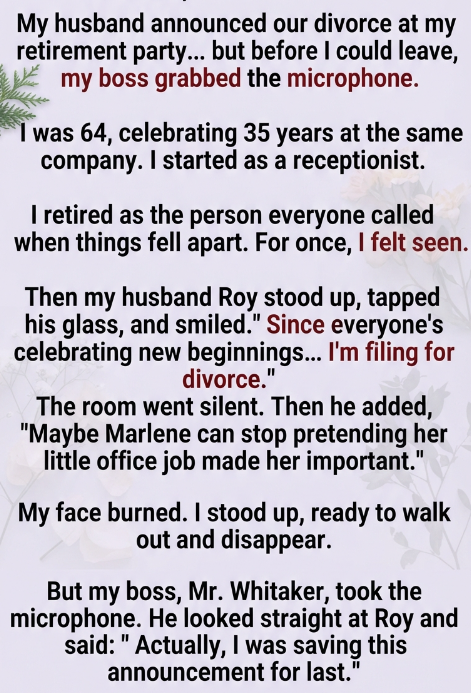
I was sixty-four years old when I retired after thirty-five years with the same company.
I had started as the front desk receptionist at twenty-nine.
Over the years, I learned every department, trained countless employees, and became the person everyone called when something went wrong.
I wasn’t the CEO.
I wasn’t an executive.
But people trusted me.
That meant more than any title ever could.
The company rented the ballroom of a local hotel for my retirement party.
Former coworkers flew in from different states.
There were speeches, photographs, and more hugs than I could count.
For the first time in my life, I truly felt appreciated.
Then my husband, Roy, stood up.
He tapped his glass with a spoon.
“I’d like to say a few words.”
Everyone smiled politely.
Roy looked around the room.
“Since everyone is celebrating new beginnings…”
He paused.
“I’m filing for divorce.”
The ballroom became completely silent.
I thought I had misunderstood him.
Then he laughed softly.
“Maybe now Marlene can stop pretending her little office job made her important.”
My face burned with humiliation.
I couldn’t breathe.
Thirty-five years of celebration had turned into the worst moment of my life.
I quietly picked up my purse.
I just wanted to leave.
Before I reached the ballroom doors, my boss, Mr. Whitaker, stepped onto the stage.
He gently took the microphone from Roy.
“Actually,” he said calmly,
“I was saving one announcement for the end of the evening.”
Roy folded his arms with a smug smile.
Mr. Whitaker looked directly at him.
“This company has succeeded for decades because of people who quietly solved problems without asking for recognition.”
He turned toward me.
“Marlene is one of those people.”
Then he smiled.
“Three years ago, our board created a leadership scholarship for employees pursuing higher education.”
“We never gave it a permanent name.”
“The board voted unanimously last month.”
He uncovered a bronze plaque.
It read:
The Marlene Hayes Leadership Scholarship
The room erupted in applause.
I stood frozen.
Mr. Whitaker wasn’t finished.
“We also asked Marlene if she would consider returning as a part-time mentor for new managers.”
He looked at me.
“I’m happy to announce she accepted.”
More applause filled the room.
Then he turned back toward Roy.
“You referred to her career as a ‘little office job.'”
He smiled politely.
“What you called little helped build this company.”
Roy’s confident expression disappeared.
Several former employees walked over to hug me.
One said,
“You taught me everything I know.”
Another added,
“I wouldn’t have become a manager without you.”
Even clients stood to applaud.
Roy quietly slipped toward the exit.
No one stopped him.
No one followed him.
A week later, he admitted the truth.
He hadn’t planned the announcement because he wanted honesty.
He had planned it because he believed I would leave the marriage feeling embarrassed, financially insecure, and grateful for whatever settlement he offered.
He assumed retirement meant I had nowhere else to go.
He was wrong.
After thirty-five years of careful saving, a solid pension, and the consulting position Mr. Whitaker had offered, I was more financially secure than he realized.
Our divorce was finalized the following year.
I kept the house because I had contributed equally to it over decades.
Roy moved into a small apartment across town.
The scholarship ceremony became an annual tradition.
Every year, I attend and meet another employee beginning a new chapter.
During the first ceremony after my retirement, a young woman asked me,
“Weren’t you embarrassed by what happened at your party?”
I smiled.
“For about five minutes.”
“Then I realized something.”
“The loudest person in the room isn’t always the most respected.”
“Sometimes the person who quietly spends decades helping others earns a standing ovation that lasts far longer than one cruel speech.”
Looking back now, I no longer remember Roy’s announcement as the ending of my marriage.
I remember it as the moment I finally saw my own worth—through the eyes of the people whose lives I’d helped shape all those years.