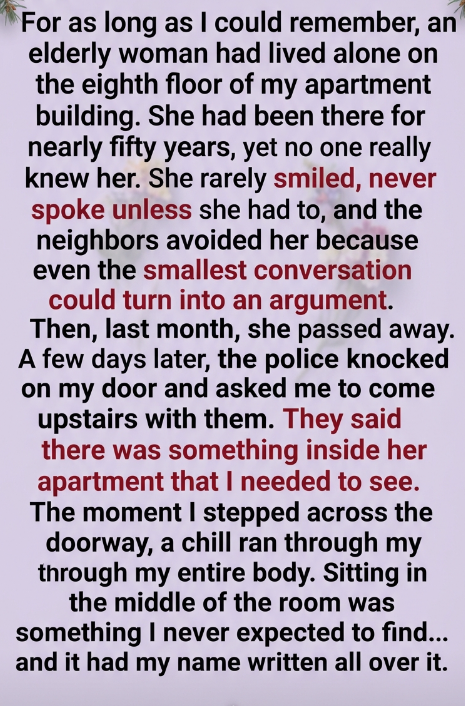
For as long as I could remember, Mrs. Eleanor Blackwood lived alone on the eighth floor of our apartment building.
By the time I was a child, people already spoke about her in whispers.
“Don’t get stuck in the elevator with her.”
“She’ll complain about anything.”
“Just keep walking.”
No one knew much about her.
Only that she had lived there since the late 1970s.
She never attended holiday parties.
Never joined tenant meetings.
Never accepted invitations.
She collected her mail every morning at exactly 8:15.
Bought groceries every Wednesday.
And spent long evenings sitting by the same window overlooking the courtyard.
If anyone greeted her, she usually answered with one short nod.
If children made too much noise, she’d bang her broom against the ceiling.
Most people called her difficult.
Some called her bitter.
Others simply ignored her.
I wasn’t much different.
Whenever we met in the hallway, she’d glance at me for a second longer than seemed normal.
Then she’d quietly continue walking.
I always wondered why.
Then, last month, she died.
The building manager taped a simple notice near the elevators.
No family listed.
No memorial service.
Just a date and condolences.
Life returned to normal almost immediately.
Three days later, someone knocked on my apartment door.
Two police officers stood outside.
One asked,
“Are you Daniel Harper?”
“Yes.”
“We need you to come upstairs.”
“Why?”
The older officer hesitated.
“There’s something in Mrs. Blackwood’s apartment that appears to concern you.”
I had no idea what he meant.
The apartment smelled faintly of lavender and old books.
Everything was perfectly organized.
Furniture from another era.
Neatly folded blankets.
Shelves filled with photo albums.
Then I saw it.
In the center of the living room sat a large cedar chest.
Across the lid, written in careful handwriting, were five words.
For Daniel Harper Only
My knees weakened.
“I’ve never been inside this apartment.”
The officer nodded.
“We know.”
“The executor found your name.”
“They asked us to witness the opening.”
My hands shook as I lifted the lid.
Inside were dozens of neatly labeled boxes.
The first contained photographs.
Hundreds of them.
Me learning to ride my bicycle.
Walking to elementary school.
Graduating from high school.
Helping my own daughter build a snowman.
They weren’t invasive close-ups.
They were ordinary moments taken from across the courtyard or from her apartment window over nearly three decades.
My heart began pounding.
The next box held newspaper clippings.
Awards I’d received.
My wedding announcement.
The obituary for my father.
Birthday cards I had never seen.
Every envelope was addressed to me but never mailed.
Confused, I looked at the officers.
“This doesn’t make any sense.”
The executor, an elderly attorney who had just arrived, quietly handed me a sealed letter.
“The answer is in there.”
I opened it.
The first line stole my breath.
Dear Daniel,
If you are reading this, I’ve finally run out of time to explain something I should have told you years ago.
I kept reading.
She wrote that forty-two years earlier, before my earliest memories, my parents had been involved in a terrible apartment fire.
My mother died saving me.
My father suffered severe injuries and spent months in the hospital.
During that time, neighbors took turns helping care for me.
One of those neighbors was Eleanor.
She had lost her own young son to leukemia just two years earlier.
For six months, she watched me almost every day.
Fed me.
Read me bedtime stories.
Walked me to preschool.
She loved me like her own.
When my father recovered, he thanked every neighbor who had helped.
Then he accepted a new job in another city.
We moved away.
Years later, after college, I unknowingly moved back into the very same apartment building.
Apartment 4B.
The one directly beneath Eleanor.
She recognized my name on the mailbox before I ever recognized hers.
She knew exactly who I was.
I had absolutely no memory of her.
She continued writing.
I wanted to tell you the truth many times.
But every year it became harder.
You had your own family.
Your own life.
I feared appearing like a lonely old woman inventing stories to keep herself company.
Then came the part that made me cry.
So instead, I watched from a distance.
Not because I wished to interfere…
But because seeing you happy reminded me that love sometimes survives even when people grow apart.
I wiped away tears before turning the page.
There was one final request.
Please don’t remember me as the angry woman everyone avoided.
Remember me as the young neighbor who once rocked you to sleep when you cried for your mother.
I couldn’t finish reading aloud.
The room had become completely silent.
The attorney cleared his throat.
“There’s one more thing.”
He handed me a small music box.
Inside was a faded photograph.
A little boy around four years old sat laughing on a swing.
Beside him was a young woman smiling brightly.
The boy wasn’t me.
It was her son.
On the back she had written:
My first little boy.
Beneath it, in different ink added years later:
And the second one life unexpectedly entrusted to me.
I closed the box and cried harder than I had in years.
Over the next few weeks, I learned more about Eleanor than I had during the previous twenty years of living in the same building.
She had quietly paid school lunch balances for children whose families couldn’t afford them.
She anonymously funded library programs.
She donated to local shelters every Christmas.
She had simply never wanted recognition.
The building organized a memorial.
For the first time, neighbors shared stories of quiet acts of kindness they had only recently discovered.
The woman everyone thought was cold had spent decades caring for people in ways no one noticed.
Today, the cedar chest sits in my study.
Not because it contains photographs of me.
But because it reminds me how little we truly know about the people we pass in hallways every day.
Sometimes the quietest lives carry the deepest stories.
And sometimes the person everyone misunderstands has been loving others all along—just in ways no one thought to see until it was too late.