The call came on a Tuesday afternoon while I was folding laundry.
“May I speak with Mrs. Karen Campbell?”
“This is Karen.”
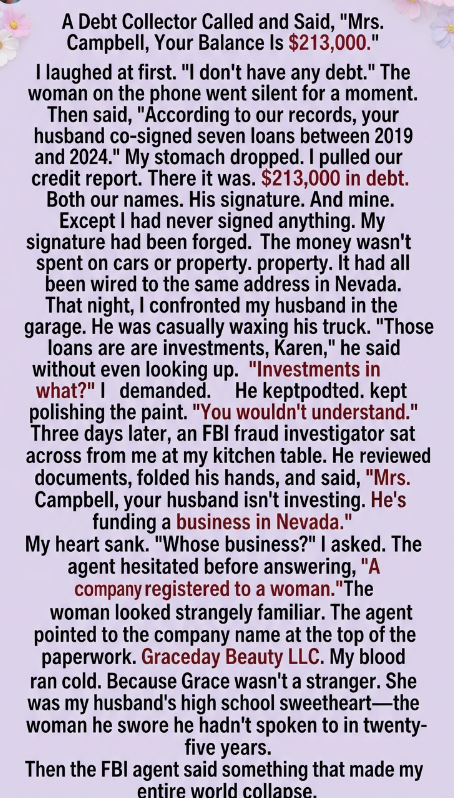
“My name is Denise. I’m calling regarding the outstanding balance of two hundred thirteen thousand, four hundred eighty-six dollars and nineteen cents.”
I actually laughed.
“I’m sorry. You have the wrong person.”
There was a brief pause.
“I’ve confirmed your Social Security number and date of birth.”
“The debt is attached to you and your husband jointly.”
I frowned.
“That isn’t possible.”
“My husband and I don’t owe that kind of money.”
“I recommend checking your credit report immediately.”
When the call ended, I logged into one of the credit monitoring websites we’d used for years.
Within seconds, my heartbeat doubled.
There they were.
Seven separate loans.
Opened between 2019 and 2024.
Total balance:
$213,486.19
Every loan listed two borrowers.
My husband.
And me.
I downloaded the documents.
The first signature belonged to my husband, Steven.
The second carried my name.
But it wasn’t my handwriting.
Someone had practiced it.
It looked convincing at first glance.
Yet I knew immediately.
I had never signed a single page.
When Steven came home that evening, I met him in the garage.
He was waxing his pickup truck as though it were any ordinary Tuesday.
I placed the paperwork on the hood.
“What is this?”
He glanced down for barely a second.
“Oh.”
“Those.”
“Yes. Those.”
“You forged my signature.”
He calmly kept polishing the truck.
“They’re investments.”
“Investments in what?”
“You wouldn’t understand.”
“I’ll try.”
“They’re business opportunities.”
“What business?”
He sighed.
“Karen, not everything requires a committee meeting.”
My stomach tightened.
“You committed fraud.”
He shrugged.
“When everything pays off, you’ll thank me.”
That answer frightened me more than any confession could have.
The next morning I contacted the bank.
Within hours, a fraud report was opened.
Because the loans crossed state lines and involved forged signatures, the case was referred to federal investigators.
Three days later, Special Agent Daniel Ortiz from the FBI sat across from me at my kitchen table.
He reviewed every document carefully before folding his hands.
“Mrs. Campbell…”
“Your husband isn’t investing.”
“He has been funding a business.”
I swallowed hard.
“What business?”
He slid a file across the table.
The company name was printed in bold letters.
Graceday Beauty LLC
My heart skipped.
Grace.
Grace Donovan.
Steven’s high school girlfriend.
The woman he had insisted was ancient history.
“The woman who owns this company…”
I whispered.
“I know her.”
Agent Ortiz nodded.
“We thought you might.”
Then he quietly added,
“There’s something else.”
He turned another page.
Every wire transfer from the loans had gone directly into Graceday Beauty LLC.
More than two hundred thousand dollars.
I stared at the numbers.
“He’s been supporting her business?”
“Yes.”
I felt sick.
Then the agent looked at me with genuine sympathy.
“We’ve also determined your husband owns fifty percent of the company.”
“What?”
“He isn’t just an investor.”
“He’s listed as a managing member under a different mailing address.”
I couldn’t breathe.
“A different address?”
The agent nodded.
“We believe he’s been using a condominium in Henderson, Nevada.”
Everything suddenly made sense.
The conferences.
The “client meetings.”
The weekends he claimed flights had been canceled.
I had trusted every explanation.
There was one more page.
The deed to the condominium.
Two owners.
Grace Donovan.
Steven Campbell.
The purchase date was four years earlier.
The same month he told me he’d been working overtime to help cover rising expenses at home.
Instead, he had been making mortgage payments somewhere else.
I looked at the agent.
“Is Grace involved in the fraud?”
He answered carefully.
“Our investigation suggests she believed Steven had authority to invest his own money.”
“At this point, we have no evidence she knew your signature had been forged.”
I appreciated the honesty.
The facts were painful enough without inventing villains.
That evening I waited for Steven to come home.
When he walked inside, I placed the FBI file on the dining room table.
He stared at it for a long time.
Then quietly sat down.
“So…”
“You know.”
“I know enough.”
He buried his face in his hands.
“It wasn’t supposed to happen like this.”
“What wasn’t?”
“I was going to pay everything back.”
“With what?”
“The business.”
“The business was finally becoming profitable.”
I looked directly at him.
“Were you having an affair with Grace?”
He closed his eyes.
“No.”
That surprised me.
He continued.
“We dated in high school.”
“We stayed friends.”
Years later, Grace had dreamed of opening a skincare company but couldn’t qualify for financing after a previous business failure.
Steven secretly agreed to help.
At first, he invested savings.
When those ran out, he took loans.
When lenders required a co-borrower, he forged my signature.
Each time he convinced himself it would be temporary.
The company would succeed.
He would repay everything before I ever discovered the truth.
Instead, the debt grew.
The lies multiplied.
And eventually there was no way back.
“What about the condo?”
He looked ashamed.
“It was cheaper than hotels.”
“It was for business trips.”
“Nothing more.”
Whether that was completely true no longer mattered.
He had destroyed the foundation of our marriage long before I learned about the condominium.
Over the following months, handwriting experts confirmed every forged signature.
The lenders acknowledged I had never authorized the loans.
The court removed my legal responsibility for the debt.
Steven accepted responsibility and later pleaded guilty to identity theft, bank fraud, and making false statements on financial documents.
Grace cooperated fully with investigators.
Financial records supported her claim that she believed Steven’s investment came from his own assets and legitimate loans.
The company was sold to satisfy creditors.
After the legal process ended, she wrote me a letter.
She didn’t ask for forgiveness.
She simply said she was deeply sorry that her business had become part of the deception, even though she hadn’t known how it was being funded.
I appreciated her honesty.
But I never replied.
Some chapters don’t need another conversation.
A year later, I sold the family home and moved closer to my daughter and grandchildren.
The debt was gone.
The marriage was over.
The peace, however, slowly returned.
People often ask me what hurt the most.
It wasn’t the money.
It wasn’t even the forged signatures.
It was discovering that every lie had been told in the name of “protecting me.”
Real protection doesn’t require deception.
Real love doesn’t ask for blind trust while secretly stealing someone’s identity.
The debt collector thought she was calling about a loan.
Instead, she unknowingly delivered the truth that saved the rest of my life.
Sometimes the most painful phone call you’ll ever receive is also the one that finally sets you free.