When my mother died, I was only nine years old.
For a long time, I believed no one could ever fill the space she left behind.
Then my father married Linda.
She never asked me to call her Mom.
She never tried to replace anyone.
Instead, she quietly earned my trust one ordinary day at a time.
She packed school lunches.
Stayed up through fevers.
Helped me with homework even after working all day.
When my father passed away years later, she told me something I’d never forgotten.
“You may not have my blood, but you’ll always be my son.”
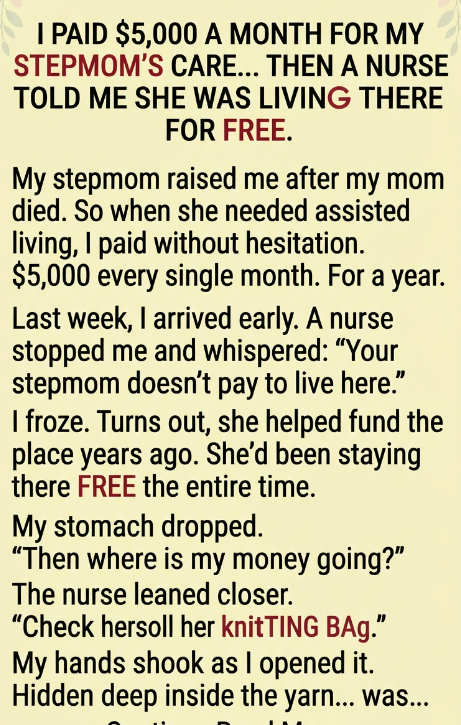
So when Linda turned eighty-four and her arthritis became too severe for her to live alone, moving her into a beautiful assisted living community wasn’t even a difficult decision.
The monthly cost was just over $5,000.
I paid it gladly.
Every month.
Automatic transfer.
Never missed a payment.
Whenever she thanked me, I always answered the same way.
“You spent years taking care of me.”
“Now it’s my turn.”
She would smile and squeeze my hand.
A year passed.
Then one Tuesday morning, I arrived earlier than usual with her favorite blueberry muffins.
The lobby was unusually quiet.
As I signed the visitor book, one of the nurses hurried toward me.
“Mr. Walker?”
“Yes?”
She glanced around to make sure no one else was listening.
“I don’t think anyone has ever explained something to you.”
“What do you mean?”
She lowered her voice.
“Your stepmother doesn’t pay to live here.”
I laughed.
“I’m the one paying.”
The nurse looked confused.
“No…”
“Linda has lifetime residency.”
I felt my stomach tighten.
“What?”
“She helped finance this facility nearly twenty years ago.”
“The board voted to guarantee her care for the rest of her life.”
I stared at her.
“There must be some mistake.”
The nurse slowly shook her head.
“There isn’t.”
My mind raced.
If Linda wasn’t paying…
Then where had the sixty thousand dollars I’d sent over the past year gone?
I whispered the question.
The nurse hesitated.
Then leaned a little closer.
“Check her knitting bag.”
Before I could ask why, she walked away.
Linda was in the sunroom leading one of her weekly knitting circles.
She smiled when she saw me.
“You’re early.”
“I brought muffins.”
“Wonderful!”
While everyone gathered plates and coffee, I quietly picked up her old floral knitting bag.
I’d seen it a hundred times.
It was always beside her chair.
Inside were yarn, needles, scissors…
And beneath a false fabric lining…
A thick leather notebook.
Several envelopes.
Dozens of bank deposit slips.
And meticulous handwritten records.
My hands began shaking.
Every monthly payment I’d made was listed.
Five thousand dollars.
Every single deposit.
Every single month.
Beside each deposit was another entry.
Not to Linda.
Not to the assisted living center.
But to something called the Second Start Fund.
I had never heard of it.
There were notes beside every transfer.
“Mrs. Alvarez — emergency heart surgery.”
“Mr. Jenkins — no family, six months of residency.”
“Single father — wheelchair van.”
“College tuition for former caregiver’s daughter.”
“Veteran hospice room.”
“Emergency medications.”
The notebook contained hundreds of names stretching back years.
I looked up just as Linda returned carrying two cups of coffee.
She immediately knew I’d found it.
“Oh,” she said softly.
“I suppose Margaret finally told you.”
“The nurse?”
Linda nodded.
I could barely speak.
“You’ve been giving my money away.”
She smiled gently.
“I’ve been giving our good fortune away.”
“But…”
“You’ve been living here for free.”
“Yes.”
“Why didn’t you tell me?”
She sat beside me.
“Because you wanted to help me.”
“And you were.”
“I don’t understand.”
She opened the notebook to the first page.
Twenty-one years earlier, after selling the manufacturing company she and my father had built together, they had quietly donated several million dollars to help construct the assisted living community.
One condition of their gift had been simple:
No building, room, or program would ever carry their names.
The only personal benefit they accepted was Linda’s lifetime residency if she ever needed it.
She looked at me.
“When your father died, he worried about one thing.”
“What?”
“That I’d become lonely.”
“So he asked me to promise I’d always find ways to help people.”
She tapped the notebook.
“This became my purpose.”
I felt tears filling my eyes.
“You should have told me.”
“If I had…”
“…you would have stopped sending the money.”
“Of course.”
“And then sixty-three people wouldn’t have received help this year.”
She handed me the notebook.
Each page held a story.
A retired teacher whose savings disappeared after cancer treatments.
A widower who couldn’t afford memory care.
A woman escaping an abusive marriage.
A young nursing assistant studying to become a registered nurse.
Every one of them had received quiet help.
Anonymous help.
Funded partly by the money I’d believed was paying Linda’s rent.
“You used every dollar?”
She nodded.
“And added some of my own.”
I laughed through tears.
“You tricked me.”
“I redirected your kindness.”
A month later, Linda invited me to a small gathering in the community library.
About thirty residents were there.
Some used walkers.
Some wheelchairs.
Others simply smiled when she entered.
One by one, people stood.
A retired firefighter thanked an anonymous donor who had paid for his rehabilitation after a stroke.
A widow thanked the same donor for covering medications she couldn’t afford.
A young physical therapist thanked whoever had paid for her final year of nursing school.
None of them knew that donor was sitting quietly in the front row, knitting another blanket.
Linda never told them.
She never wanted credit.
When she passed away peacefully three years later at the age of eighty-seven, the funeral chapel overflowed.
Former nurses.
Residents.
Families.
Scholarship recipients.
Volunteers.
People whose lives she had quietly changed.
After the service, the director of the assisted living community handed me one final envelope.
Inside was a letter in Linda’s handwriting.
Dear Son,
If you’re reading this, I’ve finally gone home.
I hope you aren’t angry that I never told you the truth.
Every month you sent money believing you were taking care of me.
The beautiful secret is…
You were.
Because nothing made me happier than watching your generosity become hope for someone else.
Never measure wealth by what sits in your bank account.
Measure it by how many people sleep a little easier because you existed.
Love always,
Linda
Today, the Second Start Fund is still going.
I continue making the same $5,000 monthly payment.
The only difference is that now I know exactly where every dollar goes.
It doesn’t buy a room.
It buys time.
Medicine.
Dignity.
Second chances.
And every time I make that transfer, I smile.
Because the woman who raised me gave me one final lesson:
The greatest inheritance isn’t money you keep.
It’s kindness that keeps multiplying long after you’re gone.