When my father died, I was fifty-one years old.
His final weeks were spent in hospice, where every conversation carried a little more weight than the last.
One evening, after everyone else had gone home, he motioned for me to come closer.
His voice was barely above a whisper.
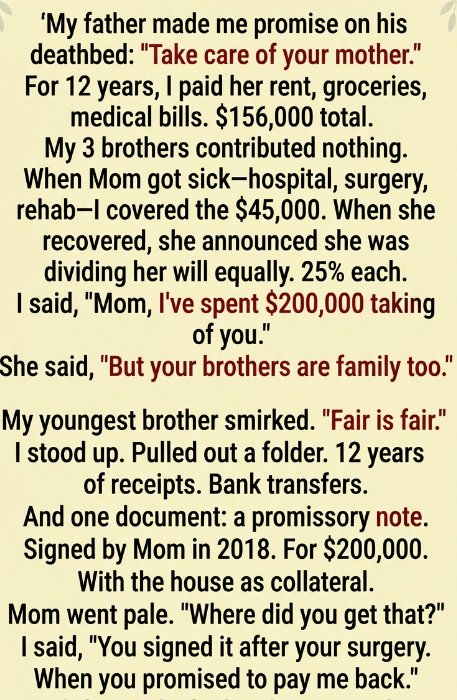
“Promise me something.”
“I will.”
“Take care of your mother.”
I squeezed his hand.
“I promise.”
He smiled.
Those were the last words he ever spoke to me.
I intended to keep that promise.
I just never imagined what it would cost.
My mother was sixty-eight when Dad passed away.
Her Social Security covered only part of her expenses.
The small pension Dad had relied on ended with his death.
Without hesitation, I stepped in.
Every month I paid her rent.
Every month I bought groceries.
When her car needed repairs, I paid.
When she needed new glasses, I paid.
Prescription medications.
Dental work.
Heating bills.
Insurance.
Property taxes after she downsized.
If Mom needed it, I covered it.
Not because anyone forced me.
Because I had given my father my word.
Over the next twelve years, my records showed exactly what I’d spent.
Rent: $91,200
Groceries: $31,600
Medical expenses: $18,900
Utilities and insurance: $14,300
Total:
$156,000
My three brothers?
Not one regular contribution.
There was always an excuse.
“I’m between jobs.”
“The kids are expensive.”
“We’ll help next year.”
Next year never came.
Then, when Mom was eighty, everything changed.
She fell in the kitchen and broke her hip.
The surgery was complicated.
Hospital bills piled up.
Rehabilitation lasted months.
Insurance covered part of it.
I paid the rest.
Nearly $45,000.
I didn’t hesitate.
She was my mother.
When she finally returned home, I felt relieved.
Then she invited the whole family over one Sunday afternoon.
“I’ve updated my will,” she announced proudly.
“I want everything divided equally.”
My oldest brother smiled immediately.
“So twenty-five percent each?”
Mom nodded.
“Exactly.”
Everyone looked pleased.
Except me.
I waited until the room grew quiet.
“Mom…”
“I’ve spent more than two hundred thousand dollars taking care of you.”
She looked uncomfortable.
“I know.”
“I appreciate everything.”
“But your brothers are family too.”
Before I could answer, my youngest brother leaned back in his chair with a smug grin.
“Fair is fair.”
The words hung in the air.
I slowly stood.
“I agree.”
I walked to my briefcase and removed a thick blue folder.
Twelve years of receipts.
Canceled checks.
Bank transfers.
Medical invoices.
Every payment was documented and organized by year.
I placed the stack on the dining room table.
Nobody spoke.
Then I removed one final envelope.
Inside was a single document.
A signed promissory note.
Dated 2018.
Amount:
$200,000
Collateral:
Mom’s house.
Mom’s signature appeared at the bottom.
The room became completely silent.
Her face turned white.
“Where did you get that?”
I looked at her gently.
“You signed it after your hip surgery.”
“You insisted.”
“I told you I didn’t expect repayment.”
“You said your pride wouldn’t let you keep accepting my help forever.”
She covered her mouth.
“I… I forgot.”
The family attorney, Mr. Walters, adjusted his glasses and carefully examined the document.
He compared the signature to several others in Mom’s estate file.
Then he looked up.
“The signature appears genuine.”
He turned another page.
“The document was notarized.”
I hadn’t even remembered that part until he pointed it out.
The notary stamp was still perfectly clear.
Mr. Walters continued reading.
“The note specifies repayment upon either sale of the property or settlement of the estate.”
My oldest brother interrupted.
“That can’t be right.”
The attorney remained calm.
“It is legally enforceable if valid.”
He spent several minutes reviewing everything.
Finally he leaned back.
“Here’s what this means.”
“The estate first satisfies legitimate debts.”
“Only after those debts are paid are the remaining assets divided among the heirs.”
My youngest brother frowned.
“So what does that mean?”
Mr. Walters made a few calculations.
Mom’s house was worth approximately $620,000.
After expenses and other assets, the estate totaled about $710,000.
The $200,000 debt would be repaid first.
The remaining $510,000 would then be divided equally.
Instead of each child receiving roughly $177,500, everyone would receive about $127,500.
Except me.
I would receive my inheritance plus repayment of the loan.
Suddenly, the room wasn’t so quiet.
My brothers immediately protested.
“That’s not fair.”
“You took advantage of Mom.”
“You manipulated her.”
Before I could answer, Mom slowly stood.
“No.”
Everyone turned toward her.
She looked directly at my brothers.
“He never asked me for a penny.”
“I begged him to let me repay him.”
“I signed that note because I wanted to.”
Then tears filled her eyes.
“And the truth is…”
“…he should never have had to spend that much in the first place.”
She looked at each of my brothers in turn.
“For twelve years, you watched your brother carry me alone.”
“You accepted every birthday dinner.”
“Every holiday meal.”
“You thanked him for helping me.”
“But you never once asked what it was costing him.”
No one spoke.
She continued quietly.
“You called equal treatment fairness.”
“It wasn’t.”
“Fairness would have been sharing the responsibility all along.”
The silence that followed felt heavier than any argument.
A week later, my oldest brother came to my house.
He carried a small envelope.
Inside was a cashier’s check for $25,000.
“I can’t undo twelve years,” he said.
“But I can stop pretending I did my part.”
Over the next few months, my other two brothers each contributed what they could.
Not because the court required it.
Because, for the first time, they admitted they’d let one person carry a burden that belonged to all of us.
Mom lived another five years.
During that time, none of us argued about money again.
The promissory note remained locked in the attorney’s file.
It was never needed.
Before she passed away peacefully, Mom changed her estate plan one final time.
Not to favor me.
Not to punish my brothers.
She simply wrote one sentence that was read aloud after her funeral.
“Equal love does not always require equal dollars.
True fairness remembers who carried the weight when no one else would.”
When the estate was finally settled, I accepted repayment exactly as the note required.
Then I quietly donated a portion of it to the hospice where my father had spent his final days.
People sometimes ask whether I regret making that promise to my father.
Never.
Keeping it cost me money.
But breaking it would have cost me something far more valuable.
My peace of mind.
And in the end, my father was right.
Taking care of family isn’t measured by what you inherit.
It’s measured by what you’re willing to give long before anyone is counting.