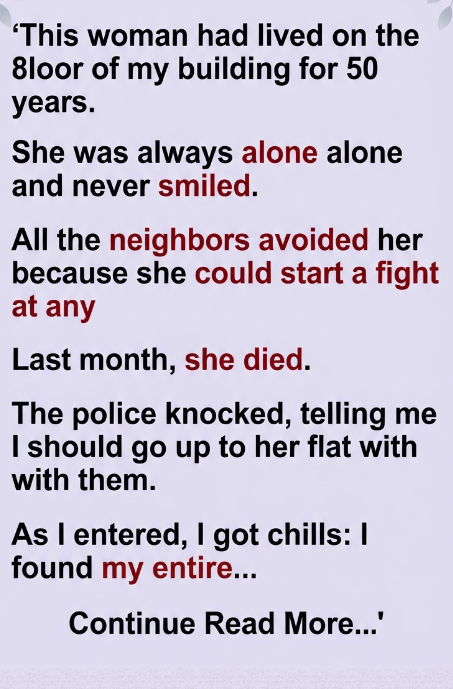
For as long as I could remember, Apartment 8B belonged to one person.
Mrs. Eleanor Brooks.
No one knew exactly how old she was.
Some neighbors claimed she had moved into the building in the early 1970s.
Others insisted she’d been there even longer.
She lived alone.
Never attended building parties.
Never accepted Christmas cookies.
Never joined conversations in the lobby.
If children played too loudly in the hallway, she’d crack open her door and glare until everyone scattered.
If someone left a bicycle near the elevator, she’d complain to management before sunset.
People called her difficult.
Some called her mean.
Most simply avoided her.
I did too.
Whenever we happened to share the elevator, she’d nod politely but never speak.
It became one of those unwritten rules in the building:
Don’t bother Mrs. Brooks.
Last month, an ambulance parked outside just after sunrise.
By lunchtime, everyone knew she’d passed away quietly in her sleep.
There was no family waiting outside.
No visitors.
No flowers.
Just two police officers and the building manager.
I thought that would be the end of it.
Three days later, there was a knock on my apartment door.
Two detectives stood outside.
“Mr. Carter?”
“Yes.”
“We need you to come upstairs with us.”
My stomach tightened.
“Why?”
One detective glanced at his notebook.
“Mrs. Brooks left written instructions asking that, if no immediate relatives could be located, you should be contacted before her apartment was cleared.”
“I’ve barely spoken to her.”
“We know.”
“She mentioned that.”
Confused, I followed them to the eighth floor.
Apartment 8B felt frozen in time.
Old wallpaper.
Wooden furniture polished until it gleamed.
A clock ticking loudly in the silence.
Nothing seemed unusual…
Until I stepped into the second bedroom.
I stopped breathing.
The walls were covered with photographs.
Not of strangers.
Of me.
Hundreds of them.
My first day of kindergarten.
Riding my bicycle.
Graduating from middle school.
Playing basketball in the parking lot.
Carrying groceries with my mother.
Leaving for college.
Even my wedding day.
Some photographs had clearly been taken from windows overlooking the courtyard.
Others looked as though someone had stood quietly across the street.
For one terrifying second, I wondered if I’d stumbled into something sinister.
Then I noticed something else.
Every photograph was dated.
Many had handwritten notes beneath them.
“First day without training wheels.”
“He still laughs exactly like his mother.”
“Today he carried groceries upstairs for the elderly man in 4C.”
“His father would have been proud.”
My father.
The detective quietly handed me a sealed envelope.
“It was addressed to you.”
My hands trembled as I opened it.
Inside was a letter.
Dear Daniel,
By the time you read this, I’m gone.
I know this room may frighten you at first.
Please let me explain before you judge me.
I kept reading.
You were four years old when your mother moved into Apartment 3A.
Your father had died only six months earlier.
She worked two jobs.
Most evenings you came home from school to an empty apartment for an hour or two until she finished work.
She worried constantly that something might happen while she was away.
I frowned.
My mother had never told me any of this.
The letter continued.
One evening she knocked on my door.
She was crying.
She asked if, while she worked, I would simply keep an eye on you from my window.
She couldn’t afford childcare.
She didn’t want you to know she needed help.
I agreed.
I looked around the room again.
Suddenly everything looked different.
The camera by the window.
The binoculars on the shelf.
The notebooks stacked neatly beside them.
Not obsession.
Observation.
Protection.
The detective pointed toward a filing cabinet.
Inside were dozens of journals.
Every entry was dated.
Every page described ordinary moments from my childhood.
“Daniel forgot his lunch today. I called the school office anonymously.”
“He scraped his knee riding his bike. Stayed outside until his mother came home.”
“Teenagers from another neighborhood were bothering the younger children. I called building security.”
“His mother looked exhausted tonight. Left homemade soup outside her door. Didn’t sign the note.”
I felt tears beginning to form.
There was more.
Much more.
One journal entry stopped me cold.
October 17, 1998
Daniel wandered toward the busy intersection chasing a soccer ball.
I reached him before the truck did.
His mother never knew how close it was.
I had no memory of that day.
But tucked into the journal was a faded newspaper clipping.
It described a child nearly struck by a delivery truck.
No names.
Just the date.
The detective quietly said, “We confirmed it happened.”
I sank into a chair.
The woman everyone believed hated children…
Had been quietly protecting one for decades.
There was one final envelope.
This one was from my mother.
She had passed away six years earlier.
The detective explained it had been found in Mrs. Brooks’s safe.
Written on the outside were the words:
Give this to Daniel after Eleanor is gone.
I unfolded it carefully.
My Sweet Boy,
If you’re reading this, Eleanor has finally let you know the truth.
You probably spent your whole life thinking she disliked you.
That was intentional.
She told me children should never feel like strangers are watching over them.
She believed you’d grow up more confident if you thought you were brave instead of protected.
She kept her promise for over thirty years.
I wiped away tears.
The letter continued.
Eleanor lost her own son when he was eight years old.
A careless driver took him while she was at work.
She blamed herself every day afterward.
Watching over you helped heal a part of her heart.
Please don’t remember her as the angry woman from Apartment 8B.
Remember her as the guardian angel who never wanted credit.
I couldn’t see the page anymore through my tears.
The following weekend, I organized Mrs. Brooks’s funeral.
At first, only a handful of people planned to attend.
Then word spread through the building.
Neighbors began sharing stories.
She had secretly paid a struggling family’s heating bill one winter.
She’d left groceries outside a widower’s door after his wife died.
She anonymously bought school supplies for children every September.
The woman everyone called bitter had spent decades quietly caring for people who never knew where the help came from.
After the service, the building manager handed me one final item.
An old brass key.
“What does it open?”
He smiled.
“The rooftop garden.”
Apparently, decades earlier, Eleanor had paid to create it—but insisted no one know she was the donor.
I climbed to the roof that evening.
The sunset painted the city gold.
For the first time, I understood why her apartment window always faced the courtyard.
It wasn’t because she wanted to watch people’s mistakes.
It was because she wanted to make sure everyone came home safely.
Today, whenever new tenants ask me about the elderly woman who used to live on the eighth floor, I don’t tell them she was lonely.
I don’t tell them she was difficult.
I tell them the truth.
Sometimes the people who seem the coldest are carrying the deepest grief.
And sometimes the person everyone avoids is the one who has been quietly protecting them all along—asking for nothing except the chance to make sure someone else gets the life they were denied.