The night my marriage ended looked painfully ordinary.
It was a Thursday.
I’d made chicken parmesan.
The dishwasher was humming.
The evening news played quietly in the background.
My husband, Andrew, pushed his plate away and looked at me with an expression I’d never seen before.
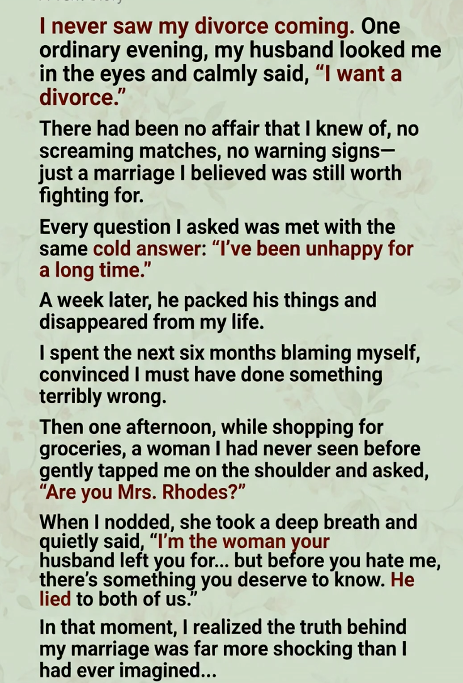
“I want a divorce.”
I laughed.
Not because it was funny.
Because my brain refused to believe I’d heard him correctly.
“What?”
“I’ve already spoken to an attorney.”
The room suddenly felt smaller.
“There has to be a reason.”
“There is.”
“What is it?”
He looked at the table.
“I’ve been unhappy for a long time.”
I searched his face.
“No affair?”
“No.”
“Someone else?”
“No.”
“So why now?”
He simply repeated the same sentence.
“I’ve been unhappy for a long time.”
That was all I ever got.
After twenty-seven years of marriage…
That was the explanation.
A week later, he packed two suitcases.
Left his wedding ring on the kitchen counter.
And walked out the front door.
I never saw him cry.
I did enough crying for both of us.
For months I replayed every year of our marriage.
Had I worked too much?
Ignored him?
Stopped listening?
Forgotten anniversaries?
I examined every memory like evidence at a trial where I was both defendant and jury.
Friends tried to comfort me.
“You’ll never know the whole story.”
I thought they were wrong.
I believed the story was simple.
He fell out of love.
That was painful enough.
Six months later, on a rainy Saturday afternoon, I stopped at the grocery store after work.
As I reached for a carton of milk, someone gently touched my shoulder.
“Excuse me…”
I turned.
A woman about fifteen years younger than me stood there.
She looked nervous.
“Are you Mrs. Rhodes?”
I nodded cautiously.
“Yes.”
She swallowed.
“My name is Claire.”
“I’m…”
“…the woman Andrew left you for.”
For a moment, neither of us spoke.
I expected anger.
Instead…
She looked terrified.
Before I could say anything, she quietly whispered,
“Before you hate me…”
“…there’s something you deserve to know.”
“He lied to both of us.”
I stared at her.
“What do you mean?”
Tears immediately filled her eyes.
“When we met…”
“…he told me he was already divorced.”
My heart skipped.
“He said the marriage had ended almost a year earlier.”
I frowned.
“That’s impossible.”
“We were still living together.”
She nodded.
“I know that now.”
She pulled a folder from her purse.
“I found these.”
Inside were printed emails.
Apartment leases.
Text messages.
Financial statements.
One email caught my attention.
It was dated eight months before Andrew had asked me for a divorce.
He had written to a real estate agent.
Looking for a condo. Need to keep purchase confidential until my divorce is finalized.
My stomach turned.
He had been planning his exit long before telling me.
Claire pointed to another document.
“This one is worse.”
It was a life insurance policy.
Andrew had quietly changed the beneficiary.
Not to Claire.
Not to another relative.
To a company.
I looked up.
“What company?”
She handed me another page.
It showed state business records.
Andrew had created a consulting business eighteen months earlier.
The company owned the condo.
The company held investment accounts.
The company received transfers from our joint savings.
My hands began shaking.
“I never knew this existed.”
“Neither did I.”
Claire sighed.
“He told me he’d been renting.”
The more we compared notes, the clearer the picture became.
He hadn’t simply lied to one woman.
He had carefully constructed two completely different lives.
To me, he claimed late-night meetings, business travel, and investment losses.
To Claire, he claimed he was rebuilding after a painful divorce, struggling financially, and waiting for legal paperwork to finish.
Neither story was true.
He wasn’t building a future.
He was protecting his assets while quietly preparing an escape.
Claire looked at me.
“I ended things yesterday.”
“What happened?”
“I asked why his divorce papers listed assets I’d never heard about.”
“He got angry.”
“Then he accidentally admitted you’d never known about the company.”
She reached into her purse again.
“I recorded the conversation.”
She pressed play.
Andrew’s voice filled the car where we had gone to talk privately.
“You weren’t supposed to compare paperwork.”
Claire’s voice:
“What paperwork?”
Then Andrew said the sentence that changed everything.
“I kept both of you separated because neither of you would’ve accepted the plan.”
The recording ended.
Neither of us spoke.
The following week, my attorney nearly smiled when he reviewed everything.
“This changes the entire divorce.”
“Why?”
“Because he failed to disclose substantial marital assets.”
The court ordered a forensic accountant to examine every financial record from the previous five years.
The investigation uncovered far more than hidden savings.
There were undeclared investment accounts.
Rental income.
Business profits.
Property purchased through shell companies.
Hundreds of thousands of dollars had never appeared in the divorce filings.
The judge was not impressed.
Andrew was ordered to reopen the financial settlement, disclose every asset, and pay substantial legal fees in addition to the revised division of marital property.
When the case finally ended, I received what the court determined should have been disclosed from the beginning.
Not because of revenge.
Because the law required honesty.
As for Claire, she testified truthfully about what she knew and what she didn’t.
The judge specifically noted there was no evidence she had participated in hiding assets or deceiving me.
She had been misled just as thoroughly as I had.
Months later, she invited me for coffee.
“I still feel guilty,” she admitted.
I shook my head.
“You didn’t break my marriage.”
“The lies did.”
She smiled sadly.
“I spent two years believing I was helping a good man start over.”
“And I spent twenty-seven years believing I knew him.”
We both laughed softly.
Not because anything was funny.
Because sometimes the only people who truly understand a deception are the ones who survived it from different sides.
Two years later, I was asked to speak at a financial literacy seminar for women rebuilding after divorce.
Someone in the audience asked,
“When did you finally stop blaming yourself?”
I thought for a moment before answering.
“The day I realized that honest people spend months searching for mistakes they made.”
“Dishonest people spend those same months making sure no one discovers theirs.”
Looking back, I no longer remember the grocery store as the place where I met the woman my husband left me for.
I remember it as the place where two strangers discovered they had been reading different chapters of the same lie.
And together, they finally found the ending that truth had been waiting to write.