For twenty-eight years, I never had a reason to doubt my husband.
David wasn’t perfect.
Neither was I.
We argued about bills.
Forgot anniversaries now and then.
Disagreed over whose turn it was to clean the garage.
But through it all, I believed one thing without question.
He was faithful.
Every Thursday evening, he’d smile, grab a deck of cards he’d never actually used, kiss me on the forehead, and say the same words.
“Poker night.”
He left around six.
Returned a little after eleven.
The routine never changed.
Neither did my trust.
Until one Saturday morning.
I was cleaning out his pickup truck before we traded it in.
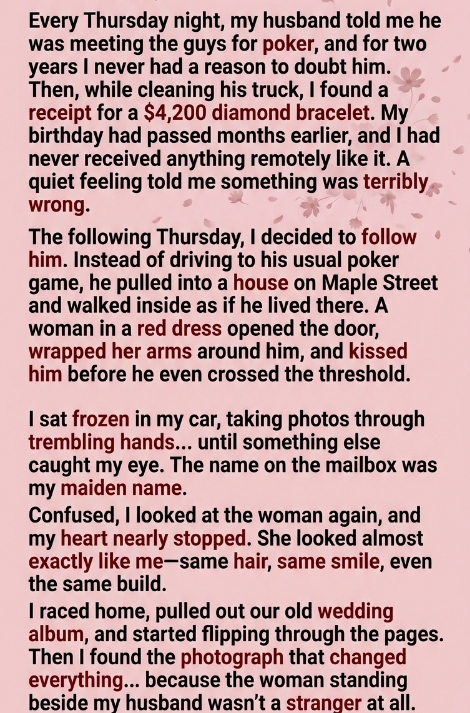
Under the passenger seat, I found a folded receipt.
A jewelry store.
One item.
Diamond tennis bracelet.
$4,200.
I stared at the date.
Three months earlier.
Just after my birthday.
My birthday gift had been a bouquet of flowers and dinner at our favorite diner.
There had been no bracelet.
No surprise tucked away in a drawer.
No anniversary coming up.
Nothing.
I slipped the receipt into my purse and said nothing.
For five long days, it haunted me.
Every explanation I invented fell apart.
Maybe it was for a client?
He wasn’t in sales.
Maybe it was for a charity auction?
There wasn’t one.
By Thursday evening, curiosity had become dread.
When David left for “poker,” I waited five minutes before following him.
He didn’t drive toward his friend Mike’s house, where poker was supposedly held.
Instead, he crossed town.
Turned onto Maple Street.
Stopped in front of a modest white house.
Before he even reached the porch, the front door opened.
A woman in a red dress stepped outside.
She smiled.
Wrapped her arms around him.
And kissed him.
Not a quick greeting.
A kiss that spoke of familiarity.
My hands shook as I raised my phone and took several photographs.
I was about to drive away when something caught my attention.
The mailbox.
The family name wasn’t hers.
It was mine.
Henderson.
My maiden name.
I frowned.
That couldn’t be right.
Then the woman turned toward the porch light.
For the first time, I saw her face clearly.
Every ounce of air left my lungs.
She looked…
Like me.
Not identical.
But close enough to stop my heart.
Same chestnut hair.
Same green eyes.
Same smile.
Even the tiny dimple on the left cheek.
I drove home in a daze.
My hands wouldn’t stop shaking.
I pulled our wedding album from the closet.
Page after page blurred together until I reached the photographs from the reception.
One picture showed David standing beside me.
Behind us stood my extended family.
Aunts.
Uncles.
Cousins.
Then…
There she was.
Standing three rows back.
About sixteen years old.
Long hair.
The same face.
I whispered,
“No…”
The caption beneath the photo simply read:
Family Reception – June 1996
I flipped through more albums.
Christmas.
Grandma’s eightieth birthday.
A family reunion.
She appeared again.
Always in the background.
Always smiling.
How had I never noticed?
Then I saw her name written on the back of one photograph.
Emily Henderson.
My cousin.
The cousin I hadn’t seen in more than twenty-five years.
We’d grown up together.
Played hide-and-seek every summer.
Then her parents moved across the country when we were teenagers.
Life happened.
College.
Marriage.
Children.
We slowly lost touch.
I hadn’t thought about her in decades.
The next morning, instead of confronting David, I called my older sister.
“Do you remember Emily?”
“Of course.”
“We haven’t spoken in years.”
My sister hesitated.
“I heard she moved back recently.”
“Why?”
“I think David’s been seeing her.”
Silence.
Then my sister quietly said,
“Oh…”
“You don’t know.”
“Know what?”
“Emily has Alzheimer’s.”
I stopped breathing.
“What?”
“Early-onset.”
“She was diagnosed about two years ago.”
Everything inside me shifted.
I drove to Maple Street.
This time, I knocked on the door.
David answered.
He looked as though he’d seen a ghost.
“I can explain.”
“You’d better.”
Before he could speak, Emily appeared behind him.
She looked at me with uncertainty.
Then smiled politely.
“I’m sorry…”
“Have we met?”
My heart shattered.
She didn’t recognize me.
Not her own cousin.
David gently guided her back toward the living room.
“I’ll be right there.”
When we stepped onto the porch, he finally told me the truth.
About two years earlier, he’d received an unexpected phone call from Emily’s neurologist.
She had listed him as an emergency contact.
Apparently, after moving back to our hometown, she’d found his number in an old address book that belonged to my late aunt.
She remembered David.
She couldn’t remember where I lived.
Or even whether I was still alive.
Because the disease had already begun stealing pieces of her memory.
She had no husband.
No children.
No close family nearby.
The state had assigned a social worker, but she was terrified of strangers.
Every Thursday, David visited.
He played old records.
Looked through family photo albums.
Cooked dinner.
Took her grocery shopping.
Helped organize medications.
Sometimes she believed he was still the young man who had married her favorite cousin.
Sometimes she thought he was simply an old friend.
The kiss?
He closed his eyes.
“She always greets everyone that way.”
“She thinks it’s 1998 half the time.”
“The doctors said correcting her every five minutes only frightens her.”
I felt ashamed for assuming the worst.
“But why didn’t you tell me?”
His voice cracked.
“Because she begged me not to.”
“She didn’t want anyone remembering her like this.”
I looked through the window.
Emily sat quietly flipping through an old photo album.
Smiling at faces she probably couldn’t name anymore.
“And the bracelet?”
David reached into a kitchen drawer and returned with a velvet box.
Inside was the diamond bracelet.
Unworn.
“I bought it for you.”
“But after Emily’s diagnosis…”
“…every spare dollar went toward extra care that insurance wouldn’t cover.”
“I couldn’t return it.”
“I couldn’t afford to give it to you either.”
“So I kept it.”
“I planned to surprise you for our thirtieth anniversary after I paid everything off.”
I looked at the bracelet.
Then at him.
Then back at Emily.
That afternoon, the three of us sat together looking through our childhood photographs.
Every few minutes Emily would suddenly remember something.
She laughed about stealing apples from Grandpa’s orchard.
Remembered teaching me to ride a bicycle.
Then, just as suddenly, she’d ask,
“Are we sisters?”
I would smile.
“No.”
“But we grew up like family.”
She smiled back.
“I like that.”
Over the next three years, Thursday nights changed.
They were no longer David’s secret.
They became ours.
We brought old recipes Emily loved.
Played the songs she remembered.
Watched faded home movies.
Sometimes she knew exactly who we were.
Sometimes she thought we were neighbors.
Sometimes she simply smiled because we were there.
When Emily passed away peacefully, the funeral was small.
The pastor said something I’ll never forget.
“Memory fades.”
“But love leaves traces that illness can never erase.”
After the service, David handed me a small box.
Inside was the diamond bracelet.
“I think it’s finally time.”
I fastened it around my wrist.
Not because it was expensive.
But because I finally understood what it represented.
For weeks, I’d believed those Thursday nights were proof my marriage had been built on lies.
Instead, they became proof that the man I’d married had quietly carried someone else’s burden because he couldn’t bear the thought of a frightened woman facing the end of her memories alone.
Sometimes the photograph that changes your life doesn’t expose betrayal.
Sometimes it reminds you that love has more forms than suspicion can ever imagine.
And sometimes the person you almost stop trusting is the one who has been protecting someone too fragile to ask for help.