When my father died at eighty-three, I expected very little.
Not because he wasn’t successful.
He’d spent forty years building a thriving landscaping company, owned two rental properties, and had enough savings to retire comfortably.
I expected very little because our relationship had always been… complicated.
My parents divorced when I was twelve.
Dad remarried two years later.
His new wife had a daughter, Vanessa, who was eight years younger than me.
Over time, “stepdaughter” quietly became “daughter.”
By the time Dad wrote his final will, Vanessa was simply listed as his daughter.
So was I.
At least on paper.
When the attorney gathered us for the reading, I sat quietly, already preparing myself for disappointment.
The house went to Vanessa.
The rental properties went to Vanessa.
The landscaping business was sold, with the proceeds going almost entirely to Vanessa.
His truck.
His tools.
His investment accounts.
Even his collection of antique clocks.
Vanessa smiled a little wider with every page.
Then the attorney reached the final paragraph.
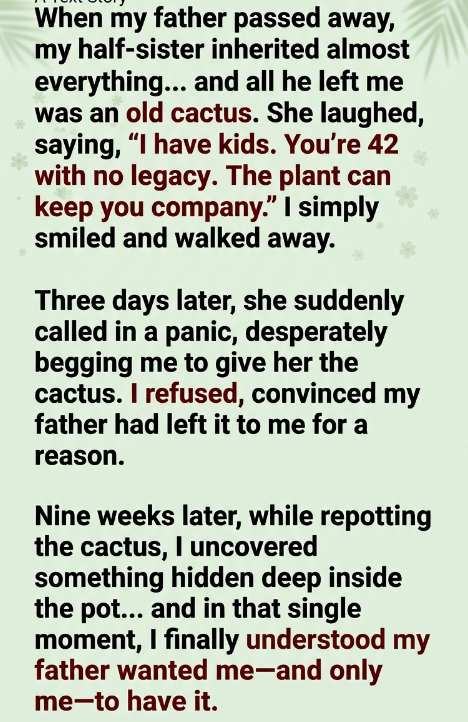
“To my eldest child, Daniel, I leave my favorite cactus, currently located in the sunroom.”
The room fell silent.
Vanessa looked at me.
Then she laughed.
Not politely.
Openly.
“A cactus?”
She shook her head.
“I guess Dad knew who actually needed a future.”
The attorney frowned.
She ignored him.
“I have children.”
She smiled smugly.
“You’re forty-two.”
“No wife.”
“No kids.”
“No legacy.”
“The plant can keep you company.”
I looked at the attorney.
He looked embarrassed.
I simply nodded.
“If that’s what Dad wanted.”
I carried the old cactus home in the passenger seat.
It wasn’t anything special.
About two feet tall.
Covered in tiny spines.
Planted in a faded clay pot.
The soil looked decades old.
I placed it near my living room window.
Three days later, my phone rang.
Vanessa.
She sounded breathless.
“I need the cactus.”
I frowned.
“What?”
“I’ll pay you.”
“No.”
“Ten thousand dollars.”
I laughed.
“Vanessa…”
“It’s a cactus.”
“Exactly.”
“So why do you suddenly want it?”
Silence.
Then she said,
“Please.”
“I can’t explain.”
“I just need it.”
“No.”
She hung up.
An hour later she texted.
$25,000.
I ignored it.
The next day:
$50,000.
Still no.
Then:
Name your price.
That was when I became certain my father had left me more than a houseplant.
I called the attorney.
“Did my father ever mention the cactus?”
He hesitated.
“There was one conversation.”
“What did he say?”
“He told me…”
“‘My son will understand when the time is right.'”
“That’s all.”
For weeks I examined the pot.
Tapped it.
Measured it.
Looked inside the drainage holes.
Nothing.
Friends joked I should cut the cactus open.
I refused.
If Dad had hidden something, destroying the plant felt wrong.
Nine weeks later, while watering it, I noticed roots pushing against the edge of the pot.
It clearly needed repotting.
I carried it outside.
Carefully loosened the soil.
Lifted the cactus free.
The root ball came away in one solid piece.
Something hard struck the table.
A small stainless-steel cylinder.
About the size of a flashlight.
It had been wrapped in waterproof plastic and buried beneath the roots.
My pulse quickened.
Inside the cylinder was a tiny brass key.
A folded handwritten letter.
And a business card.
The key was attached to a tag.
Safe Deposit Box 214.
The letter simply read:
Daniel,
If you’re reading this, you were patient.
That’s why this belongs to you.
I knew Vanessa would search every drawer in my house within hours.
She always looked for shortcuts.
You always believed some things were worth caring for.
A cactus rewards patience.
So does truth.
The rest is waiting where the key belongs.
Love,
Dad
The following morning, I visited the bank listed on the business card.
The manager confirmed the box had remained untouched for years.
After verifying my identity and the letter, she unlocked Box 214.
Inside wasn’t a fortune in cash.
There were three things.
A leather journal.
A sealed envelope.
And a thick folder of documents.
I opened the envelope first.
Another letter.
Before you judge your sister too harshly, understand this:
She believed I loved her only for what I could give her.
Somewhere along the way, I helped create that belief.
That’s my failure.
I turned to the journal.
It wasn’t a diary.
It was a record.
For more than fifteen years, Dad had written about the landscaping business.
Not profits.
People.
Employees whose mortgages he’d quietly paid after illnesses.
Scholarships he’d funded.
Families he’d helped after storms destroyed their homes.
Each page ended with one sentence:
“Kindness only matters if nobody expects repayment.”
Then I opened the folder.
It contained the papers for something I had never heard of.
The Rhodes Family Community Garden Trust.
Years earlier, Dad had quietly purchased twelve vacant lots on the edge of town through the trust.
The properties weren’t especially valuable then.
But over time, the surrounding neighborhood had transformed.
The trust now owned land worth well over two million dollars.
The trust’s purpose was clearly stated.
The land could never be sold for private development.
Instead, it was to remain community gardens, educational greenhouses, and public green space.
The final page named the lifetime trustee.
Daniel Rhodes.
Not owner.
Trustee.
My father hadn’t left me wealth to spend.
He had entrusted me with something he believed I would protect.
The bank manager smiled.
“Your father visited every spring.”
“He always brought vegetables grown in those gardens.”
I drove to the property that afternoon.
Children were watering tomatoes.
Retirees tended roses.
A teacher showed elementary students how worms enriched the soil.
None of them knew who I was.
An elderly volunteer approached me.
“You must be Daniel.”
I blinked.
“How did you know?”
“Your father said one day you’d come.”
He handed me a weathered envelope.
“I’ve been keeping this.”
Inside was one final note.
A legacy isn’t measured by what your children inherit.
It’s measured by what strangers continue growing after you’re gone.
Vanessa inherited my possessions.
I left you my purpose.
For the first time since the funeral, I cried.
Not because I’d received more than my sister.
Because I finally understood that my father had seen something in me I had never fully seen in myself.
A week later, Vanessa appeared at my door.
She looked exhausted.
“I’m sorry.”
I invited her inside.
She stared at the cactus.
“I searched Dad’s study after the funeral.”
“I found an old gardening notebook.”
“It mentioned a key beneath a cactus.”
“So that’s why you wanted it.”
She nodded.
“I thought it was money.”
“It wasn’t.”
“No.”
“It wasn’t.”
I told her about the trust.
The gardens.
The journal.
Dad’s letters.
She listened quietly.
Then she began to cry.
“I spent the whole reading thinking he loved you more.”
I shook my head.
“He loved us differently.”
“He knew what each of us needed.”
Months later, Vanessa began volunteering at the gardens every Saturday.
At first she came out of guilt.
Then because she genuinely enjoyed it.
One spring morning, she laughed as a group of children proudly harvested their first carrots.
“I think Dad would have liked this.”
“I know he would.”
The old cactus still sits beside my living room window.
It’s bigger now.
Healthier.
Every year it blooms with tiny white flowers for only a few days.
Visitors often ask why I keep such an ordinary-looking plant.
I always smile.
“Because sometimes the smallest inheritance carries the greatest responsibility.”
People often believe love is proven by what someone leaves behind.
My father taught me something better.
The greatest inheritance isn’t the thing worth the most money.
It’s the thing that reveals who they believed you could become.