The moment my daughter walked through the front door, I knew something had happened.
Lucy had always been easy to read.
When she was happy, she practically bounced through the house.
When she was upset, she tried to hide it.
That afternoon, she quietly took off her shoes, dropped her backpack by the stairs, and headed straight toward her bedroom.
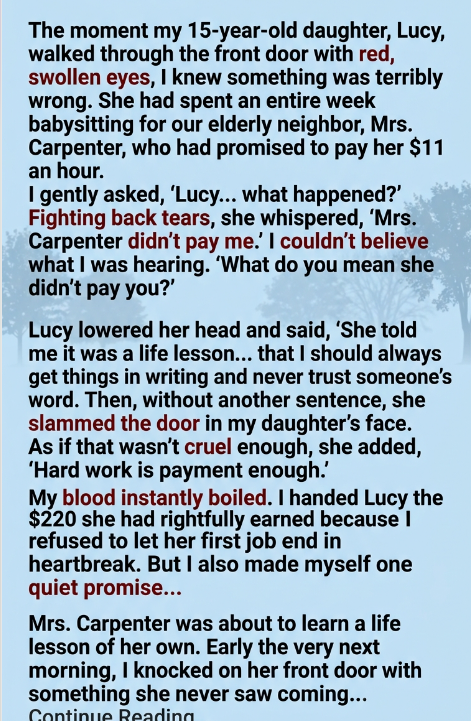
Her eyes were swollen.
Her cheeks were streaked with dried tears.
She wouldn’t even look at me.
“Lucy?”
She stopped walking.
“What happened?”
For several seconds she said nothing.
Then, in a voice barely louder than a whisper, she answered.
“Mrs. Carpenter didn’t pay me.”
—
At first I thought there had been some misunderstanding.
“What do you mean she didn’t pay you?”
Lucy slowly sat down on the bottom stair.
“You know how she asked me to babysit her granddaughter while her daughter was in the hospital?”
I nodded.
Mrs. Carpenter had approached us the previous week.
She said she desperately needed someone reliable to watch her six-year-old granddaughter every afternoon for four hours.
She had offered Lucy $11 an hour.
Five days.
Twenty hours total.
$220.
Lucy had been thrilled.
It would be her first real paycheck.
She had already planned how she’d spend it.
Half into savings.
Some toward a used laptop she’d been dreaming about.
The rest for school clothes.
—
“What happened today?” I asked gently.
Lucy wiped her eyes.
“When I finished, I thanked her.”
“Then I asked if she still wanted to pay me in cash.”
Mrs. Carpenter looked at her and smiled.
Then she laughed.
“I’ve decided to teach you something more valuable than money.”
Lucy frowned.
“What do you mean?”
Mrs. Carpenter crossed her arms.
“You should’ve gotten our agreement in writing.”
“You trusted someone’s word.”
“That’s your first life lesson.”
Lucy thought she was joking.
Then Mrs. Carpenter opened the front door.
“Hard work builds character.”
“Consider that your payment.”
She smiled.
“And next time, don’t be so trusting.”
Then she shut the door.
Right in my daughter’s face.
—
Lucy finally broke down crying.
“I worked so hard.”
“I even cleaned her kitchen.”
“I read stories every day.”
“I made dinner for her granddaughter.”
“I thought she liked me.”
I hugged her tightly.
“You did absolutely nothing wrong.”
Then I reached into my wallet.
I counted out $220.
Placed it in her hand.
“This is your paycheck.”
She shook her head.
“No, Mom.”
“Yes.”
“You earned it.”
She cried even harder.
Not because of the money.
Because someone she trusted had taken advantage of her kindness.
—
That evening, after Lucy went upstairs, I sat quietly in the living room thinking.
The money wasn’t really the issue anymore.
It was the lesson.
Mrs. Carpenter wanted a fifteen-year-old girl to believe honesty didn’t matter.
That adults couldn’t be trusted.
That hard work deserved manipulation instead of respect.
No.
That lesson wasn’t going to stand.
—
Early the next morning, I walked across the street carrying a manila folder.
Mrs. Carpenter answered wearing her robe.
She smiled smugly.
“If you’re here about the babysitting, I’ve already explained my lesson.”
“I know.”
“I actually came to thank you.”
She looked confused.
“For what?”
“You reminded me how important written agreements are.”
I handed her the folder.
She glanced inside.
Her smile disappeared.
—
Mrs. Carpenter owned three rental properties.
One of them happened to be the small house my husband and I rented.
Her son handled repairs.
But legally…
She was still our landlord.
Inside the folder was a formal notice.
Effective immediately, every future communication regarding rent, maintenance, inspections, and access to the property would be required in writing.
No more verbal agreements.
No favors.
No flexibility.
No exceptions.
Attached was a complete list of repairs we’d casually mentioned over the past two years.
The leaking bathroom faucet.
The broken porch light.
The cracked front steps.
The malfunctioning smoke detector.
The failing water heater.
Every issue.
Dated.
Photographed.
Documented.
At the bottom was one sentence.
“Since verbal promises can no longer be trusted, we will require written confirmation for all future obligations.”
—
She stared at me.
“This is ridiculous.”
I smiled politely.
“Is it?”
“You’ve always trusted me.”
“I did.”
“But yesterday you taught my daughter that trust isn’t enough.”
“I figured I should learn from the expert.”
—
She became defensive.
“You’re overreacting.”
“Maybe.”
“But Lucy didn’t think she was overreacting when you refused to pay her.”
Mrs. Carpenter sighed dramatically.
“It was only $220.”
I nodded.
“Exactly.”
“So let’s make this easy.”
“You pay the $220 you promised.”
“And we’ll continue being the easy tenants we’ve always been.”
She folded her arms.
“I don’t negotiate with threats.”
I smiled.
“This isn’t a threat.”
“It’s your lesson.”
—
Three days later, the city inspector arrived.
Not because I called maliciously.
Because one of the repairs involved a faulty smoke detector and unstable front steps.
Both were legitimate safety concerns.
The inspector documented several code violations.
Mrs. Carpenter received a deadline to complete the repairs.
Ignoring them could result in significant fines.
Suddenly…
That unpaid $220 looked very expensive.
—
That afternoon she knocked on my door.
She held an envelope.
Inside was $220.
Cash.
“I suppose Lucy earned this.”
I looked at the envelope.
Then back at her.
“She did.”
Mrs. Carpenter hesitated.
“I may have… gone too far.”
“You think?”
She looked genuinely embarrassed.
“I thought I was teaching responsibility.”
“You taught betrayal.”
She lowered her eyes.
“I understand that now.”
—
Lucy happened to come downstairs.
Mrs. Carpenter turned toward her.
“I’m sorry.”
“You worked hard.”
“You deserved every dollar.”
“I was wrong.”
Lucy quietly accepted the envelope.
Then surprised both of us.
She smiled gently.
“I forgive you.”
Mrs. Carpenter’s eyes filled with tears.
“I don’t deserve that.”
“No,” Lucy answered honestly.
“But my mom says forgiveness doesn’t mean pretending something didn’t happen.”
“It means not carrying it forever.”
I couldn’t have been prouder.
—
Over the next several months, something unexpected happened.
Mrs. Carpenter changed.
She began paying neighborhood teenagers before they even asked.
She started using written agreements for every job.
She even volunteered at the local high school, teaching financial literacy and basic employment rights.
One afternoon she stopped me outside.
“I still think about Lucy.”
“So do I.”
“She taught me more than I taught her.”
I smiled.
“I think that’s how real life lessons usually work.”
—
Years later, when Lucy accepted her very first full-time job after college, her employer handed her a written employment contract.
She laughed softly before signing it.
When I asked why, she smiled.
“I always get things in writing.”
Then she looked at me.
“But I also learned something even more important.”
“What’s that?”
“Never become the kind of person who uses someone’s trust against them.”
That was the only life lesson that truly mattered.
And unlike Mrs. Carpenter’s lesson…
It didn’t cost her a single dollar to learn.