Nothing could have prepared me for the phone call that shattered my life.
I was stocking shelves during my afternoon shift at CVS when my cellphone buzzed.
The caller ID showed my daughter’s elementary school.
At first I assumed she’d gotten sick.
Maybe she had a fever.
Maybe she’d fallen on the playground.
Instead, her kindergarten teacher spoke so quietly I could barely hear her.
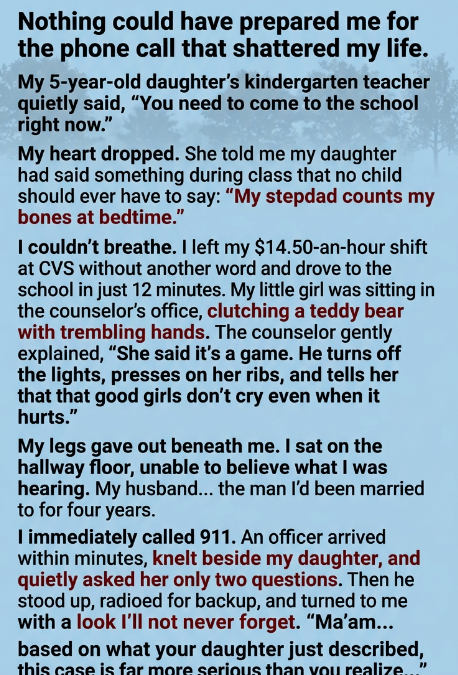
“You need to come to the school right now.”
My stomach tightened.
“Is Lily okay?”
There was a long pause.
“Please just come.”
I didn’t ask another question.
I told my supervisor there was a family emergency, grabbed my keys, and drove faster than I ever had in my life.
The school was twelve minutes away.
It felt like twelve hours.
—
When I arrived, the school counselor met me at the front office.
She gently guided me down the hallway without saying much.
“We’ve already made sure Lily feels safe.”
Those words terrified me even more.
Safe from what?
She opened the counselor’s office door.
My little girl sat curled up in a chair, hugging a worn teddy bear almost as big as she was.
When she saw me, she ran into my arms.
“Mommy.”
I held her so tightly I thought I’d never let go again.
—
The counselor waited until Lily was coloring quietly before speaking.
“Today the children were talking about bedtime routines.”
I nodded.
“One child said his dad reads stories.”
“Another said her mom sings songs.”
She hesitated.
“Then Lily said…”
The counselor swallowed.
“‘My stepdad counts my bones at bedtime.'”
I stared at her.
“I don’t understand.”
“Neither did her teacher.”
“So she gently asked what that meant.”
The counselor’s voice became even softer.
“Lily said he turns off the lights, presses on her ribs, and tells her that good girls don’t cry even when it hurts.”
I couldn’t feel my hands.
My knees gave out beneath me.
I sat on the hallway floor trying to breathe.
—
My husband, David.
The man I’d been married to for four years.
The man who helped Lily ride a bicycle.
The man who packed her lunches.
The man I believed I knew.
Nothing made sense.
—
The counselor placed a hand on my shoulder.
“We’ve already contacted law enforcement, as we’re required to do whenever a child describes something that raises concerns for their safety.”
I nodded silently.
Minutes later, two police officers arrived, followed by a child advocacy specialist.
Everything happened calmly.
No raised voices.
No accusations.
Just careful, patient questions designed to help Lily feel safe.
One officer knelt beside her.
He introduced himself using only his first name.
Then he asked two simple questions.
“Do you feel safe going home today?”
Lily quietly shook her head.
Then he asked,
“Is there anyone you’re afraid of?”
She whispered one name.
“David.”
The officer stood.
He stepped into the hallway and spoke quietly into his radio.
“Request additional units.”
When he returned, his expression had completely changed.
He looked at me with genuine compassion.
“Ma’am…”
“Based on what your daughter has shared, we need to make sure she remains somewhere safe while trained investigators determine exactly what happened.”
—
Everything that followed happened quickly.
A detective specializing in crimes involving children arrived.
So did a social worker.
They explained every step before taking it.
No one pressured Lily.
No one asked her to repeat herself over and over.
Instead, arrangements were made for her to speak later with professionals trained to interview children in a way that minimizes additional stress.
The detective explained why.
“Our priority is protecting your daughter while making sure any information is gathered appropriately.”
I appreciated that more than I could express.
—
David was contacted later that afternoon.
He was instructed not to return to our apartment while the investigation was underway.
An emergency protective order was requested.
Friends helped me gather clothing, medications, and Lily’s favorite blanket while officers ensured we could leave safely.
That night we stayed with my older sister.
Lily finally fell asleep holding my hand.
I didn’t sleep at all.
—
The following weeks were the hardest of my life.
There were interviews.
Court hearings.
Meetings with counselors.
Paperwork that seemed endless.
I blamed myself constantly.
How had I missed something?
Had there been signs?
The counselor gently reminded me of something I needed to hear.
“People who harm children often work very hard to appear trustworthy to everyone else.”
Those words didn’t erase my guilt.
But they helped me understand that manipulation often hides behind normal appearances.
—
Lily began working with a child therapist.
Little by little, she laughed again.
She started sleeping through the night.
She asked fewer frightened questions.
She slowly became a child again instead of carrying worries no five-year-old should have.
—
Months later, after the legal process had run its course, I packed the last of David’s belongings into boxes.
I didn’t keep a single photograph.
Not because I wanted to erase the past.
But because my daughter’s future mattered far more than preserving it.
—
One evening, almost a year later, Lily climbed onto the couch beside me with a picture she’d drawn.
It showed our little apartment.
Our cat.
The two of us holding hands beneath a bright yellow sun.
At the top she’d written, in careful kindergarten handwriting:
**”Home is where I feel safe.”**
I couldn’t stop the tears.
Not tears of fear this time.
Tears of relief.
Because after everything we’d survived, she finally believed those words again.
—
If I learned anything from that terrible phone call, it was this:
Children often tell adults important things in unexpected ways.
A sentence that seems confusing or unusual may be their attempt to describe something they don’t yet have the words to explain.
Listening carefully, staying calm, and taking their words seriously can make all the difference.
Thanks to one observant teacher who didn’t dismiss an unusual comment, one compassionate counselor who acted immediately, and professionals who put a child’s safety first, my daughter got what every child deserves.
To be heard.
To be protected.
And to grow up knowing that when she asked for help—even in the smallest voice—someone listened.