Children notice things adults overlook.
That’s why I never ignore my daughter’s bedtime stories.
Most nights she talked about playground games, spelling tests, or who traded snacks at lunch.
But one Tuesday night, after I tucked her into bed, she grabbed my sleeve.
“Mommy?”
“Yes, sweetheart?”
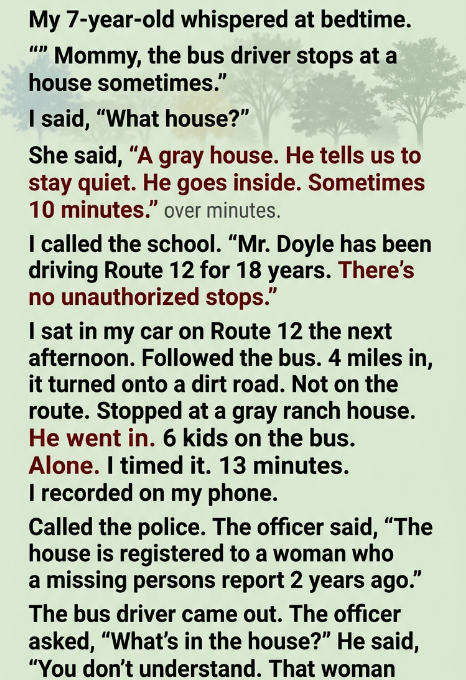
“The bus driver stops at a house sometimes.”
I smiled at first.
“What house?”
She frowned, trying to remember.
“A gray house.”
“Why?”
“He tells us to stay quiet.”
“And then?”
“He goes inside.”
“For how long?”
She counted on her fingers.
“Sometimes… ten minutes.”
I stared at her.
“What do you kids do?”
“We just wait.”
“Is anyone else there?”
“No.”
“Does he lock the bus?”
“I don’t know.”
Then she rolled over as if she’d just told me the most ordinary thing in the world.
I barely slept that night.
—
The next morning I called the school transportation office.
“There must be some mistake,” the dispatcher said.
“Our drivers aren’t allowed to make unauthorized stops.”
I explained what my daughter had told me.
She checked the records.
“Mr. Doyle has driven Route 12 for eighteen years.”
“So?”
“There’s no scheduled stop at any gray house.”
“Could you check with him?”
“I’m sure there’s an explanation.”
Her calm tone didn’t calm me.
—
The following afternoon I left work early.
I parked near the elementary school.
When Route 12 pulled away, I stayed several cars behind.
Everything looked normal.
Children climbed off at the first few stops.
Then, about four miles later…
The bus signaled.
It turned onto a narrow dirt road.
There were no houses listed on the official route.
No bus stop signs.
No waiting parents.
Just trees.
About half a mile in, the bus stopped in front of an aging gray ranch house.
Exactly as my daughter had described.
My heart started racing.
Six children were still on board.
Mr. Doyle stepped off the bus.
Looked around.
Unlocked the front door.
Walked inside.
Leaving six children alone.
I hit record on my phone.
Every second felt longer than the last.
One minute.
Five minutes.
Eight.
Thirteen.
Then he walked back outside carrying what looked like a grocery bag.
He climbed onto the bus and drove away.
I immediately called 911.
—
Two patrol cars intercepted the bus at the next intersection.
The children remained safely on board while officers spoke with the driver.
Another deputy met me at the gray house.
After checking the property records, he looked surprised.
“This house belongs to a woman named Eleanor Brooks.”
“So?”
He hesitated.
“She was reported missing two years ago.”
My stomach dropped.
“Missing?”
“According to the report, her family hadn’t seen her since shortly after her husband died.”
Before anyone could say another word, Mr. Doyle arrived in the second patrol car.
An officer asked calmly,
“What’s inside the house?”
Mr. Doyle looked exhausted.
“You don’t understand.”
“Help us understand.”
He sighed.
“The woman inside…”
“…is my mother.”
Everyone froze.
—
The deputies carefully entered the house.
What they found wasn’t what anyone expected.
Eleanor Brooks was alive.
Ninety-one years old.
Confused.
Frail.
Living alone.
She suffered from advanced dementia.
She no longer recognized most people.
She hadn’t spoken to her extended family in nearly two years.
The original missing-person report had been filed after she wandered away once and relatives lost contact with her.
Later, social services confirmed she had returned home, but outdated records had never been properly updated.
The database still listed her as missing.
—
“So why stop here?” an officer asked.
Mr. Doyle lowered his head.
“My shift starts before home-care nurses arrive.”
“I stop every afternoon to make sure she’s eaten.”
He opened the grocery bag.
Inside were soup, milk, bread, fresh fruit, and medication from the pharmacy.
“I help her take her pills.”
“I check that the stove’s off.”
“I make sure she’s okay.”
The officer frowned.
“Why not report this to your employer?”
Mr. Doyle looked embarrassed.
“They denied my request to adjust my schedule.”
“I couldn’t afford to quit.”
“So…”
“I convinced myself thirteen minutes wouldn’t hurt.”
He looked toward the bus.
“I know it was wrong.”
“I just didn’t know what else to do.”
—
The officers understood his reason.
But they also understood something else.
Leaving children unattended on a school bus—even briefly—created an unacceptable safety risk.
School officials arrived within the hour.
Parents were contacted.
The district immediately arranged substitute transportation.
Mr. Doyle was placed on administrative leave while the situation was reviewed.
—
A week later, the school held a meeting with every family on Route 12.
The superintendent spoke first.
“Our students were never physically harmed.”
“But district policies exist to protect children.”
He announced new GPS monitoring for all buses, random route audits, and emergency backup drivers for employees facing family caregiving crises.
Mr. Doyle also spoke.
He apologized to every parent.
“I should have asked for help instead of making my own rules.”
No one doubted that he loved his mother.
But everyone agreed he had made the wrong decision.
—
The county’s aging services department quickly stepped in.
They arranged full-time in-home care for Eleanor.
A caseworker helped reconnect her with relatives who genuinely wanted to be involved.
She would never again spend entire days alone.
Mr. Doyle eventually accepted a different position with the school district—one that no longer involved transporting children and gave him a schedule flexible enough to care for his mother properly.
—
That night, I tucked my daughter into bed.
She looked up at me.
“Was the lady okay?”
“Yes.”
“Was the bus driver bad?”
I thought carefully before answering.
“He made a dangerous choice.”
“Why?”
“Because sometimes people try to solve a problem all by themselves instead of asking for help.”
She nodded slowly.
“I’m glad you listened to me.”
I kissed her forehead.
“So am I.”
Because one quiet bedtime conversation had protected six children, helped an elderly woman receive the care she needed, and reminded me of something every parent should remember:
When a child tells you something unusual, don’t dismiss it.
Listen.
Ask questions.
And if something doesn’t feel right, trust your instincts.
Sometimes that’s exactly how the truth begins.