When my father married Linda, I was twenty-two years old.
I didn’t call her “Mom.”
She never asked me to.
Instead, she quietly became part of my life.
When Dad passed away eight years later, everyone assumed she’d move closer to her daughter, Mia.
She didn’t.
She stayed.
“I’ve already lost one family,” she once told me.
“I’m not losing another.”
From then on, I became the one who helped her.
—
As the years passed, Linda’s health slowly declined.
I drove her to doctor’s appointments.
Picked up prescriptions.
Mowed her lawn.
Fixed things around the house.
Cooked meals whenever arthritis made it difficult for her.
Her daughter, Mia, lived only forty minutes away.
Yet months sometimes passed without a visit.
Whenever Linda called, Mia always had an excuse.
“I’m busy.”
“I’ll come next weekend.”
“I’m traveling.”
That next weekend rarely came.
—
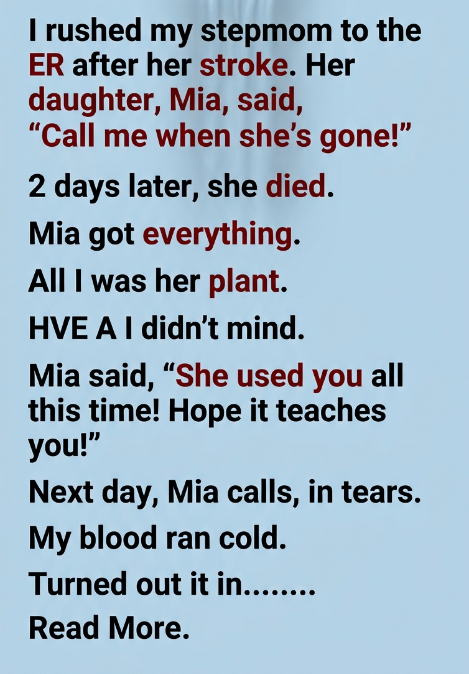
One rainy Tuesday morning, Linda suffered a massive stroke.
The hospital called me because I was listed as her emergency contact.
I rushed to her house.
Found her unconscious beside the kitchen table.
The ambulance arrived within minutes.
At the emergency room, doctors did everything they could.
I called Mia immediately.
She answered after the fourth ring.
“Your mother’s had a stroke.”
There was silence.
Then she sighed.
“Call me when she’s gone.”
The line went dead.
I stared at the phone in disbelief.
—
For two days I barely left the hospital.
I held Linda’s hand.
Read to her.
Talked about Dad.
Even though she couldn’t respond, I hoped she could hear me.
On the second evening, the machines became quieter.
The doctor gently placed a hand on my shoulder.
“I’m sorry.”
Linda passed away peacefully.
—
I called Mia.
She arrived an hour later.
No tears.
No hug.
She immediately asked,
“When do we meet with the lawyer?”
—
A week later, the will was read.
Everything belonged to Mia.
The house.
Savings.
Car.
Jewelry.
Family photographs.
Everything.
I wasn’t mentioned.
Not even once.
Honestly…
I wasn’t surprised.
Linda had every right to leave her estate to her only biological child.
I never expected anything.
—
Outside the lawyer’s office, Mia smiled smugly.
“I bet this hurts.”
I simply looked at her.
She continued.
“She used you.”
“You drove her around.”
“Fixed her house.”
“Took care of her for years.”
“And she left you absolutely nothing.”
She laughed.
“Hope it teaches you not to be so naïve.”
Then she walked away.
I drove home with an empty heart.
Not because I inherited nothing.
Because I’d just buried someone I genuinely loved.
—
The next morning, my phone rang.
Mia.
She was sobbing so hard I could barely understand her.
“You have to help me.”
“What happened?”
“I… I don’t know what to do.”
—
She explained that after moving into Linda’s house, she’d opened a locked cedar chest she’d never seen before.
Inside wasn’t treasure.
It was paperwork.
Thousands of pages.
Medical records.
Bank statements.
Receipts.
Letters.
At the very top sat a handwritten envelope addressed to her.
She opened it.
The first sentence made her break down.
**”If you’re reading this, you’ve finally come home.”**
—
Linda’s letter was honest.
Painfully honest.
She wrote that she’d always loved Mia.
But she had spent years grieving the relationship they no longer had.
Then came the sentence that changed everything.
**”The person who truly became my family was never the one who inherited my house.”**
Mia stopped reading and started crying.
She finally understood.
The inheritance wasn’t a reward.
It was a responsibility.
—
Then came another surprise.
Hidden beneath the letter was a binder.
Inside was a complete maintenance schedule for the old house.
The roof needed replacing.
The foundation had serious cracks.
The septic system was failing.
There were unpaid property taxes.
And a home-equity loan Mia never knew existed.
After the debts were paid…
Very little remained.
—
“I thought the house was worth a fortune,” Mia whispered through tears.
“It isn’t.”
“It needs hundreds of thousands in repairs.”
She paused.
“I don’t even know where to begin.”
—
I drove over that afternoon.
Not because of the house.
Because despite everything…
Linda would’ve wanted someone there.
Together we spent hours sorting documents.
As we worked, Mia quietly admitted something.
“I was jealous.”
“Of what?”
“Mom always talked about you.”
“She said you never forgot birthdays.”
“Never missed appointments.”
“I convinced myself she loved you more.”
I shook my head.
“She loved you differently.”
“You were her daughter.”
“I was simply the one who showed up.”
—
Before we left for the evening, I noticed one final envelope taped beneath the lid of the cedar chest.
This one had my name.
My hands trembled as I opened it.
Inside was a short note.
**”You never helped me because you expected something in return.”**
**”That’s why I trusted you with what mattered most.”**
Tucked behind the letter was a small key.
It opened the safety deposit box Linda and my father had rented decades earlier.
Inside were family photographs.
Dad’s military medals.
My grandmother’s wedding ring.
Old handwritten recipes.
Letters Dad had written before he died.
Items with little financial value…
But priceless sentimental worth.
Linda hadn’t forgotten me.
She had simply given each of us something different.
Mia inherited the property.
I inherited the memories.
—
Months later, Mia sold the house after making the necessary repairs.
She used part of the proceeds to establish a small scholarship in Linda’s name for students studying nursing—the career Linda had loved for over thirty years.
When she invited me to the dedication ceremony, she quietly said,
“I spent years thinking inheritance meant money.”
“What does it mean now?” I asked.
She smiled sadly.
“It means becoming the kind of person someone wants to remember.”
I looked at the photograph of Linda displayed beside the scholarship plaque.
Then I realized something.
The greatest inheritance she ever left either of us wasn’t written in her will.
It was the example she set through kindness, quiet strength, and unconditional love.
That was worth far more than any house could ever be.