My grandmother was the kind of person who never asked anyone for anything.
If she needed groceries, she’d quietly make do with whatever was already in the pantry.
If something broke, she’d fix it herself with tape, glue, or pure determination.
She had spent her entire life helping everyone else.
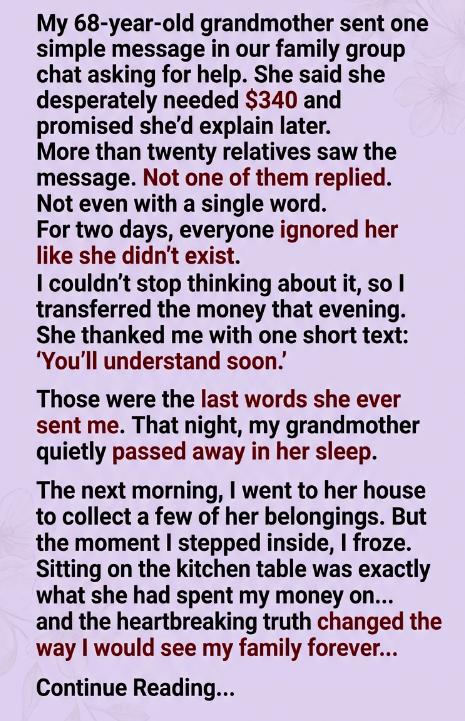
So when she posted a message in our family group chat asking for help, I knew something had to be seriously wrong.
Her message was simple.
*”I hate asking, but I need $340 as soon as possible. I’ll explain later. I’m so sorry.”*
There were twenty-three people in that group.
My uncles.
My aunts.
My cousins.
Even relatives who proudly showed off expensive vacations every few weeks.
Within minutes, people had seen the message.
I watched the little “Seen” notifications climb.
Five.
Ten.
Fifteen.
Twenty-three.
Not a single reply.
No one even wrote,
*”Are you okay?”*
For two days, the chat remained completely silent.
Then someone changed the subject by sharing funny vacation photos.
Grandma’s message disappeared farther and farther up the screen as though it had never existed.
—
I couldn’t stop thinking about it.
That evening, I transferred the $340.
A minute later, my phone buzzed.
*”Thank you.”*
*”You’ll understand soon.”*
I smiled, assuming she’d explain when I visited over the weekend.
She never got the chance.
—
That night, Grandma passed away peacefully in her sleep.
The call came just after sunrise.
I sat on the edge of my bed staring at the wall, unable to believe the last person I’d texted the night before was gone.
—
The following morning, after the funeral arrangements began, I went to her small house to gather a few family photographs and important documents.
The place was exactly as she’d left it.
Her knitting basket rested beside her favorite chair.
The old radio still sat on the kitchen counter.
Her reading glasses lay open beside yesterday’s newspaper.
Then I noticed the kitchen table.
Sitting neatly in the center were several small paper bags.
And beside them…
My receipt.
The amount at the bottom read:
**$340.00**
My hands started shaking.
—
Inside the bags weren’t expensive clothes.
Or electronics.
Or anything for herself.
There were groceries.
Fresh vegetables.
Rice.
Chicken.
Milk.
Medicine.
Baby formula.
Diapers.
Children’s cereal.
Every item had a small handwritten name attached to it.
One bag said,
**”Emily – newborn twins.”**
Another read,
**”Tom – recovering from surgery.”**
Another,
**”Mrs. Jenkins next door.”**
There were eight bags altogether.
Grandma hadn’t bought supplies for herself.
She had spent every dollar helping other people.
—
Tucked beneath the receipt was a notebook.
On the first page she had written:
*”If you’re reading this…”*
*”Then I probably didn’t get the chance to explain.”*
I sat down and kept reading.
—
*”Several families in our neighborhood have been struggling.”*
*”Some are too proud to ask for help.”*
*”Some are simply forgotten.”*
*”I promised them I’d bring groceries before the weekend.”*
*”I thought someone in the family might help me keep that promise.”*
*”I was wrong.”*
Tears blurred the page.
—
Near the end of the notebook was another paragraph.
*”Don’t be angry with them.”*
*”People become busy.”*
*”Sometimes they assume someone else will step in.”*
*”But thank you for reminding me that kindness still lives in this family.”*
*”Please finish delivering the bags for me.”*
—
That afternoon, I drove around town delivering every package exactly where Grandma had intended.
At one small apartment, a young mother burst into tears when I handed her the groceries.
“I didn’t know how I was going to feed the kids this weekend,” she whispered.
At another house, an elderly widower hugged me so tightly I could barely breathe.
He quietly admitted he had been cutting his medication in half because he couldn’t afford a refill.
Grandma had known.
Without anyone else realizing it, she had been quietly taking care of people all around her.
—
A week after the funeral, our family gathered to sort through Grandma’s belongings.
Before anyone started choosing keepsakes, I placed her notebook in the middle of the table.
No speeches.
No accusations.
I simply asked everyone to read it.
The room stayed silent for a very long time.
Some relatives cried.
Others couldn’t even lift their heads.
One uncle quietly admitted,
“I saw her message.”
“I meant to reply later.”
Another cousin whispered,
“I thought someone else would help.”
No one had a good excuse.
Because there wasn’t one.
—
Before we left, I made one suggestion.
Instead of arguing over Grandma’s few possessions, we each contributed $340 to start a neighborhood fund in her memory.
The money would be used exactly the way she had used hers—to quietly help families facing difficult times.
To my surprise, every single person agreed.
It didn’t erase what had happened.
Nothing could.
But perhaps it ensured her kindness wouldn’t end with her.
—
Sometimes I think about Grandma’s last text.
*”You’ll understand soon.”*
At first, I thought she meant the groceries.
Now I know she meant something much bigger.
She wanted me to understand that generosity isn’t measured by how much money we have.
It’s measured by what we do when someone quietly asks for help.
And sometimes, the greatest inheritance a person leaves behind isn’t money or property.
It’s the example of a life spent caring for people who expected nothing in return.