When my son was born, everyone said he looked nothing like me.
He had blond hair.
Blue eyes.
I have dark hair and brown eyes.
At first, I laughed it off.
“Maybe he’ll grow into my features.”
But the comments never stopped.
Even family members joked,
“Are you sure he’s yours?”
Slowly, those jokes became doubts.
The doubts became suspicion.
And suspicion poisoned my marriage.
—
One evening I finally said it.
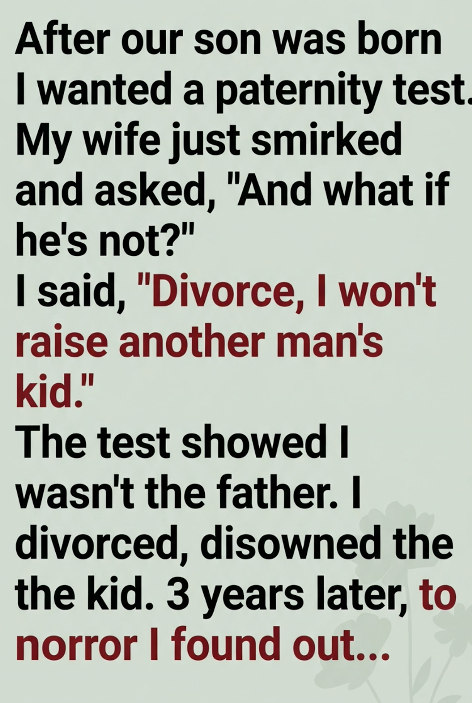
“I want a paternity test.”
My wife looked at me for a long moment.
Then she gave a small, bitter smile.
“And what if he’s not?”
“If the test says I’m not the father,” I replied, “I’ll file for divorce. I won’t raise another man’s child.”
She didn’t argue.
She simply said,
“Fine.”
Looking back, I wish I’d noticed how tired she looked.
Not guilty.
Just… hurt.
—
Two weeks later, the results arrived.
**Probability of paternity: 0%.**
I felt as though the floor had disappeared beneath me.
I packed a bag that same day.
My wife cried.
She begged me to listen.
“I’ve never been with anyone else.”
I held up the report.
“The science doesn’t lie.”
She whispered one sentence before I walked away.
“Sometimes people do.”
I didn’t understand what she meant.
—
The divorce was finalized a few months later.
I gave up my parental rights.
I convinced myself it was the only rational choice.
I tried to move on.
But every birthday that appeared on my calendar hurt more than I expected.
I told myself I had lost a lie.
Yet it still felt like I had lost a son.
—
Three years later, I received an unexpected call from a family court attorney.
“I think you need to come in.”
When I arrived, my ex-wife was there.
So was a representative from the laboratory that had performed the DNA test.
My stomach tightened.
The attorney took a deep breath.
“The original test result was incorrect.”
I stared at him.
“What?”
He slid a thick file across the table.
The lab had conducted an internal audit after discovering a technician had mislabeled several samples during the week my test was processed.
Multiple families had received inaccurate results.
Including mine.
A new DNA test—performed under strict court supervision—showed a **99.999% probability** that I was the child’s biological father.
The room spun.
—
I looked at my ex-wife.
She wasn’t angry.
She was simply exhausted.
“I told you I’d never cheated.”
Tears filled my eyes.
“I know.”
Three years too late.
—
The hardest part wasn’t learning the truth.
It was meeting my son again.
He was six now.
Old enough to ask questions.
Old enough to remember that one day his dad had disappeared.
He peeked around his mother’s leg and asked quietly,
“Are you the man in my baby pictures?”
I couldn’t speak.
I just nodded.
—
Rebuilding trust wasn’t something that happened in a single afternoon.
His mother agreed to let me be part of his life again, but only gradually and only if it was in his best interests.
I respected that.
I had missed birthdays.
First days of school.
Bedtime stories.
I couldn’t erase those years.
All I could do was show up consistently from that day forward.
—
One afternoon, months later, my son handed me a drawing.
It showed three people holding hands.
“You forgot someone,” I joked gently.
He smiled.
“No.”
“I drew us the way I hope we will be.”
I folded the picture carefully and kept it.
—
I still think about the day I demanded that first test.
DNA testing is a valuable tool, but no test is infallible, and mistakes—though rare—can have devastating consequences.
The report I trusted without question turned out to be wrong.
The price wasn’t measured in money.
It was measured in three years of a little boy’s childhood.
Three years that no apology, no court order, and no second test could ever give back.
From then on, I learned that when the stakes are life-changing, the search for the truth should include not only evidence—but also the willingness to verify it before making irreversible decisions.