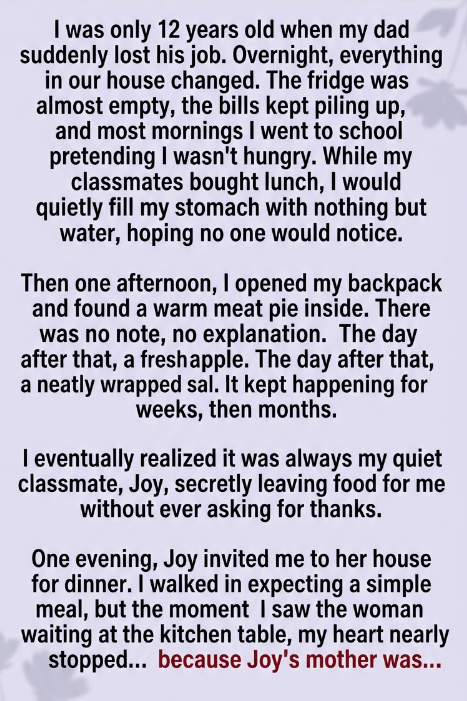
When I was twelve years old, my father lost his job without warning.
One Friday afternoon, he came home carrying a small cardboard box filled with the few personal belongings from his office. I remember watching him stand silently in our driveway before opening the front door. He forced a smile for my mother and me, but I could see the fear in his eyes.
Within weeks, our entire life changed.
The refrigerator that had once been full slowly became empty.
The lights were turned off whenever we left a room to save electricity.
My mother quietly skipped meals, pretending she wasn’t hungry so my father and I could eat a little more.
At school, I never told anyone what was happening.
Every lunchtime, my classmates lined up to buy pizza, burgers, fries, and milkshakes.
I would walk to the water fountain, drink two or three cups of water, then sit outside with a book so nobody would notice I had nothing to eat.
I became very good at pretending.
Whenever someone offered to share food, I would smile and say,
“I’m not hungry.”
It was easier than admitting the truth.
One Monday afternoon, after the last class ended, I opened my backpack to grab my homework.
Inside was a warm meat pie wrapped carefully in paper.
There wasn’t a note.
No name.
No explanation.
I looked around the classroom, but everyone had already left.
I took it home and split it with my parents.
None of us said much while we ate.
We were simply grateful.
The next day, I found a fresh apple.
The day after that, a neatly wrapped turkey sandwich.
Then homemade cookies.
Then fruit.
Then juice.
Every single school day, something appeared inside my backpack.
Whoever was doing it knew exactly when I needed it most.
Weeks turned into months.
I never caught them.
Until one rainy afternoon.
I had forgotten my math book and rushed back into the classroom after everyone had gone outside.
As I stepped through the doorway, I stopped.
Joy.
The quiet girl who sat by the window every day.
She was standing beside my desk, gently placing a sandwich into my backpack.
She turned around, saw me, and froze.
For a long moment, neither of us spoke.
Finally she lowered her eyes and whispered,
“I’m sorry… I didn’t want to embarrass you.”
I felt tears forming before I even realized I was crying.
“You’ve been doing this?”
She nodded shyly.
“My mom makes an extra lunch every morning.”
“I just bring it.”
“Please don’t tell anyone.”
I couldn’t find the right words.
So I simply said,
“Thank you.”
She smiled.
“You would’ve done the same for me.”
At the time, I wasn’t sure that was true.
But I never forgot those words.
From then on, Joy and I slowly became friends.
She never treated me differently.
She never mentioned the lunches again.
She acted as though helping someone was the most ordinary thing in the world.
One Friday after school, she asked,
“Would you like to come to my house for dinner?”
I hesitated.
“I don’t want to be a burden.”
“You won’t be,” she replied.
“My mom already knows you’re coming.”
I agreed.
As we walked to her house, I imagined a fancy home with wealthy parents.
After all, they had been feeding me for months.
Instead, we arrived at a small, modest house not much bigger than ours.
The paint was faded.
The front steps were cracked.
Flowers grew in old paint cans beside the porch.
It looked… familiar.
Like the kind of home where every dollar mattered.
Joy opened the front door.
“Mom, we’re home!”
A woman walked out of the kitchen carrying a pot of soup.
The moment I saw her face, I stopped breathing.
It was Mrs. Carter.
The cafeteria manager from my school.
She smiled warmly.
“So you’re finally here.”
I stared at her.
“You… know who I am?”
She laughed softly.
“I’ve known for a very long time.”
Over dinner, Mrs. Carter told me the whole story.
One afternoon, months earlier, she noticed I walked past the lunch line without buying anything.
At first she thought I simply wasn’t hungry.
Then she realized I did the same thing every day.
Instead of eating, I drank water.
She quietly asked Joy if everything was okay.
Joy told her my father had lost his job.
Mrs. Carter wanted to help immediately.
But she also knew how humiliating charity could feel to a proud twelve-year-old boy.
So together they came up with a plan.
Every morning before school, Mrs. Carter packed one extra lunch.
Joy secretly placed it inside my backpack before the last bell.
No announcements.
No attention.
No embarrassment.
Just quiet kindness.
I looked down at my plate, unable to speak.
Mrs. Carter reached across the table and gently placed her hand over mine.
“Being hungry is hard enough,” she said.
“No child should have to be ashamed of it too.”
That sentence stayed with me for the rest of my life.
A few months later, my father finally found another job.
Things slowly improved.
We never became wealthy, but we were okay again.
Years passed.
Joy and I remained close friends through high school before attending different universities.
Mrs. Carter continued working in the school cafeteria, quietly helping students no one else noticed.
She never told anyone.
She never asked for recognition.
She simply kept serving meals with the same gentle smile.
Twenty years later, I returned to my old elementary school.
Not as a student.
As the owner of a successful construction company.
I met with the principal and donated enough money to create a permanent program providing free breakfasts and lunches to students whose families were struggling financially.
There was only one condition.
The program had to carry a name.
Not mine.
Mrs. Carter’s.
A few weeks later, the school held a small ceremony.
Mrs. Carter had recently retired after more than thirty years of service.
When she saw the plaque that read:
“The Carter Kindness Fund — No Child Learns Well on an Empty Stomach.”
She burst into tears.
She walked over and hugged me tightly.
“You didn’t have to do this,” she whispered.
I smiled.
“You told me to repay your kindness by helping someone else.”
“I finally had the chance.”
Joy stood beside her mother with tears in her own eyes.
She laughed and said,
“I guess I only carried the sandwiches.”
I shook my head.
“No.”
“You carried hope.”
Today, every time I visit that school, I see children eating warm meals without worrying about whether they can afford them.
Most of them have no idea why the program exists.
They don’t know the story of a frightened twelve-year-old boy who filled his stomach with water because he couldn’t afford lunch.
They don’t know about the quiet girl who slipped sandwiches into his backpack every afternoon.
And they don’t know about the cafeteria manager who understood that kindness means protecting someone’s dignity as much as filling their stomach.
But I know.
Because one simple act of compassion changed the course of my entire life.
Sometimes the greatest heroes don’t wear uniforms or stand on stages.
Sometimes they’re just a quiet classmate…
And her mother…
Who decide that no child should ever have to face hunger alone.