I was eighteen years old when I learned that love could be measured differently inside the same family.
My older sister, Claire, had just been accepted into a prestigious university in Paris.
The entire family gathered in the living room to celebrate.
My father stood, smiling proudly, and handed her a white envelope.
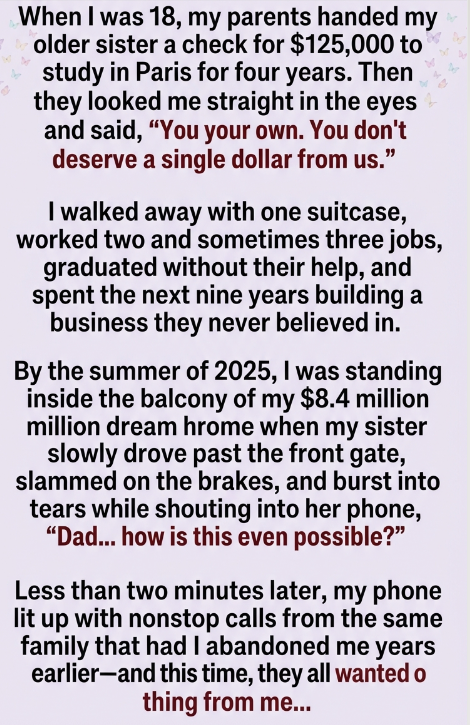
Inside was a cashier’s check for $125,000.
“It should cover your tuition and living expenses,” he said.
“You just focus on becoming successful.”
Everyone applauded.
My mother hugged Claire and cried happy tears.
I was genuinely happy for my sister.
Then my father turned to me.
“So…”
“What are your plans?”
“I’ve been accepted to the state university,” I replied.
“I’ll be studying business.”
He didn’t smile.
Instead, he folded his arms.
“If that’s what you want, you’re paying for it yourself.”
I blinked.
“I thought… maybe you’d help me too.”
He looked me straight in the eye.
“You don’t deserve a single dollar from us.”
The room went silent.
My mother didn’t object.
Claire looked uncomfortable but said nothing.
I stood there, waiting for someone to tell me it was a cruel joke.
No one did.
That night, I packed one suitcase.
The next morning, I left.
No one tried to stop me.
The first year was brutal.
I worked mornings stocking shelves at a grocery store.
Afternoons, I attended classes.
At night, I cleaned office buildings.
On weekends, I delivered food.
Some weeks I worked more than seventy hours.
There were nights when I slept in my car between shifts because driving home would have wasted too much gas.
I learned how to stretch ten dollars into a week’s worth of meals.
I bought used textbooks.
I repaired my own shoes with glue.
I never asked my parents for another cent.
Not because I wasn’t struggling.
Because they’d already made their answer clear.
During my final year of college, I started a tiny online business helping local companies build websites and manage digital marketing.
My father laughed when he heard about it through relatives.
“A real job would’ve been smarter.”
Those words reached me through my aunt.
I smiled and kept working.
The business slowly grew.
One client became five.
Five became twenty.
Twenty became hundreds.
I hired my first employee.
Then ten.
Then fifty.
Over the years, we expanded into software development and business automation.
There were failures.
There were sleepless nights.
There were months I wondered if payroll would clear.
But every obstacle taught me something I couldn’t have learned from comfort.
Nine years after leaving home, my company employed more than one hundred people.
We served clients across the country.
That summer, I bought the home I’d dreamed about since I was sleeping in my car.
It overlooked the ocean.
Large windows.
A wraparound balcony.
A quiet place where I could finally breathe.
It cost $8.4 million.
Not because I wanted to impress anyone.
Because it represented every sacrifice I’d made.
A few weeks after moving in, I stood on the balcony drinking coffee when a familiar SUV slowed in front of the gate.
Claire.
She stared at the house.
Then she slammed on the brakes.
I watched as she stepped out, covering her mouth.
Moments later she pulled out her phone.
Even from where I stood, I could hear her shouting.
“Dad…”
“How is this even possible?”
Less than two minutes later, my phone started ringing.
Dad.
Ignored.
Mom.
Ignored.
Claire.
Ignored.
An uncle.
A cousin.
An aunt I hadn’t spoken to in years.
Voicemail after voicemail arrived.
“We should talk.”
“Family is important.”
“Call us back.”
It was amazing how quickly people remembered I existed.
A week later, I agreed to meet them at a quiet restaurant.
Not because I wanted reconciliation.
Because I wanted closure.
Everyone was already seated when I arrived.
For a few minutes, they made awkward small talk.
Then my father finally smiled.
“We’re proud of what you’ve accomplished.”
It was the first compliment he’d given me in nearly a decade.
Then came the real reason for the meeting.
Claire’s husband had lost his business.
Their finances were collapsing.
The Paris degree had never turned into the career everyone expected.
Dad had recently retired.
His investments had performed poorly.
They were struggling.
My father cleared his throat.
“We were hoping…”
“…that maybe you could help the family.”
There it was.
The one thing they all wanted.
Money.
I took a slow sip of water.
Then I reached into my briefcase and placed two envelopes on the table.
The first contained copies of every student loan statement I’d paid off alone.
The second contained the final mortgage documents for my parents’ old house.
Confused, Dad looked up.
“What is this?”
I smiled calmly.
“Do you remember when you told me I didn’t deserve a single dollar?”
He looked away.
“I remember.”
“I’ve spent years thinking about those words.”
“I finally realized something.”
“I didn’t deserve your money.”
“But I also don’t owe you mine.”
The room fell silent.
Then I slid one more document across the table.
It wasn’t a check.
It was proof that, three months earlier, I had quietly paid off the remaining mortgage on the modest home where my elderly grandmother lived.
She had raised me with kindness whenever my parents were too busy comparing me to Claire.
She never asked for anything.
She never expected repayment.
So I made sure she’d never have to worry about losing her home.
“I’ve always believed in helping family,” I said.
“I just have a different definition of who truly showed up for me.”
Grandmother reached over and squeezed my hand.
Without saying a word, tears rolled down her face.
As we stood to leave, my father stopped me.
“I made mistakes.”
“I know.”
“I’m sorry.”
For the first time in years, I believed he meant it.
But forgiveness and rebuilding trust are not the same thing.
“I forgive you,” I replied.
“But forgiveness doesn’t erase consequences.”
“It simply means I won’t carry the anger anymore.”
Then I walked away.
Over the next few years, I funded scholarships for students who had been rejected or abandoned by their families.
The scholarship had only one requirement.
Applicants had to write about a moment when someone told them they would never succeed.
Every year, reading those essays reminded me of my eighteen-year-old self standing in that living room.
The difference was that those students would hear something I never did.
“We believe in you.”
People often assume success is the best revenge.
They’re wrong.
Revenge keeps you tied to the people who hurt you.
Peace comes from building a life so meaningful that you no longer need their approval.
My parents gave my sister $125,000.
They gave me nothing.
What they didn’t realize was that the greatest gift they accidentally gave me wasn’t money.
It was the determination to prove to myself—not to them—that my future would never be decided by someone else’s opinion of my worth.