My father died in April 2025 after a short battle with cancer.
He was seventy-four years old.
For nearly fifty years, he had built one of the most respected construction companies in our county.
He wasn’t a wealthy man when he started.
He began with one pickup truck, a toolbox, and a willingness to work longer than everyone else.
By the time he passed away, he had built a successful business, owned our childhood home outright, maintained several investment accounts, and left behind an estate valued at roughly $3.6 million.
More important than the money, though, was the reputation he had earned.
Everyone trusted my father.
He believed in keeping his word.
That’s why I didn’t question my older brother, Michael, when he stood up after the funeral luncheon and confidently announced,
“We don’t need to waste time reading the will.”
Everyone looked at him.
Michael folded his arms.
“Dad already told me exactly what he wanted.”
“The business is mine.”
“The house is mine.”
“The investment accounts are mine.”
“He said I was supposed to take care of everything.”
Our aunts nodded.
A few cousins quietly accepted it.
No one wanted another painful family meeting.
I almost accepted it too.
Almost.
That afternoon, I went to Dad’s workshop behind the house.
The smell of sawdust, machine oil, and old cedar still lingered in the air.
It felt like he had just stepped outside for a moment.
I wasn’t looking for money.
I simply wanted one keepsake.
Maybe his favorite hammer.
Maybe the tape measure he’d carried for years.
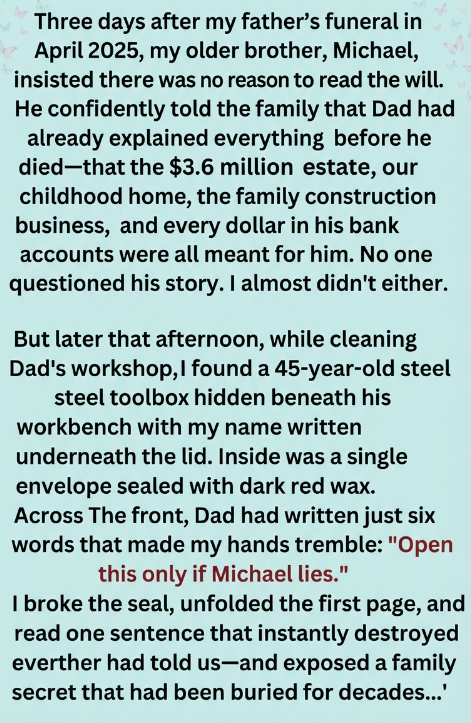
As I swept beneath his old workbench, my broom struck something solid.
Hidden behind stacked lumber was an old steel toolbox.
The faded paint was scratched almost beyond recognition.
It looked at least forty years old.
When I lifted the lid, I noticed something written underneath in my father’s unmistakable handwriting.
For Daniel.
My name.
My heart began to race.
Inside the toolbox was only one thing.
A cream-colored envelope sealed with dark red wax.
Across the front were six words.
Open this only if Michael lies.
For several seconds, I simply stared at it.
Then, with shaking hands, I broke the seal.
The first page contained only one sentence.
“If you’re reading this, Michael has ignored my final wishes.”
I felt sick.
Behind that page was a thick stack of documents.
The very first was a signed copy of my father’s official will.
It had been prepared by his attorney less than a year before he died.
Everything Michael had said was false.
The estate wasn’t left to him.
The business was to be divided equally between us.
The investment accounts were to be split evenly.
The house was to be sold unless we both agreed otherwise.
There was even a handwritten note attached.
“Neither of my sons built this company alone.”
“Neither should own it alone.”
I couldn’t understand why Dad had hidden the documents instead of leaving them with his attorney.
Then I turned the page.
He explained everything.
Several months before his death, Dad discovered that important financial documents had disappeared from the office.
Later, he learned Michael had been quietly pressuring him to rewrite the will.
Dad refused.
Although he still trusted Michael as his son, he no longer trusted him with legal paperwork.
So he made certified copies of every important document.
He left the originals with his attorney.
Then he hid an identical set in the old toolbox.
“If everything happens honestly,” he wrote,
“Daniel will never need to see this.”
“But if Michael lies…”
“…this will protect the truth.”
The final envelope inside the toolbox contained something none of us expected.
A bundle of accounting records dating back almost thirty years.
Along with them was another letter.
“There is one more truth I’ve kept hidden because I hoped my sons would never need to know.”
According to the letter, our grandfather had nearly lost the construction company decades earlier after secretly accumulating enormous gambling debts.
To prevent bankruptcy, my father quietly sold land he had inherited from our grandmother.
He used every dollar to pay off the debts and save the business.
Only three people ever knew.
Dad.
His attorney.
And Michael.
Years earlier, Michael had promised never to use that secret against the family.
Instead, Dad later discovered Michael had begun telling people that the company existed only because of him.
That wasn’t true.
Dad had carried the burden alone for decades to protect his father’s memory.
“I forgave Michael for many mistakes,” the letter read.
“But I could never allow dishonesty to become his inheritance.”
The next morning, I contacted Dad’s attorney.
He sounded unsurprised.
“I’ve been expecting your call.”
He explained that Dad had instructed him not to release the will until both sons were present together.
Michael had canceled the appointment without informing anyone else.
The attorney immediately scheduled a formal reading.
This time, every close relative attended.
The will matched the copy inside the toolbox exactly.
Word for word.
When Michael realized the truth had been preserved, the confidence disappeared from his face.
He admitted he had hoped everyone would simply accept his version of events.
Instead, the facts spoke for themselves.
After the meeting, Michael asked to speak with me privately.
“I messed up.”
I nodded.
“You did.”
“I thought Dad trusted me more.”
“He trusted you.”
“He just didn’t trust the choices you were making.”
Michael lowered his head.
“I don’t expect you to forgive me.”
“I know.”
“But Dad wanted us to protect what he spent his life building.”
“For me, that starts with the truth.”
The months that followed weren’t easy.
The business wasn’t sold.
Instead, we followed our father’s written wishes.
Michael stepped away from managing the company’s finances while an independent accountant reviewed every account.
Nothing criminal was found, but several questionable decisions were corrected.
I oversaw operations.
Michael focused on project management.
For the first time in years, every major decision required both signatures.
It wasn’t always comfortable.
But it rebuilt accountability.
Slowly, trust began to grow again.
Not because we forgot what had happened.
Because we stopped pretending it hadn’t.
Today, my father’s old steel toolbox sits in my office.
The envelope is still inside.
So is the note with those six unforgettable words:
“Open this only if Michael lies.”
People who visit sometimes ask why I keep an old, rusted toolbox instead of something more valuable.
I always give the same answer.
“The toolbox isn’t the treasure.”
“The honesty my father left inside it is.”
In the end, my father didn’t leave me a hidden fortune.
He left me something far more important.
Proof that truth has a remarkable way of surviving—even when someone works very hard to bury it.