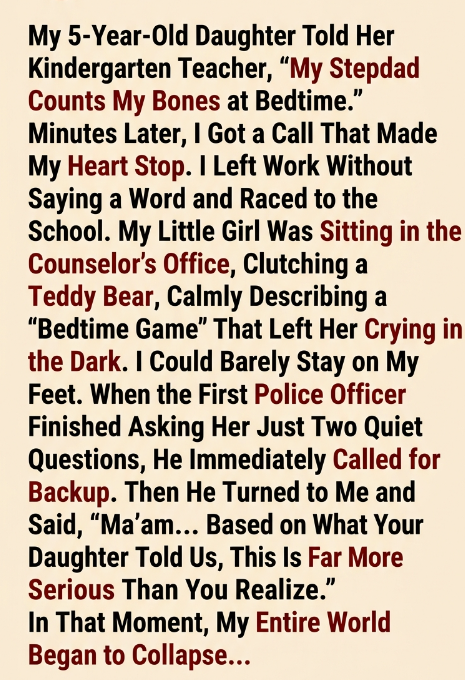
The call came at 10:17 on a Tuesday morning.
I was stocking shelves during my shift at the pharmacy when my phone vibrated.
“Mrs. Carter?” a calm voice asked.
“Yes.”
“This is your daughter Emma’s school counselor.”
My stomach tightened.
“Is she okay?”
“There was something she shared with her teacher today.”
“What happened?”
“I think you should come to the school immediately.”
“Is she hurt?”
There was a pause.
“No.”
“But please come as soon as you can.”
I didn’t clock out.
I didn’t explain.
I grabbed my keys and drove faster than I ever had in my life.
Every terrible possibility raced through my mind.
None of them prepared me for what I walked into.
…
Emma sat in the counselor’s office hugging her favorite teddy bear.
She smiled when she saw me.
“Mommy.”
I wrapped my arms around her.
“What happened, sweetheart?”
She looked confused.
“I told my teacher about the bedtime game.”
The counselor gently placed a hand on my shoulder.
“Emma told her teacher that your husband counts her bones before she goes to sleep.”
I frowned.
“What does that mean?”
Emma answered before anyone else could.
“He turns off the light.”
“Then he touches my ribs and counts them.”
“If I move, he starts over.”
My blood ran cold.
I looked at the counselor.
“There has to be some explanation.”
Emma continued in the same innocent voice only a five-year-old could have.
“He says it’s our secret game.”
“And if I tell anybody, he’ll be sad.”
The room became completely silent.
Within minutes, two police officers and a child protection investigator arrived.
One officer knelt beside Emma.
He didn’t ask leading questions.
He spoke softly.
“Can you tell me who plays that game?”
“My stepdad.”
“Where does it happen?”
“In my room.”
“What happens if you say no?”
Emma hugged her teddy tighter.
“He gets mad.”
The officer’s expression changed immediately.
He stood and quietly stepped into the hallway.
A moment later, I heard him speaking into his radio.
“We need additional units.”
When he returned, he looked directly at me.
“Ma’am…”
“Based on what your daughter has shared, we need to investigate immediately.”
“I know this is overwhelming, but our priority is keeping your daughter safe.”
My knees nearly gave out.
…
That afternoon, detectives obtained a court order to search our home.
Emma and I stayed with my sister.
A specially trained child forensic interviewer met with Emma the next morning in a child advocacy center designed to help children speak safely and without pressure.
I wasn’t allowed in the interview room.
At first, that hurt.
Later, I understood why.
Children often speak more freely without a parent present.
The professionals explained every step to me.
No one rushed.
No one assumed.
They simply followed the evidence.
Later that day, detectives returned.
They couldn’t discuss every detail because the investigation was ongoing.
But one detective told me something that stayed with me forever.
“Your daughter’s teacher did exactly the right thing.”
“She noticed unusual language.”
“She listened.”
“And she reported it.”
Those actions gave investigators the opportunity to protect Emma and determine what had happened.
…
As the investigation continued, additional evidence was gathered, including electronic records and other information that investigators believed supported criminal charges.
My husband was arrested and formally charged.
The case moved through the courts over the following months.
Emma never had to testify in a crowded courtroom.
The judge allowed her earlier recorded forensic interview to be used where permitted, along with testimony from professionals involved in the investigation.
Eventually, he was convicted.
The sentence couldn’t erase what Emma had experienced.
But it ensured he could no longer harm her or another child.
…
Healing was much slower.
Emma had nightmares.
She was afraid to sleep with the lights off.
She worried that people she loved would disappear.
A child therapist helped her understand something important.
“What happened wasn’t your fault.”
Little by little, she smiled more.
The nightmares became less frequent.
She started drawing pictures filled with sunshine instead of storms.
I attended counseling too.
For months, I blamed myself.
How hadn’t I seen the warning signs?
Our therapist reminded me that people who harm children often work hard to hide their behavior from other adults.
The responsibility belonged entirely to the person who chose to abuse a child’s trust.
Not to the child.
Not to the parent who had been deceived.
…
Five years later, Emma stood on an elementary school stage accepting an award for kindness.
After the ceremony, her kindergarten teacher came over.
She looked older.
So did I.
Emma hugged her tightly.
“Thank you for listening to me.”
The teacher wiped away tears.
“You were very brave.”
Emma smiled.
“I didn’t know I was being brave.”
“I was just telling the truth.”
As we walked to the car, I realized something.
The phone call that once felt like the worst moment of my life had also been the beginning of my daughter’s safety.
One observant teacher.
One careful conversation.
One report made out of concern.
It changed everything.
Sometimes, the bravest thing a child can do is speak.
And sometimes, the most important thing an adult can do is believe them enough to make sure they’re safe.