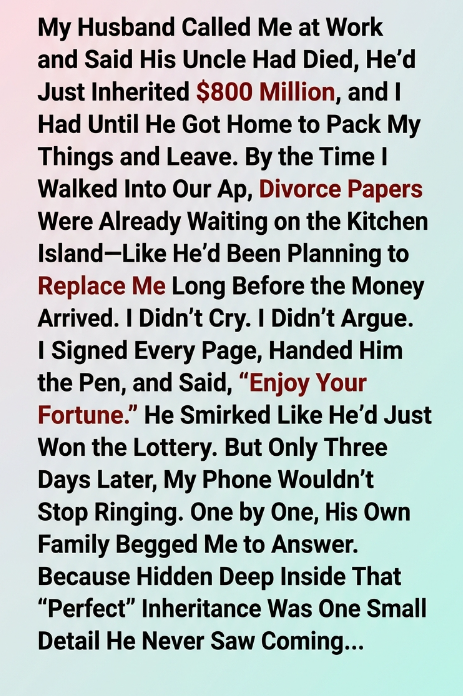
My husband called me at 2:43 on a Wednesday afternoon.
I was halfway through a budget meeting when my phone buzzed.
“Can you step outside?” he asked.
His voice sounded excited.
Almost breathless.
“What happened?”
“My uncle passed away.”
“I’m so sorry.”
There was a brief silence.
Then he laughed.
“But he left me everything.”
“What do you mean?”
“I just inherited nearly $800 million.”
For a second, I thought I had heard him wrong.
“My lawyer confirmed it.”
“I’m officially one of the richest people in the country.”
I smiled despite the sadness of his uncle’s death.
“That’s unbelievable.”
“It is.”
Then his voice changed.
Cold.
“You have until I get home to pack your things.”
I stopped walking.
“What?”
“I’m divorcing you.”
I laughed because it made no sense.
“This isn’t funny.”
“I’m serious.”
“I’ve wasted enough years pretending.”
“I don’t need you anymore.”
The call ended.
I stood in the hallway staring at my phone.
…
When I reached our apartment an hour later, two large suitcases sat beside the front door.
The locks had already been changed.
His attorney waited inside.
Divorce papers rested neatly on the kitchen island.
Like everything had been planned.
My husband, Ethan, leaned against the counter with a smug smile.
“I figured we’d make this quick.”
“You planned this before today.”
He shrugged.
“I’ve been thinking about it.”
“For how long?”
“A while.”
Then I noticed another woman’s coat hanging in the hallway.
Everything suddenly made sense.
“There is someone else.”
He didn’t answer.
He didn’t have to.
I quietly read every page.
Our apartment had been purchased before the marriage and was titled solely in Ethan’s name.
Our finances had always been separate.
The agreement offered me exactly what the law required—and nothing more.
I signed.
Handed him the pen.
Looked him in the eye.
“Enjoy your fortune.”
He smiled.
“I intend to.”
I picked up my suitcases and walked out.
I never looked back.
…
Three days later, my phone wouldn’t stop ringing.
His mother.
His sister.
Two cousins.
An uncle.
Even his childhood best friend.
I ignored every call.
Finally, Ethan’s grandmother left a voicemail.
“Please answer.”
“It’s important.”
“This isn’t about getting you back.”
I reluctantly called her.
She sounded exhausted.
“Ethan made a terrible mistake.”
“I know.”
“No.”
“You don’t understand.”
“The inheritance…”
“It isn’t what he thinks.”
…
I agreed to meet her.
She slid a thick binder across the table.
Inside were trust documents.
Estate plans.
Letters from attorneys.
She pointed to one paragraph.
“Read this.”
I did.
Then I read it again.
The inheritance wasn’t an unconditional gift.
It had been placed into a family trust decades earlier.
Ethan wasn’t receiving $800 million personally.
He had been nominated as the managing trustee.
The money legally belonged to charitable foundations, family businesses, and future generations of beneficiaries.
His role came with strict fiduciary duties.
He couldn’t simply spend it however he wanted.
He couldn’t transfer it to himself.
He couldn’t liquidate assets for personal luxury.
And one clause stood out above all the others.
Any trustee who demonstrated financial dishonesty, abuse of fiduciary responsibility, or conduct that materially harmed the family’s interests could be removed by a vote of the trust’s independent advisory board.
“What does that have to do with me?” I asked.
His grandmother sighed.
“Everything.”
She handed me another document.
Months earlier, Ethan’s uncle had written a confidential letter explaining why he wanted Ethan to become trustee.
One sentence was highlighted.
“The reason I trust Ethan is because his wife has consistently demonstrated integrity, humility, and sound judgment. I believe she will help him make wise decisions when wealth inevitably tests his character.”
I felt my throat tighten.
His uncle barely knew me.
Or so I thought.
His grandmother smiled sadly.
“He watched both of you for years.”
“He wasn’t evaluating Ethan.”
“He was evaluating the marriage.”
…
Meanwhile, Ethan had wasted no time.
He leased a private jet.
Placed deposits on three luxury homes.
Ordered an eighty-foot yacht.
Announced publicly that he was “retiring forever.”
His attorney repeatedly warned him that none of the trust assets belonged to him personally.
Ethan ignored the advice.
He even attempted to instruct managers of one family-owned company to transfer funds for personal purchases.
The requests were refused.
Within seventy-two hours, the advisory board held an emergency meeting.
They reviewed his conduct.
His public statements.
His attempted use of trust assets.
His treatment of advisors.
Then someone asked a simple question.
“Where is his wife?”
His grandmother answered honestly.
“He divorced her the same day he believed he became wealthy.”
The room reportedly fell silent.
One board member quietly replied,
“That tells us everything we need to know.”
…
The next morning, Ethan received formal notice.
He had been removed as trustee.
Under the trust agreement, the position passed to the alternate trustee his uncle had named years earlier.
A respected retired judge.
Ethan remained entitled only to the modest annual family distribution specified in the trust—comfortable, but nowhere near the fortune he had imagined controlling.
His dreams of limitless wealth disappeared overnight.
…
That afternoon, he finally called me.
For the first time in our marriage…
He sounded frightened.
“I made a mistake.”
“I know.”
“They took everything.”
“No.”
“They took the job you never actually owned.”
Silence.
“I thought the money was mine.”
“You never bothered reading the documents, did you?”
“No.”
“I figured the lawyers…”
“You figured wrong.”
He started crying.
“I’ve ruined everything.”
I didn’t argue.
I didn’t celebrate.
I simply ended the call.
…
Several weeks later, Ethan’s grandmother invited me to lunch.
She thanked me for always treating her family with kindness, even after the divorce.
Before we left, she handed me a handwritten note from Ethan’s late uncle.
It had been addressed to me.
“If you’re reading this, circumstances didn’t unfold the way I hoped. I wanted you to know that I always admired your character. Wealth reveals who people already are. It rarely changes them.”
I folded the letter carefully.
Those words stayed with me.
…
A year later, I had a new apartment, a new job leading the finance department at a growing nonprofit, and a peaceful life I never imagined possible.
One afternoon, I ran into Ethan by chance.
He looked older.
Quieter.
He apologized sincerely.
This time, I believed he meant it.
“I thought money would make me happier,” he admitted.
“What did it do?”
“It showed me exactly who I had become.”
I wished him well and walked away.
Not because I hated him.
Because my future no longer depended on the choices he’d made.
People often believe sudden wealth changes lives.
Sometimes it does.
But more often, it simply magnifies what was already there.
Ethan thought inheriting $800 million meant he had won the lottery.
He never realized the greatest test wasn’t whether he could receive the fortune.
It was whether he had the character to be trusted with it.
And that was the one thing no inheritance could buy.