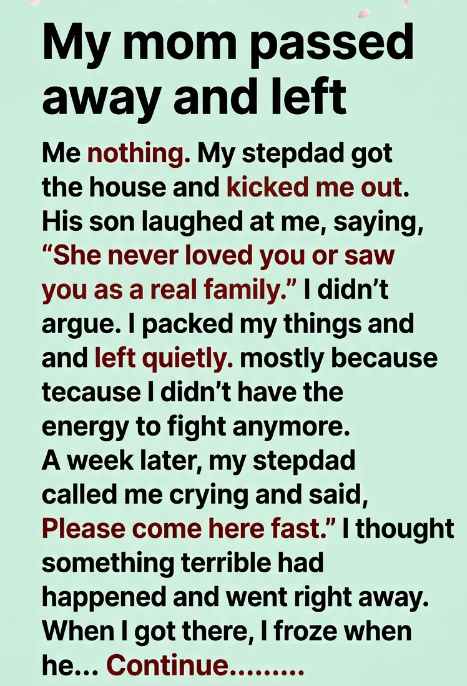
When my mother passed away, I lost more than a parent.
I lost the only place that had ever truly felt like home.
She had battled heart failure for years, but nothing prepared me for the call from the hospital.
After the funeral, everyone kept telling me she’d “made arrangements.”
I believed them.
A week later, my stepfather, Richard, gathered the family in the attorney’s office.
My heart pounded as the lawyer began reading my mother’s will.
“The family residence…”
“To my husband, Richard.”
I nodded.
That made sense.
“The savings accounts…”
“To Richard.”
“The investment accounts…”
“To Richard.”
I waited.
Nothing.
Finally, the attorney looked toward me.
“There are no additional bequests.”
That was it.
Nothing.
Not even one sentence.
Richard’s son, Brian, couldn’t hide his smile.
Outside the office, he laughed.
“I guess she finally admitted the truth.”
“What truth?”
“You were never really family.”
He stepped closer.
“She didn’t leave you a single thing.”
“I guess she never loved you as much as you imagined.”
I didn’t answer.
I was too exhausted to argue.
When I returned to the house, Richard quietly said,
“I think it’s best if you move out.”
The words hurt almost as much as losing my mother.
I packed two suitcases.
Took a framed childhood photograph.
My mother’s recipe book.
And the old quilt she’d sewn when I was little.
That was all.
I rented a tiny apartment across town.
It wasn’t much.
But at least it was mine.
I cried every night that first week.
Not because I wanted money.
Because I believed my mother had forgotten me.
…
Exactly seven days later, my phone rang.
Richard.
I almost ignored it.
When I answered, he was crying so hard I could barely understand him.
“Please…”
“Come here.”
“Right now.”
“I need you.”
My stomach tightened.
“What happened?”
“Just… please.”
I grabbed my keys.
The entire drive, I imagined the worst.
A heart attack.
A fire.
An accident.
When I pulled into the driveway, I saw Richard sitting alone on the front porch.
His face was pale.
His hands trembled.
When he looked up, tears streamed down his cheeks.
“I found this.”
He handed me a small wooden box.
I recognized it instantly.
My mother’s memory box.
She had kept it locked for as long as I could remember.
“I was cleaning the closet,” Richard whispered.
“It fell from the top shelf.”
“I never knew it was there.”
Inside lay old photographs.
Birthday cards.
My kindergarten drawings.
Hospital bracelets from when I was born.
Every Mother’s Day card I’d ever made.
And at the very bottom…
A sealed envelope.
Across the front, in my mother’s handwriting, were the words:
For Emily—If Somehow This Was Missed.
My hands shook as I opened it.
Inside was a letter.
My beautiful girl…
If you’re reading this, something has gone wrong.
You were never supposed to be left out.
My breathing stopped.
She continued.
Months ago, my attorney helped me create a trust just for you.
I wanted Richard to have the house because he deserves to live here for the rest of his life.
But everything that belonged to your grandparents…
Every family heirloom…
Every investment your father left before he passed away…
Those belong to you.
I looked at Richard.
“What?”
He looked devastated.
“I never knew.”
There was another page.
The trust paperwork is inside the blue folder in my safety deposit box.
Richard knows where the key is.
He stared at me.
“I… I do.”
He rushed inside.
Minutes later, he returned with a small key taped beneath my mother’s old jewelry box.
Exactly where she’d always hidden spare keys.
The next morning, we met with her attorney.
The attorney looked horrified.
“There was a filing error.”
During the final update to my mother’s estate plan, the trust had been created correctly—but a clerical mistake meant the attorney handling the probate had relied only on the will and overlooked the separate trust documents.
Once the records were reviewed, the mistake became clear.
The trust held the assets my mother had intended for me, including investments, family heirlooms, and other property that had never been part of the probate estate.
Everything had been legally mine all along.
Brian was furious.
He insisted it wasn’t fair.
The attorney calmly reminded him,
“Your stepmother’s intentions are clearly documented.”
“There is nothing to contest.”
…
On the drive home, Richard pulled over.
“I’m ashamed.”
“You believed I wanted you gone.”
“You told me to leave.”
“I know.”
“I thought your mother had made her wishes clear.”
“I was grieving.”
“I wasn’t thinking.”
He wiped away another tear.
“You’ve been my daughter for eighteen years.”
“I failed you when you needed me most.”
I reached over and squeezed his hand.
“We both lost her.”
He nodded.
“I don’t expect forgiveness overnight.”
“But I hope you’ll let me earn it.”
…
Richard kept the house, just as my mother had wanted.
I never asked him to leave.
Instead, we began having Sunday dinners together again.
Slowly, the silence between us disappeared.
Brian chose to distance himself from the family after unsuccessfully challenging the trust.
That was his decision.
Life moved on.
One spring afternoon, Richard and I planted roses beside my mother’s favorite bench in the backyard.
He smiled sadly.
“You know…”
“She’d be annoyed with both of us.”
I laughed.
“Why?”
“For spending weeks believing she could ever stop loving you.”
I looked at the flowers blooming beneath the afternoon sun.
My mother hadn’t left me nothing.
She had left me exactly what she wanted me to have.
It was grief, confusion, and one overlooked envelope that had hidden the truth.
Sometimes the greatest inheritance isn’t revealed the day a will is read.
Sometimes it waits quietly in a dusty wooden box until the people left behind are finally ready to find it.
And as I folded my mother’s last letter one more time, I realized something that no legal document could ever measure:
She hadn’t just left me an inheritance.
She had left me proof that I had been loved every single day of my life.