When I was sixteen, an envelope changed my life.
It arrived on a rainy Thursday afternoon.
Inside was an acceptance letter from one of the country’s most respected art schools, along with a scholarship covering nearly all of my tuition.
I ran home so fast I almost forgot my backpack at the bus stop.
I found my father sitting at the kitchen table.
“Dad,” I said, barely able to breathe, “I got in.”
He looked at the letter.
Then at me.
“What is this?”
“My acceptance.”
“They offered me a scholarship.”
He read exactly three lines.
Then he crumpled the paper into a ball.
Before I could react, he tore it in half.
Then again.
Then again.
The pieces fell onto the kitchen floor.
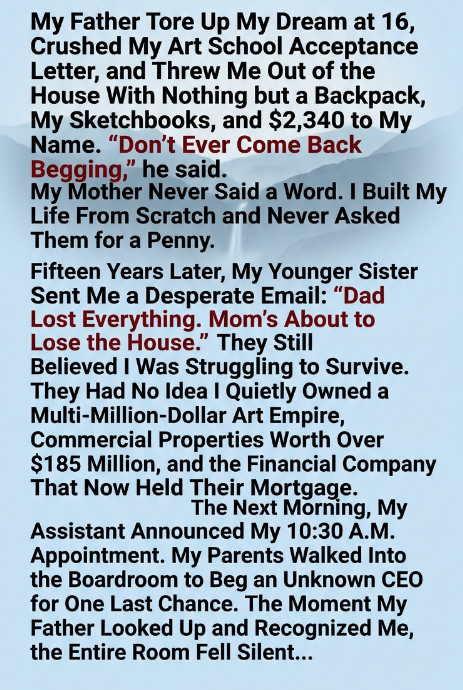
“You’ll never make a living drawing pictures.”
“It’s childish.”
“You’ll get a real job.”
“I’ve already spoken to my friend at the machine shop.”
“I don’t want the machine shop.”
His face hardened.
“You don’t get to choose.”
“I earned this.”
“No.”
“You embarrassed this family chasing fantasies.”
He pointed toward the front door.
“If you walk away from the future I’ve arranged…”
“Don’t ever come back begging.”
My mother stood silently beside the sink.
She never spoke.
She never stopped him.
I packed one backpack.
Three sketchbooks.
A change of clothes.
And every dollar I’d saved from working after school.
Exactly $2,340.
I walked out before sunset.
No one followed.
…
The first years were brutal.
I slept on friends’ couches.
Worked in restaurants.
Painted murals for cafés.
Sold portraits in weekend markets.
When I couldn’t afford canvases, I painted on scraps of plywood construction sites were throwing away.
Eventually, one gallery owner noticed my work.
A corporate client commissioned a series of paintings.
Then another.
One exhibition became five.
Five became international licensing agreements.
Years later, I founded a design company.
That company expanded into commercial real estate, financing creative developments, and investment partnerships.
I never became famous.
I became successful.
Quietly.
By the time I turned thirty-one, my businesses owned commercial properties with a combined value exceeding $185 million.
One subsidiary specialized in commercial lending and mortgage servicing.
Very few people connected my name to the teenager who had disappeared fifteen years earlier.
I preferred it that way.
…
One evening, an email appeared in my inbox.
The sender’s name stopped me cold.
Emily.
My younger sister.
The subject line simply read:
Please.
The message was short.
“Dad lost everything.”
“Mom says the bank is about to take the house.”
“They don’t know I’m writing you.”
“I know what Dad did.”
“I’m not asking for money.”
“I just thought you deserved to know.”
I stared at the screen for a long time.
Then I asked my chief financial officer to review the property address.
The next morning he returned with a file.
“The mortgage isn’t owned by the original lender anymore.”
“Who owns it?”
He slid the folder toward me.
“Our company purchased the servicing rights as part of a larger portfolio eighteen months ago.”
I looked at the account number twice.
It was true.
The house I’d been thrown out of…
Now had its mortgage managed by one of my own companies.
I leaned back in my chair.
Life has an odd sense of timing.
…
The following morning, my assistant entered my office.
“Your 10:30 appointment is here.”
I glanced at my schedule.
The names made my chest tighten.
Robert and Helen Carter.
My parents.
Neither knew I owned the company.
They believed they were meeting with an executive authorized to review hardship requests.
“Send them in.”
The boardroom doors opened.
My mother entered first.
She looked older.
Smaller.
My father followed carrying a worn leather folder.
Neither looked at me immediately.
My father began speaking before taking his seat.
“Thank you for seeing us.”
“We’ve fallen behind.”
“We’re hoping for one last chance.”
Then he looked up.
His eyes met mine.
The folder slipped from his hands.
Papers scattered across the polished floor.
The room became perfectly still.
He whispered my name.
“…Ethan?”
I nodded.
“Good morning.”
My mother covered her mouth.
Tears instantly filled her eyes.
For several seconds…
No one moved.
Finally, my father spoke.
“I didn’t know…”
“I know.”
“I never imagined…”
“I know.”
He slowly sat down.
“I suppose you’ve been waiting a long time for this.”
I looked at him calmly.
“No.”
“I wasn’t waiting.”
“I didn’t even know the mortgage was ours until yesterday.”
…
The meeting continued.
Not as a family argument.
As a business discussion.
My lending manager presented the account history.
The missed payments.
The financial statements.
The available options.
My father listened quietly.
When the presentation ended, he looked at me.
“I deserve whatever happens.”
I didn’t answer immediately.
Instead, I asked one question.
“What happened?”
He sighed.
“The machine shop closed.”
“We refinanced to keep it alive.”
“Then your mother’s medical bills.”
“Then poor investments.”
“I kept believing one more loan would fix everything.”
“It didn’t.”
For the first time in my life…
He sounded defeated.
Not angry.
Not proud.
Just tired.
…
Then my mother spoke for the first time.
“I’m sorry.”
Those two words carried fifteen years of silence.
“I should have followed you that day.”
“I should have picked up every piece of that letter.”
“I should have chosen my son.”
She cried openly.
“I’ve apologized to myself every day.”
I reached into a drawer.
Inside was a laminated photograph.
It showed my first gallery exhibition.
Standing beside me was an elderly woman.
Mrs. Alvarez.
The art teacher who had quietly helped me apply for scholarships after I left home.
She had become the parent I needed when I had none.
“I wasn’t alone,” I said softly.
“Someone believed in me.”
My mother nodded through tears.
“I’m grateful she did.”
“So am I.”
…
When the meeting ended, my father stood slowly.
“I don’t want special treatment because we’re related.”
“You won’t get any.”
He looked relieved.
“I hoped you’d say that.”
I smiled faintly.
“But every customer who qualifies for a restructuring deserves to have their application reviewed fairly.”
My lending team evaluated their finances using the same standards applied to every borrower.
The company approved a restructuring plan based on their demonstrated ability to meet revised terms.
It wasn’t a gift.
It wasn’t revenge.
It was the outcome the process supported.
…
After the paperwork was complete, my father stopped beside the boardroom door.
“I destroyed your acceptance letter.”
“You did.”
“I thought I was protecting you.”
“I know.”
“I was wrong.”
“Yes.”
He lowered his head.
“I can’t undo that day.”
“No.”
“But you can stop pretending it never happened.”
He nodded once.
“I will.”
…
Several months later, I received a package in the mail.
Inside was a carefully restored document.
My sister had spent weeks piecing together the fragments of my torn acceptance letter that my mother had secretly gathered from the kitchen floor all those years ago.
She had preserved them in a protective frame.
Tucked behind it was a note in my mother’s handwriting.
“I couldn’t save the letter that day.
I hope it’s not too late to save the truth.
I was proud of you then.
I was just too afraid to say it.”
That framed letter now hangs in the lobby of my company’s headquarters.
Not because it reminds me of what I lost.
But because it reminds me what happens when someone refuses to let another person’s fear define their future.
My father thought tearing up one acceptance letter would end my dream.
He never realized that dreams aren’t made of paper.
They’re carried by the people who refuse to stop creating, even after every door has been slammed shut.
And sometimes, years later, life quietly brings those people back through the very doors they were once forced to leave.