When my daughter came home with her family tree assignment, I expected construction paper, crooked stick figures, and too much glue.
Instead, she handed me a picture that made my stomach tighten.
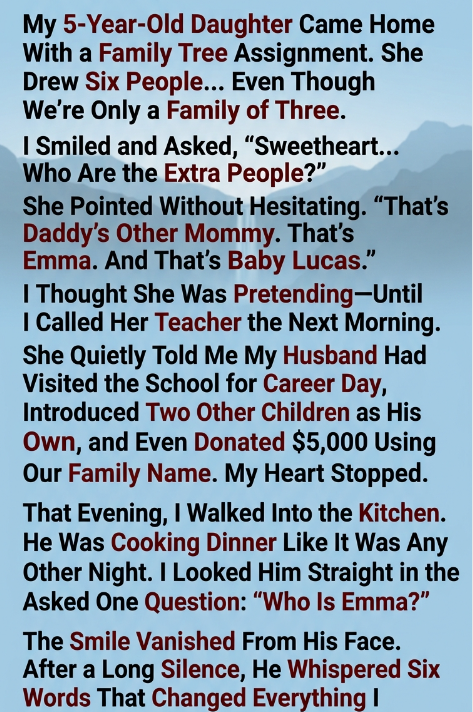
There were six people.
Not three.
I smiled, assuming it was another one of her wonderfully imaginative drawings.
“Sweetheart,” I asked gently, “who are the extra people?”
She pointed confidently.
“That’s Daddy’s other mommy.”
Her tiny finger moved to two smaller figures.
“That’s Emma.”
“And that’s Baby Lucas.”
I laughed nervously.
“Oh? Who are they?”
She shrugged as though it were the most obvious thing in the world.
“They’re Daddy’s family.”
My smile faded.
Children imagine all kinds of things, I told myself.
Still…
Something about the certainty in her voice unsettled me.
The next morning, I called her kindergarten teacher.
“I hope this doesn’t sound strange,” I said, embarrassed. “My daughter drew some extra people on her family tree.”
The teacher was quiet for several seconds.
Then she asked softly,
“She hasn’t talked to you about Career Day?”
“No.”
Another long pause.
“Your husband came to school last month.”
“Yes, I know.”
“He brought two children with him.”
I felt the room begin to spin.
“He introduced them as his.”
I gripped the kitchen counter.
“I’m sorry… what?”
“He said they were his children.”
She sounded genuinely uncomfortable.
“I assumed you knew.”
“And he made a donation to our literacy program.”
“Five thousand dollars.”
“The receipt was made out under your family’s name.”
After we hung up, I sat in complete silence.
There had to be an explanation.
There had to be.
…
That evening, my husband was making spaghetti when I walked into the kitchen.
He smiled.
“Perfect timing.”
“Dinner’s almost—”
“Who is Emma?”
The wooden spoon stopped moving.
He slowly turned off the stove.
Then he looked at me.
The smile disappeared.
After what felt like forever, he whispered six words.
“They’re my sister’s children.”
I blinked.
“What?”
“My sister’s children.”
The words didn’t make sense.
“You don’t have a sister.”
“I do.”
My knees nearly gave out.
“I’ve had one my entire life.”
“You lied to me for twelve years?”
“I never knew how to explain.”
I folded my arms.
“Then start explaining.”
…
He sat down at the kitchen table.
“I was fourteen when my parents divorced.”
“My father had an affair.”
“The woman he married already had a little girl named Emma.”
“A few years later they had Lucas.”
I interrupted.
“Our daughter said ‘Daddy’s other mommy.'”
He nodded sadly.
“That’s what they call my stepmother.”
I stared at him.
“You’ve been seeing them?”
“Yes.”
“For years.”
“Why hide it?”
He closed his eyes.
“Because every time I tried to bring them up, my mother would fall apart.”
He explained that after the divorce, his mother refused to acknowledge that his father’s second family existed.
If he visited them, she cried.
If he mentioned them, she accused him of betraying her.
Eventually, he learned to keep both worlds completely separate.
Then we met.
He told himself he’d explain everything after we married.
Then after our daughter was born.
Then after his mother became healthier.
There was always another reason to wait.
Years passed.
The silence grew heavier.
“I wasn’t trying to have two families,” he said quietly.
“I was trying not to lose either one.”
…
“What about Career Day?”
He rubbed his forehead.
“Emma’s school invited family members.”
“My stepmother asked if I’d come because their father was traveling for work.”
“I said yes.”
“They wanted all three kids together.”
“So I brought our daughter.”
I stared at him.
“You never thought to mention that to me?”
“I was ashamed.”
He lowered his head.
“The donation?”
“It came from our charitable giving account.”
“I should’ve told you.”
“You should have.”
“I know.”
…
The hardest conversation came three days later.
I asked to meet everyone.
His father.
His stepmother.
Emma.
Lucas.
They arrived looking just as nervous as I felt.
Emma, now eleven, looked at me with wide eyes.
“I’m sorry if we caused trouble.”
“You didn’t.”
Her little brother quietly stepped behind his grandmother.
Then our daughter ran over.
“Can we all play now?”
The adults looked at one another.
Children often have a way of cutting through years of complicated history with a single innocent question.
…
Later that afternoon, my husband’s stepmother asked if we could talk privately.
“I’ve wanted to meet you for years,” she admitted.
“I told him he should tell you everything.”
“He said he was afraid.”
“Of what?”
“That you’d think he was choosing us over you.”
I sighed.
“I don’t mind that he loves his family.”
“I mind that he hid them.”
She nodded.
“So would I.”
…
The following week, my husband and I began seeing a marriage counselor.
Not because we wanted to end our marriage.
Because we wanted to rebuild it honestly.
The counselor said something neither of us had considered.
“Secrets don’t always begin with bad intentions.”
“But they almost always end by breaking trust.”
That sentence stayed with both of us.
Rebuilding wasn’t quick.
Trust rarely is.
It took honest conversations.
Answered questions.
Apologies without excuses.
And a willingness to stop protecting old fears at the expense of new relationships.
…
A year later, our daughter came home with another family project.
This time she drew eight people.
She looked up proudly.
“I got it right now.”
I smiled.
“You did.”
The picture included our little family.
My husband’s father and stepmother.
Emma.
Lucas.
And even my mother-in-law, who—after many difficult conversations and a great deal of healing—had finally agreed to meet them.
Not every reunion was easy.
Not every scar disappeared.
But at least no one had to pretend they didn’t exist anymore.
Looking at that drawing, I realized the biggest problem had never been that my husband had more family than I knew.
It was that he believed the truth would destroy the people he loved.
Instead, it was the years of silence that almost did.
Sometimes the hardest conversation isn’t the one that ends a family.
It’s the one that finally gives a family the chance to become whole.