Family is supposed to be the place where your children are safest.
That illusion ended on a Sunday afternoon.
Our extended family had gathered for my parents’ annual barbecue.
The children were playing in the backyard while the adults talked on the patio.
My eight-year-old son, Noah, adored his older cousin, Tyler.
Tyler was twelve.
Noah followed him everywhere.
He thought Tyler was the coolest kid in the world.
I wish I had paid closer attention.
…
I heard the scream before I saw what happened.
Not the kind of cry that follows a scraped knee.
A scream that stopped every conversation.
I ran toward the backyard.
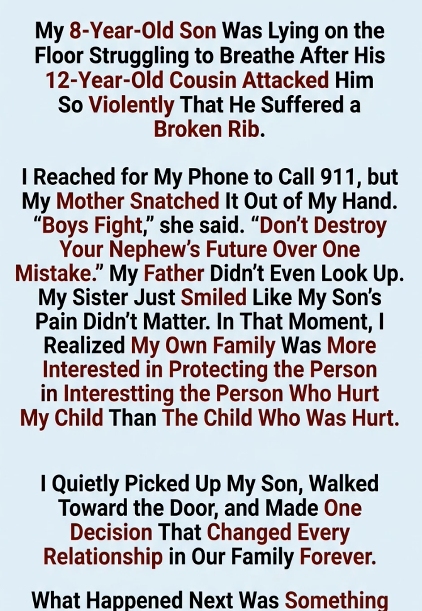
Noah was curled on the ground, gasping for air.
Tyler stood several feet away, breathing heavily.
A soccer ball lay forgotten beside them.
“What happened?”
Noah couldn’t answer.
Every breath looked painful.
I knelt beside him.
His face had turned pale.
His hands clutched his side.
I reached for my phone.
“I’m calling 911.”
Before I could dial, my mother grabbed the phone from my hand.
“Boys fight,” she said sharply.
“Don’t destroy your nephew’s future over one mistake.”
I stared at her in disbelief.
“My son can’t breathe.”
“He’ll be fine.”
My father remained in his chair.
He didn’t even look up from the baseball game playing on television.
My sister walked over, wrapped an arm around Tyler, and said,
“He didn’t mean it.”
Then she looked at Noah and added,
“He’s always been dramatic.”
I looked down at my son.
He was still struggling to breathe.
That was the moment something inside me changed.
I realized my family wasn’t asking one question.
They weren’t asking whether Noah was okay.
They were only worried about Tyler.
Quietly, I picked up my son.
I took my phone back.
And without another word, I walked to my car.
No one followed.
…
At the emergency department, doctors examined Noah immediately.
Imaging showed he had a broken rib and other injuries consistent with a significant blow to his side.
The physician explained that, because the injury involved a child and the circumstances described a serious assault, the hospital would follow its normal safeguarding procedures and notify the appropriate authorities, as required by law in many places.
I simply nodded.
My priority wasn’t punishment.
It was making sure Noah was safe.
…
That evening my phone exploded with messages.
My mother:
“How could you involve the police?”
My sister:
“You’re ruining Tyler’s life!”
My father:
“Families handle these things privately.”
I answered only once.
“My responsibility is to protect my son.”
Then I turned my phone off.
…
Over the following weeks, investigators interviewed the adults and children who had been present.
Doctors documented Noah’s injuries.
The authorities gathered information and handled the matter through the appropriate legal and child-protection processes.
I didn’t control the outcome.
I didn’t ask for special treatment.
I simply told the truth.
…
Noah eventually admitted something that broke my heart even more.
“It wasn’t the first time.”
“What do you mean?”
He stared at the floor.
“Tyler pushes me every time we visit.”
“He says nobody will believe me because I’m the little kid.”
I felt sick.
“Why didn’t you tell me?”
He shrugged.
“Grandma always says cousins should work things out.”
That sentence haunted me.
Not because an eight-year-old believed it.
Because somewhere along the way, the adults had taught him to.
…
We started counseling together.
One afternoon, our therapist asked Noah,
“What do you remember most about that day?”
I expected him to talk about the pain.
Instead he said,
“When you picked me up.”
The therapist smiled gently.
“What about it?”
“I knew you believed me.”
I cried all the way home.
…
Months later, my parents asked to meet.
They wanted things to “go back to normal.”
I listened quietly.
Then I asked one question.
“If Noah were your child instead of Tyler, would you have taken his injuries seriously?”
No one answered.
The silence told me everything.
I explained that rebuilding trust would require something they had never offered:
Acknowledging what had happened.
Taking responsibility.
And putting Noah’s safety first.
Until then, our contact would remain limited.
It wasn’t revenge.
It was a boundary.
…
Nearly two years later, things looked different.
My sister apologized sincerely—not because of legal consequences, but because she had finally accepted that minimizing violence had only hurt both boys.
Tyler, after receiving counseling and appropriate intervention, wrote Noah a letter accepting responsibility without making excuses.
Whether Noah chose to forgive him was entirely his decision.
I never pressured him.
Healing belongs to the person who was hurt.
…
One evening, Noah asked me,
“Did you know what to do that day?”
I smiled honestly.
“No.”
“I just knew one thing.”
“What’s that?”
“My job wasn’t to protect the family’s comfort.”
“It was to protect you.”
He nodded.
Then he hugged me tighter than he ever had before.
Looking back, the decision that changed everything wasn’t walking out of my parents’ house.
It was refusing to let fear, guilt, or family pressure outweigh my responsibility as a parent.
Sometimes the hardest choice isn’t leaving the people who refuse to protect your child.
It’s accepting that protecting your child has to come first—even if it changes your family forever.