When my daughter Sophie started fourth grade, she couldn’t stop talking about her teacher.
“Miss Jackson is the nicest teacher ever.”
“Miss Jackson says I’m getting better every week.”
“I can’t wait until Thursday.”
At first, I smiled.
Every parent hopes their child finds a teacher who believes in them.
Sophie had always been shy.
If someone at school made her feel seen, I was grateful.
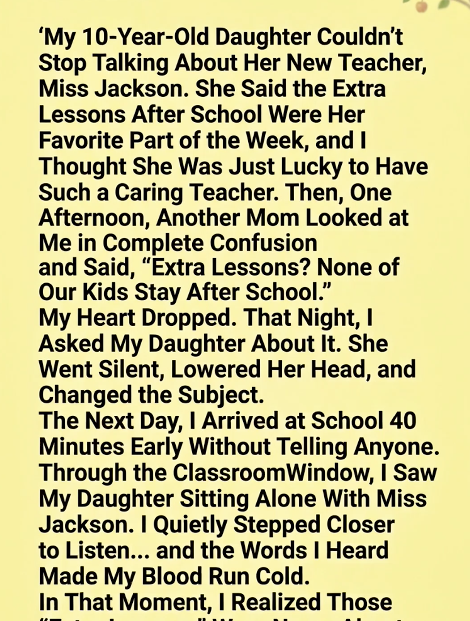
Then she started mentioning “extra lessons.”
“They’re my favorite.”
“We stay after school.”
“Miss Jackson says I don’t have to tell everyone because the other kids might feel left out.”
That last part gave me pause.
Still, I assumed it was a reading group or enrichment program.
Teachers often help students who need a little extra support.
I didn’t think much of it.
Until one afternoon at soccer practice.
Another mother overheard Sophie talking about staying late.
She frowned.
“Extra lessons?”
“Yes.”
“My daughter says several of them stay every Thursday.”
The woman looked genuinely confused.
“That’s strange.”
“I volunteer in the office every Thursday.”
“None of the fourth-grade classes have after-school lessons.”
A cold feeling settled in my stomach.
…
That evening, I waited until Sophie was brushing her teeth.
“So…”
“Tell me more about these extra lessons.”
She froze.
Her toothbrush stopped moving.
“They’re… just lessons.”
“What do you learn?”
She looked down.
“I don’t know.”
“You don’t know?”
She shrugged.
“Can we talk about something else?”
That wasn’t like Sophie.
Not at all.
I smiled gently.
“We’ll talk later.”
But I barely slept that night.
…
The next afternoon, I arrived at school forty minutes before dismissal.
I didn’t tell the office.
I simply parked where I could see the classroom windows.
The building was quiet.
Most of the children had already left for recess.
Then I saw Sophie.
She was sitting alone at her desk.
Miss Jackson sat beside her.
No books.
No math worksheets.
No spelling lists.
I quietly walked closer.
The classroom door was slightly open.
I could hear them talking.
Miss Jackson’s voice was calm.
“Take your time.”
“You never have to rush.”
Then I heard Sophie whisper,
“I still think it’s my fault.”
My heart stopped.
Miss Jackson answered immediately.
“No.”
“It wasn’t your fault.”
“Can you say that with me?”
Sophie’s voice trembled.
“It wasn’t…”
“…my fault.”
Miss Jackson smiled warmly.
“Again.”
Stronger this time.”
I stood frozen.
Those weren’t tutoring lessons.
I gently knocked on the door.
Both of them looked up.
Miss Jackson stood.
“Mrs. Reynolds…”
“I was actually planning to call you.”
…
She invited me inside.
The first thing she said surprised me.
“I’m sorry this wasn’t explained better.”
She opened a folder.
Several weeks earlier, Sophie’s guidance counselor had noticed changes in her behavior.
She had become unusually quiet.
Startled easily.
Stopped participating in class.
After speaking with me, the school counselor explained that the school had recommended short, school-approved emotional support sessions during the school day, with parental communication expected as part of the process.
Miss Jackson looked genuinely concerned.
“I thought you had received the consent forms.”
“I never saw any forms.”
The school counselor joined us moments later.
After reviewing the records, they discovered the paperwork had been sent home in Sophie’s backpack weeks earlier.
It had never reached me.
Later that evening, we found the unopened envelope tucked beneath the lining of Sophie’s schoolbag, where it had slipped into a small tear.
No one had realized it was there.
…
Once we were home, I gently asked Sophie,
“Sweetheart…”
“What happened?”
She burst into tears.
“It started after the car accident.”
Six months earlier, we’d been involved in a collision.
Neither of us had suffered major physical injuries.
I’d believed we’d both recovered.
I hadn’t realized Sophie still blamed herself because she had asked me to stop for ice cream moments before the crash.
“If I hadn’t asked…”
“Daddy wouldn’t have turned.”
I hugged her tightly.
“Oh, sweetheart.”
“The accident wasn’t your fault.”
She cried harder.
“I thought maybe it was.”
Miss Jackson hadn’t been keeping secrets to isolate my daughter.
She had been helping her practice saying something she desperately needed to believe.
“It wasn’t my fault.”
…
Over the next few months, we worked closely with the school counselor and Sophie’s pediatrician to make sure she received appropriate support.
I also learned an important lesson.
Even when schools have the best intentions, communication with parents must be clear and complete.
Miss Jackson apologized for assuming I had received the paperwork.
I apologized for arriving that day convinced the worst.
Neither of us had all the information.
What mattered was that Sophie’s well-being came first.
…
At the end of the school year, the class held a small celebration.
Parents were invited.
Before everyone left, Sophie walked over to Miss Jackson carrying a handmade card.
Inside she’d written only one sentence.
“Thank you for helping me believe it wasn’t my fault.”
Miss Jackson smiled through tears.
“So…”
“Do you believe it now?”
Sophie nodded.
“I do.”
On the drive home, she reached across the back seat and squeezed my hand.
“Dad?”
“Yes?”
“Thanks for coming to school that day.”
“I thought you’d be mad.”
I smiled.
“I wasn’t mad.”
“I was worried.”
“There’s a difference.”
Looking back, the words I heard through that classroom door did make my blood run cold.
Not because my daughter was in danger.
Because I realized she’d been carrying a burden so heavy that she believed she needed to bear it alone.
The “extra lessons” were never about math or reading.
They were about helping a little girl find her way back to believing she deserved peace.
And that was the most important lesson she learned all year.