Some people say time heals everything.
It doesn’t.
Sometimes it simply teaches you how to carry the scar.
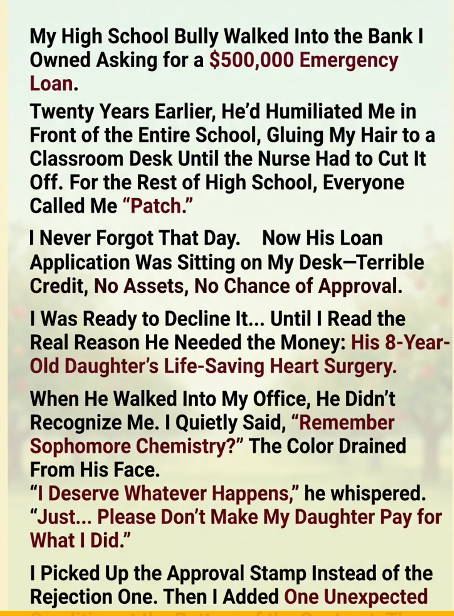
When I was sixteen, everyone at Lincoln High knew me by one nickname.
“Patch.”
Not because I liked baseball.
Not because I wore patches on my clothes.
Because one afternoon in sophomore chemistry, a boy named Jason Miller squeezed industrial adhesive onto my chair while I was working on a lab report.
When I stood up, my long hair was glued tightly to the wooden desk.
The entire classroom exploded with laughter.
The teacher thought it was another harmless prank.
Until the school nurse realized pulling harder would only tear my scalp.
She carefully cut away a large section of my hair.
For months, I walked through school with an uneven bald patch behind my left ear.
The nickname followed me until graduation.
Jason was suspended for several days.
He never apologized.
…
That humiliation became fuel.
I buried myself in schoolwork.
Won scholarships.
Studied finance.
Worked sixty-hour weeks.
Eventually, after years in commercial banking, I bought a struggling community bank and helped rebuild it into one of the most respected local institutions in the county.
I believed I’d left high school behind forever.
Then one rainy Tuesday morning, my lending manager placed a file on my desk.
“Large commercial request,” she said.
“Half a million dollars.”
I opened the application.
Borrower:
Jason Miller.
I sat perfectly still.
The same Jason.
His credit history showed years of missed payments.
His business had failed.
He had very little collateral.
Under ordinary lending standards, the application was unlikely to qualify as submitted.
I was about to note that additional information and stronger financial support would be required.
Then I reached the final page.
Purpose of loan:
Urgent medical expenses for my eight-year-old daughter while we finalize insurance appeals and other financing.
Attached was a letter from a pediatric cardiac specialist explaining that she had a serious heart condition and needed surgery soon. The estimated costs and insurance issues were documented.
I leaned back in my chair.
For the first time in twenty years…
I wasn’t thinking about chemistry class.
I was thinking about a little girl I’d never met.
…
An hour later, my assistant announced,
“Mr. Miller is here.”
When Jason entered my office, I recognized him immediately.
Older.
More tired.
Gray beginning to appear in his beard.
He looked around politely.
Then smiled.
“Thank you for seeing me.”
He had no idea who I was.
I closed the file.
“Jason…”
“Do you remember sophomore chemistry?”
He frowned.
“What?”
“The glue.”
“The classroom desk.”
“The girl everyone called ‘Patch.'”
His face turned white.
He stared at me for several long seconds.
Then whispered,
“…Emily?”
I nodded.
He slowly sat down without being invited.
“I…”
“I’ve thought about that day a thousand times.”
“I deserved to be suspended.”
“I deserved worse.”
He lowered his eyes.
“I’m sorry.”
“I know saying it now doesn’t erase anything.”
“It doesn’t,” I answered honestly.
He nodded.
“I figured.”
Then he looked directly at me.
“I deserve whatever decision you make.”
He took a deep breath.
“Just…”
“Please don’t make my daughter pay for what I did.”
Those words stayed with me.
Because he wasn’t asking me to forgive him.
He was asking me not to punish a child for an adult’s mistakes.
There is a difference.
…
I explained something important.
“Our bank has lending standards we have to follow. I can’t simply approve a loan that doesn’t meet those standards because of emotion—whether those emotions are positive or negative.”
His shoulders dropped.
“I understand.”
“But,” I continued, “that doesn’t mean there are no options.”
Instead of rejecting the application, I called in our senior lending officer and our community assistance coordinator.
Together, we reviewed every possible avenue.
A loan guarantee program.
A medical financing nonprofit.
An appeal through the hospital’s financial assistance office.
A state program for children with serious heart conditions.
After several hours, we built a package that combined multiple sources of funding. The bank approved a much smaller secured loan that fit our underwriting standards, while the remaining costs were covered through programs Jason hadn’t known existed.
He stared at the paperwork.
“I don’t know what to say.”
“I do,” I replied.
“Read the last page.”
…
At the bottom of the agreement was one additional condition.
It wasn’t financial.
It wasn’t legal.
It simply read:
“After your daughter has recovered, volunteer at least 100 hours over the next two years mentoring students about bullying, kindness, and accountability through a community organization approved by the bank’s charitable foundation. Participation is voluntary and not a legal condition of the loan; if you choose to accept our community partnership support, this is the commitment we ask in return.”
Jason looked up.
Confused.
“That’s it?”
I smiled.
“I don’t need revenge.”
“I need fewer children growing up believing humiliation is entertainment.”
His hands began shaking.
Then he quietly cried.
“I can do that.”
“No,” I corrected gently.
“You can do better than that.”
“You can make sure another kid never becomes someone else’s ‘Patch.'”
…
Six months later, Jason’s daughter had a successful surgery.
A year after that, I visited a middle school where a guest speaker was addressing an auditorium full of seventh graders.
It was Jason.
He stood on stage holding an old yearbook.
“I used to think bullying ended when the joke was over,” he told the students.
“I was wrong.”
“I carried shame for twenty years.”
“The person I hurt carried the pain.”
He looked toward me in the back row.
“The greatest act of kindness I’ve ever received wasn’t being told my past didn’t matter.”
“It was being shown that I could still choose what kind of person I’d become.”
…
After the assembly, his daughter ran over to me.
“Were you really friends with my dad in school?”
Jason and I looked at each other.
Then we both laughed.
“Not exactly,” I said.
She smiled.
“Well…”
“I’m glad you’re friends now.”
Children have a wonderful way of simplifying complicated truths.
As she skipped away, Jason quietly said,
“You know…”
“I almost didn’t submit that application.”
“Why?”
“I was ashamed.”
I nodded.
“I’m glad you did.”
“Not because it helped your business.”
“Because it gave both of us a chance to stop letting one terrible day define the rest of our lives.”
Looking back, approving the financing wasn’t the hardest decision I made that week.
The hardest decision was refusing to let the worst version of someone else determine the best version of myself.
And that, I realized, was the only victory that truly mattered.