After twenty-four years of marriage, I knew my husband better than anyone.
Or at least I thought I did.
I knew he couldn’t cook without burning something.
I knew he whistled whenever he fixed things around the house.
I knew he refused to throw away old T-shirts because they were “perfectly broken in.”
But nothing prepared me for the smell.
It started so gradually that I barely noticed it.
At first I blamed the summer heat.
Then his new medication.
Then stress.
Within a month, it had become impossible to ignore.
The odor clung to him no matter how many times he showered.
His clothes smelled freshly washed.
His breath was normal.
His skin looked healthy.
Yet every time he came close, there was an overpowering smell unlike anything I’d ever experienced.
I tried to be gentle.
“Honey… maybe we should have this checked.”
He immediately shook his head.
“It’s nothing.”
“It’ll go away.”
It didn’t.
It got worse.
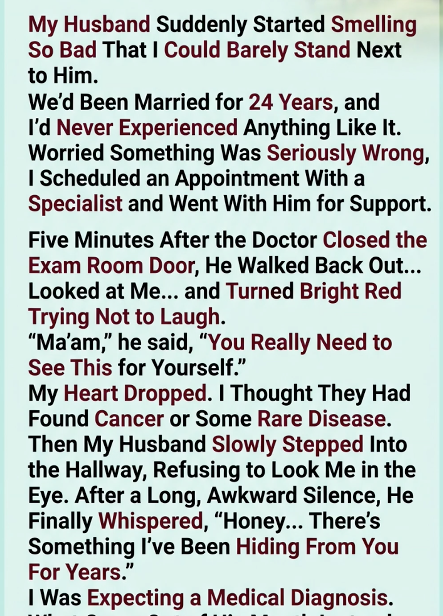
Eventually I made an appointment with a dermatologist who specialized in unusual skin and sweat disorders.
My husband protested the entire drive there.
“I feel ridiculous.”
“I probably just need stronger soap.”
Still, he went.
Mostly because he could see how worried I was.
…
Five minutes after the doctor closed the exam room door, it opened again.
The physician stepped into the hallway.
He looked directly at me.
His face turned bright red.
He pressed his lips together as though desperately trying not to laugh.
“Mrs. Bennett…”
“You really need to come in.”
My heart stopped.
Cancer.
A rare infection.
Some terrible disease.
Every frightening possibility raced through my mind.
I hurried inside.
My husband sat on the examination table staring at the floor.
The doctor pointed toward his feet.
“Would you mind looking at his socks?”
I frowned.
“My… husband’s socks?”
He nodded.
“They’re the source of the mystery.”
Confused, I looked down.
The socks were thick wool hiking socks.
Except…
One of them was noticeably darker than the other.
The doctor carefully asked my husband,
“Would you like to explain?”
My husband covered his face with both hands.
“No.”
“I’d rather disappear.”
The doctor chuckled kindly.
“I’m afraid that’s not medically possible.”
…
After a long silence, my husband sighed.
“Honey…”
“There’s something I’ve been hiding from you for years.”
I braced myself.
He looked completely embarrassed.
“I only own…”
“…one pair of lucky socks.”
I blinked.
“What?”
“My lucky socks.”
He nodded miserably.
“I’ve been wearing the same pair over and over.”
I stared at him.
“For how long?”
He whispered so quietly I almost didn’t hear him.
“About…”
“…twelve years.”
“Twelve YEARS?”
“They’re washed!”
“I promise!”
“But they’re falling apart.”
The doctor smiled.
“That’s actually part of the problem.”
He explained that the fabric had deteriorated so badly that it was trapping moisture and bacteria in ways ordinary washing could no longer remove.
The old material had essentially become impossible to clean thoroughly.
It wasn’t my husband himself creating the smell.
It was the severely worn socks combined with old shoes that had absorbed years of moisture.
He also noticed mild athlete’s foot, which was contributing to the odor but was easily treatable with medication.
Thankfully, there was no sign of anything dangerous.
…
The doctor asked the obvious question.
“Why not simply buy new socks?”
My husband looked at me sheepishly.
“They were Dad’s.”
Everything suddenly became quiet.
His father had died thirteen years earlier.
Those “lucky socks” had been the last birthday gift his father ever gave him before a sudden heart attack.
“I wore them to every important day,” he admitted.
“Our wedding anniversary trips.”
“Every promotion interview.”
“When our daughter graduated.”
“When Mom came through surgery.”
“I started believing…”
“…that if I stopped wearing them…”
“I’d lose the connection.”
My heart broke.
It had never been about socks.
It had been grief.
Hidden inside a drawer.
Worn one day at a time.
…
The doctor spoke gently.
“I hear stories like this more often than you’d think.”
“We sometimes hold onto ordinary objects because they’re tied to extraordinary memories.”
“But memories don’t disappear when an object wears out.”
He prescribed medication for the fungal infection and suggested replacing the socks and shoes to help resolve the odor.
…
That evening, my husband finally agreed to let the socks go.
Before throwing them away, he reached inside one of them.
Something crackled.
He frowned.
“There shouldn’t be anything in there.”
Carefully, he turned the sock inside out.
A tiny folded piece of paper fell onto the kitchen table.
It was yellowed with age.
His father’s handwriting covered one side.
“If these old socks ever wear out…”
“Good.”
“That means you’ve walked farther than I did.”
“Don’t keep them because of me.”
“Buy new ones.”
“Take your own children on new adventures.”
“That’s how you honor me.”
My husband couldn’t speak.
Neither could I.
His father had somehow predicted exactly what would happen.
He had hidden the note years before, hoping it would only be found when the socks finally reached the end of their life.
…
The following weekend, we bought half a dozen new pairs.
My husband smiled as he put them into the drawer.
“I still feel guilty.”
I squeezed his hand.
“I don’t think your dad wanted you to carry guilt.”
“I think he wanted you to keep walking.”
He nodded.
“I think you’re right.”
We framed the note and hung it beside an old photograph of his father wearing hiking boots and laughing on a mountain trail.
Every time I walk past it, I smile.
Because that doctor’s appointment didn’t reveal cancer.
It didn’t uncover a rare disease.
It uncovered something far more human.
A husband who had quietly carried his father with him every single day because he wasn’t ready to say goodbye.
And sometimes, the hardest things to throw away aren’t the oldest possessions.
They’re the last ordinary pieces of someone we loved.
Fortunately, love has never depended on a pair of worn-out socks.