People always assumed my parents adored their grandchildren equally.
That wasn’t true.
My fourteen-year-old daughter, Emma, knew it long before I was willing to admit it.
My sister’s son, Tyler, could do no wrong.
If he broke something, it was an accident.
If Emma earned straight A’s, my mother would smile politely before changing the subject.
I kept telling myself I was imagining it.
Parents aren’t supposed to play favorites.
Grandparents certainly aren’t.
I wanted to believe I was wrong.
…
Three years earlier, my job changed.
I became a regional operations director, and every few months I had to travel across the country for several days.
Whenever that happened, Emma stayed with my parents.
She preferred it.
Her school was only ten minutes from their house, and my parents always insisted they were happy to help.
“I love having her here,” my mother would say.
I believed her.
…
One Monday morning, I flew nearly eighteen hundred miles away for a conference.
The first day was packed with meetings.
My phone stayed on silent.
During a presentation, I noticed three missed calls.
All from Emma.
She almost never called during school hours.
I stepped into the hallway and called back immediately.
She answered on the first ring.
She was crying so hard I could barely understand her.
“Mom…”
“I’m sorry.”
“For what?”
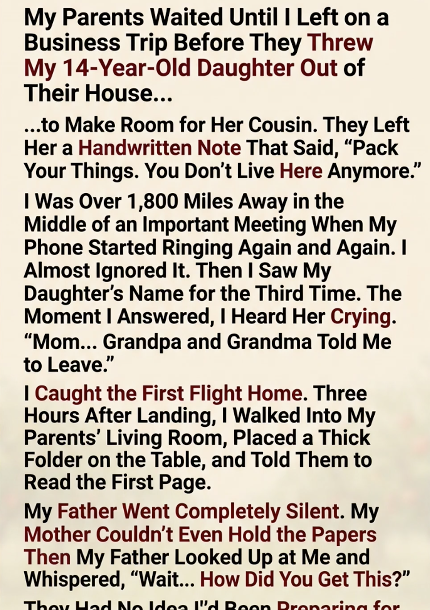
“Grandpa and Grandma told me to leave.”
I froze.
“What?”
“They said Tyler needs my room now.”
“They left me a note.”
“I thought they were joking.”
“They weren’t.”
My heart began pounding.
“Where are you?”
“I’m sitting outside the library.”
“I didn’t know where else to go.”
I told her not to move.
Then I ended the call and booked the first flight home.
…
By the time I reached our town, it was nearly evening.
Emma was safe.
A close friend had picked her up after I called.
Only then did I drive to my parents’ house.
I didn’t shout.
I didn’t slam the door.
I simply walked into the living room.
My mother smiled as though nothing unusual had happened.
“Oh.”
“You’re home early.”
I placed a thick folder on the coffee table.
“Read the first page.”
Dad frowned.
“What is this?”
“Read it.”
He opened the folder.
The color drained from his face.
Mom reached for the papers.
Her hands immediately began shaking.
My father whispered,
“…How did you get this?”
I looked directly at him.
“I’ve had it for almost three years.”
…
Three years earlier, while helping my parents reorganize old financial files, I’d discovered unopened foreclosure notices hidden inside a filing cabinet.
They had never told anyone.
Not me.
Not my sister.
They were months behind on the mortgage.
Property taxes were overdue.
The house was days away from being sold.
They’d been too embarrassed to admit it.
I quietly contacted an attorney and the lender.
After reviewing every option, I purchased the property at fair market value through the proper legal process, satisfied the outstanding debts, and signed a written occupancy agreement allowing my parents to remain in the home for the rest of their lives as long as they maintained the property and complied with the agreement.
I never mentioned the ownership change afterward.
To me, keeping a roof over their heads mattered more than recognition.
The first page my father now held wasn’t a threat.
It was a copy of the recorded deed.
The house legally belonged to me.
…
Mom looked stunned.
“You… own this house?”
“Since 2023.”
“You never told us.”
“You never asked.”
Dad slowly lowered the papers.
“You did this for us.”
“Yes.”
“So why…”
I interrupted him.
“Why didn’t I tell you?”
“Because I didn’t want you to feel ashamed.”
I paused.
“But today isn’t about ownership.”
“It’s about Emma.”
I reached into my purse and unfolded the handwritten note they’d left for her.
“Pack your things.”
“You don’t live here anymore.”
I laid it beside the deed.
“You gave this to a fourteen-year-old child.”
Neither of them spoke.
My mother finally whispered,
“Tyler needed more space.”
“So you decided my daughter needed no space at all?”
…
Dad removed his glasses.
“We thought she’d stay with a friend.”
“You thought?”
I repeated.
“You threw a child out of the house while her mother was nearly two thousand miles away.”
My voice never rose.
It didn’t have to.
The facts were enough.
…
Mom suddenly began crying.
“We made a terrible mistake.”
I nodded.
“You did.”
“But mistakes have consequences.”
I handed them another document.
It wasn’t an eviction notice.
It was a letter from my attorney explaining that, under the occupancy agreement they had signed years earlier, they could continue living in the home provided they complied with its terms—including treating other lawful occupants with respect and not excluding them without my permission.
I wasn’t throwing my parents out.
I wasn’t interested in revenge.
But I made one thing clear.
Emma would never again be made to feel unwelcome in a house I had worked so hard to save.
If they wanted to continue living there, they would have to respect that.
…
That evening I found Emma at my friend’s house.
She looked exhausted.
The moment she saw me, she burst into tears.
“I thought you wouldn’t believe me.”
I wrapped my arms around her.
“I will always believe you enough to listen.”
She held up the folded note.
“I kept it.”
“I’m glad.”
“You know why?”
She shook her head.
“Because it reminds us that when people show us who they are, we don’t have to pretend we didn’t see it.”
…
The months that followed weren’t easy.
My parents apologized.
More than once.
Not with excuses.
With genuine regret.
They admitted they’d allowed favoritism to become normal for years without realizing how deeply it hurt Emma.
Rebuilding trust took time.
It wasn’t automatic.
Emma decided for herself when she wanted to visit again.
No one pressured her.
That choice belonged to her.
…
Several years later, after Emma graduated from college, she asked if we could drive past the old house.
We sat in the car for a while.
Then she smiled.
“You know what I remember most?”
“The note?”
She shook her head.
“No.”
“You getting on that plane.”
“I knew then…”
“…that no matter where you were in the world…”
“…you’d always come back for me.”
Looking back, the most important document in that folder wasn’t the deed.
It wasn’t the attorney’s letter.
It wasn’t the signed agreement.
It was the quiet promise I’d made to myself the day Emma was born:
No matter who failed her.
No matter who turned her away.
She would never have to wonder whether her mother would come.
And I never broke that promise.